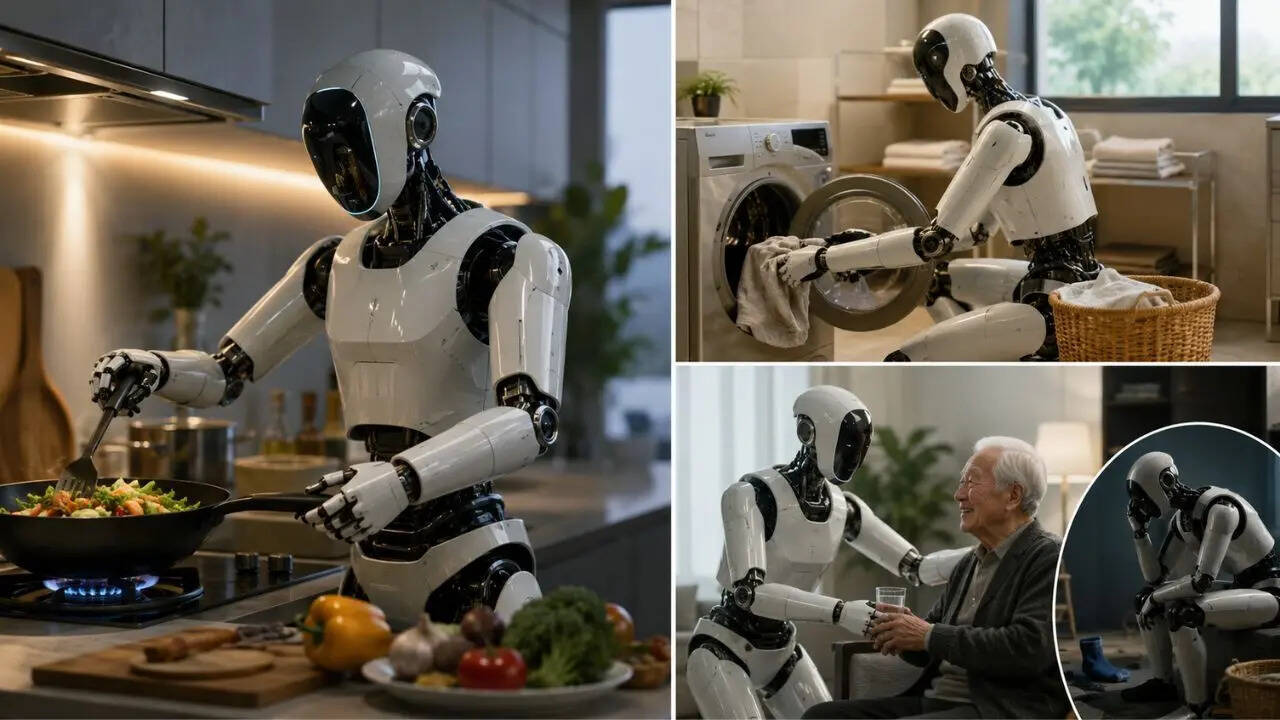
An eighty-two-year-old woman sits in a sunlit kitchen in Hangzhou, watching a flawless metallic hand reach into a boiling pot. The hand does not flinch. It grips a stainless steel ladle with algorithmic precision, scoops exactly four ounces of broth, and deposits it into a porcelain bowl without spilling a single drop.
This is the promise of China’s newest humanoid robot. It is a marvel of aluminum, silicon, and lithium-ion batteries. It can stir-fry pork, pull a crisp white sheet across a mattress, and gently lift a frail elder from a wheelchair. It represents trillions of yuan in projected market value and decades of engineering breakthroughs.
Yet, as the machine turns to deliver the soup, it freezes.
The obstacle isn’t a complex software virus or a sudden power failure. It is a stray slipper. A simple, worn, felt slipper lying lopsided on the linoleum.
The machine shudders slightly. Its optical sensors whir, capturing billions of data points per second. It possesses enough computing power to map the trajectory of a ballistic missile, but it cannot figure out how to navigate a messy living room.
We are witnessing an unprecedented global race to put human-shaped machines into our homes. Driven by a looming demographic crisis, Chinese tech firms are pouring billions into creating mechanical companions. But in our rush to build the future, we have run headfirst into a paradox that has baffled scientists for forty years. The hardest things for a robot are the easiest things for a child.
The Panic of the Empty Cradle
To understand why a machine like this exists, look at the demography.
China is aging at a speed never before recorded in human history. By 2035, an estimated 400 million people in the country will be over sixty years old. That is greater than the entire population of the United States. At the same time, the birth rate has cratered. There are simply not enough young human hands to care for the elderly, cook their meals, or wash their clothes.
Enter the humanoid.
The latest model to emerge from China’s tech hubs looks less like a sci-fi monster and more like a sleek, faceless butler. It stands about five foot five. It moves with a strange, liquid grace. Unlike the rigid industrial arms that have bolted car chassis together for decades, this machine is designed to exist in the soft, unpredictable spaces of human life.
Watch it prepare a meal. It recognizes a tomato not just as a red sphere, but as a delicate object that requires a grip pressure of precisely 1.5 newtons. Too much force, and it creates a puddle of pulp; too little, and the fruit slips away. The robot balances this pressure instantly, slicing the vegetable with the rhythmic consistency of a Michelin-starred chef.
For an adult child living three cities away, worrying about an aging parent who forgets to turn off the stove, this machine feels like a miracle. It feels like salvation.
It costs roughly the same as a mid-sized sedan, and companies are betting that millions of families will gladly pay that price to secure peace of mind. The engineering prowess on display is undeniable. The mechanical hands possess dozens of degrees of freedom, mimicking the intricate dance of human tendons and bones.
But then comes the threshold.
The Tyranny of the Unstructured World
In computer science, there is a famous observation known as Moravec’s paradox. It states that reasoning requires very little computation, but sensorimotor skills require enormous computational resources. It is easy to teach a computer to play world-class chess. It is incredibly difficult to teach it to walk down a crowded sidewalk.
A factory floor is a structured world. Every bolt is exactly where it should be. Every conveyor belt moves at a constant speed. If a human drops a wrench on a factory floor, the assembly line stops.
Our homes, however, are beautifully, chaotic messes.
Consider what happens when you walk through your house. You do not consciously calculate the friction coefficient of the rug versus the hardwood. You do not run a geometric analysis on a discarded dog toy before stepping over it. You just... step. Your brain processes these chaotic variables unconsciously, instantly adjusting your balance and path.
To a humanoid robot, that same living room is a nightmare of shifting geometry.
A pile of laundry on the floor isn’t just cloth; it is an amorphous shape that changes form every time it is touched. A plush rug absorbs light differently than a polished tile, confusing the depth-sensing cameras. A cat darting across the room requires an instantaneous recalculation of balance that can easily overwhelm the robot’s actuators.
When China's new humanoid encounters the felt slipper in the Hangzhou kitchen, its neural networks go to war with themselves.
The robot’s primary directive is safety. It must not fall, and it must not crush anything. When faced with an object it cannot definitively categorize—Is it solid? Is it compressible? Will it slide if stepped on?—the machine chooses the safest option.
It stops dead in its tracks.
The soup grows cold. The elderly woman waits. The illusion of the perfect mechanical caretaker evaporates, replaced by a 150-pound hunk of inert metal blocking the doorway.
The Hidden Cost of Care
There is a deeper, quieter anxiety that accompanies these machines, one that goes beyond engineering hurdles. It is the question of what happens to us when we outsource the most intimate parts of our lives to a collection of gears and algorithms.
I once spent a week watching a family test an early prototype of an assistive domestic robot. The grandfather, a fiercely independent man named Lao Chen, had suffered a stroke that left his left side weak. He hated relying on his daughter to help him dress, feeling that every button she fastened chipped away at his dignity.
When the robot arrived, Lao Chen was thrilled. The machine didn’t judge him. It didn’t sigh when he took ten minutes to tie his shoes. It simply held his arm steady with unwearied, mechanical patience.
But by the fourth day, a strange quiet settled over the house.
The daughter, seeing that the robot had the physical care covered, spent more time in her room on her phone. The casual touch—the brief brush of hands when passing a teacup, the instinctive adjustment of a collar—was gone. The robot performed the tasks perfectly, but it left a vacuum where human presence used to be.
We tend to view technology as a tool that solves a problem and leaves the rest of reality intact. It never does. Every technology is a trade-off. We exchange the messiness of human frustration for the sterile efficiency of a machine.
Are we ready for a world where an old man's primary physical contact is with silicone-coated steel? If the robot can cook the dinner and wash the clothes, what is left for the family to do except watch?
And yet, when you look at the numbers, there may not be a choice. The shortage of human caregivers is an absolute reality. A robot that stops at a slipper is still better than no help at all.
Training the Ghost in the Machine
Engineers are not blind to this limitation. Right now, in laboratories across Shenzhen and Beijing, thousands of robots are running through virtual simulations of messy bedrooms. They are being subjected to "reinforcement learning," a process where the AI is punished for falling and rewarded for successfully navigating obstacles.
They are trying to teach the machine how to guess.
Human beings are masterful guessers. We don't need to see the entire slipper to know it’s a slipper; a glimpse of the heel is enough for our brains to fill in the rest. Robots have historically needed to see and verify everything.
The new wave of software uses large vision-language models, allowing the robot to look at a cluttered floor and think, That shape resembles a shoe, which is likely soft and safe to step near.
Slowly, the machines are getting better. They are learning to nudge objects out of the way with their feet. They are learning to balance on one leg while stepping over a cord.
But progress is measured in millimeters, while the demographic clock ticks in years.
The gap between a robot that performs flawlessly in a choreographed corporate keynote and a robot that survives a week in a house with three children and a golden retriever remains vast. The keynote video shows the machine neatly folding a shirt on a pristine table. It doesn't show the twelve failed takes where the robot ripped the sleeve off because a sensor miscalibrated by a fraction of a millimeter.
The sun begins to set over the kitchen in Hangzhou.
The engineer monitoring the trial via a remote laptop types a command. He overrides the robot’s hesitation, manually guiding its path around the discarded slipper. The machine clicks, its knee joints bending as it shifts its weight, bypassing the obstacle. It steps forward and places the bowl of soup on the table.
The elderly woman smiles and thanks the machine. The robot, programmed to recognize gratitude, tilts its head in a simulated gesture of warmth.
It is a beautiful, fragile moment. It feels like a glimpse into a seamless tomorrow. But beneath the surface, the truth remains stubborn. The machine did not solve the problem; a human thousands of miles away did.
The robot can hold the ladle. It can slice the tomato. It can carry the weight of an aging society on its metallic shoulders. But for now, and for the foreseeable future, the great march of human technological progress can still be brought to a grinding halt by a single piece of stray footwear left on the bedroom floor.