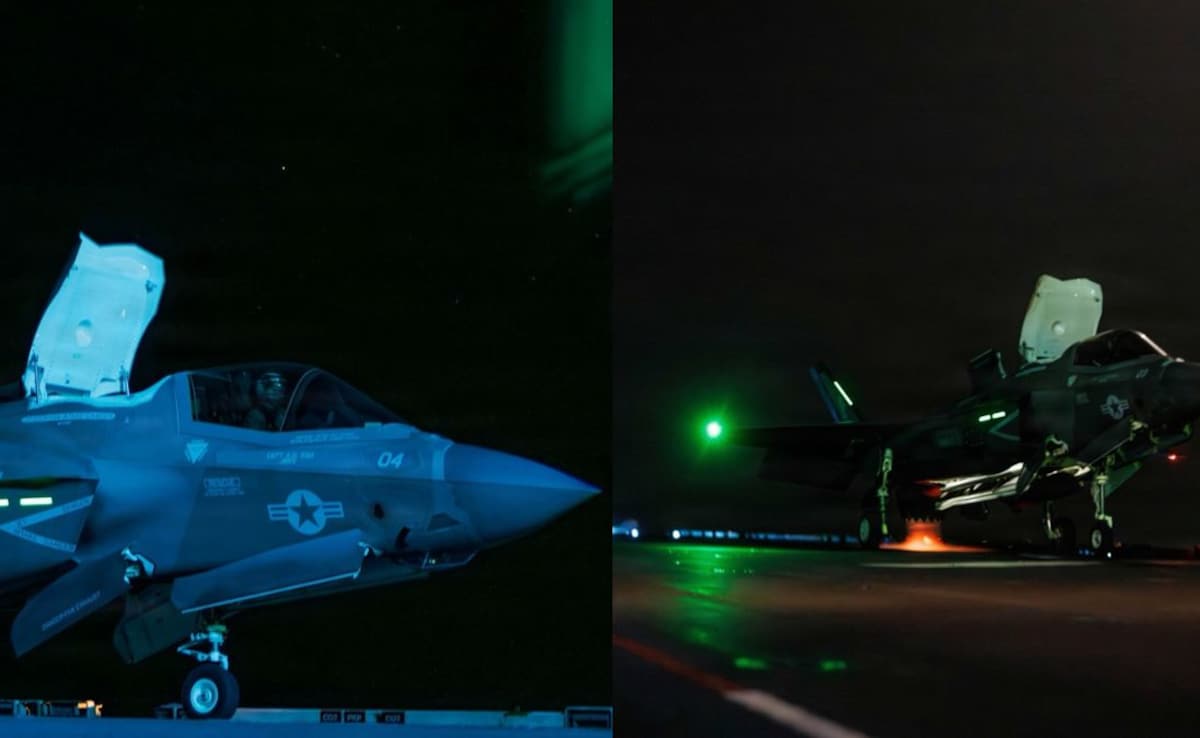
The headlines are screaming about "Trump’s Hormuz Arsenal." They paint a picture of steel-gray warships, the vertical-thrust of F-35B Lightning II jets, and the tilt-rotor flex of the MV-22 Osprey. It sounds like a scene from a blockbuster. It looks like power. It feels like security.
It is actually a collection of expensive, slow-moving targets waiting to be dismantled by $20,000 kamikaze drones and asymmetrical geography.
The mainstream narrative is obsessed with counting hulls and airframes. If we have 15 warships and the other guy has three, we win, right? Wrong. In the Strait of Hormuz, the math of traditional naval dominance has been inverted. We are playing a 20th-century game of battleship in a century defined by "saturation" and "cheap lethality."
The Carrier Strike Group Delusion
The obsession with the F-35B and the LHA (Landing Helicopter Assault) ships in the Persian Gulf ignores the fundamental physics of the region. The Strait of Hormuz is roughly 21 miles wide at its narrowest point. For a naval commander, that isn't an "arsenal." It’s a hallway.
When you shove a multi-billion dollar platform like a Wasp-class amphibious assault ship into that narrow corridor, you aren't projecting power. You are surrendering the one thing that keeps a ship alive: sea room.
I have watched planners pour over satellite imagery of Iranian anti-ship cruise missile (ASCM) sites for decades. The consensus is always the same: "Our Aegis systems will swat them down." This is the "lazy consensus" that gets sailors killed. Aegis is incredible. It is a marvel of radar engineering. But it is not magic. It operates on a finite probability of intercept.
If a littoral adversary launches 50 missiles simultaneously—a mixture of high-end C-802 clones and low-end, indigenous "suicide" drones—the math breaks. If your interceptors have a 95% success rate, three missiles still hit the deck. When those missiles hit a ship packed with F-35Bs and jet fuel, the "arsenal" becomes a funeral pyre.
The F-35B and the Short-Range Trap
The F-35B Lightning II is a technical masterpiece, but in the Hormuz context, it’s the wrong tool for the wrong job. The jet’s primary selling point is its Short Take-Off and Vertical Landing (STOVL) capability. This allows it to operate from smaller decks.
However, the F-35B has a combat radius of approximately 450 to 500 nautical miles. In a theater where land-based mobile missile launchers can hide in the Zagros Mountains and strike anything within 600 miles, the F-35B has to start its mission already inside the enemy's "no-go" zone.
To keep the jets safe, you have to move the ships further away. But if you move the ships further away, the F-35B lacks the legs to reach the target without heavy aerial refueling. And guess what? Those big, lumbering tankers are the first things that get shot down in a real scrap.
The "arsenal" is a closed loop of dependency that falls apart the moment the first shot is fired. We are betting the farm on stealth technology against an opponent that only needs to look out their window with a pair of binoculars to see us coming through the Strait.
The Osprey Is a Logistics Nightmare in a Hot Zone
Then there is the MV-22 Osprey. It’s fast. It’s versatile. It’s also a maintenance sponge that requires a massive logistical footprint.
In a high-intensity conflict in the Gulf, the Osprey is meant to move Marines and supplies. But the Osprey is vulnerable to the exact kind of "low-tech" threats that thrive in the Hormuz environment: Man-Portable Air-Defense Systems (MANPADS) and heavy machine guns.
If we are using Ospreys to "secure" the Strait, we are essentially gambling that the enemy won't have a $30,000 Russian-made Igla-S hidden on a fishing dhow. I’ve seen what happens when sophisticated hardware meets a determined, low-cost insurgency. The expensive hardware usually wins the battle and loses the fiscal war. Every Osprey lost is a $90 million hole in the budget; every MANPADS used is a rounding error for the opposition.
The Geography of Failure
The "Arsenal" proponents talk about the 15 warships as if they are operating in the open Atlantic. They aren't. They are operating in a bathtub.
The Iranian coastline is a jagged mess of sea caves, small islands, and hidden coves. This is perfect terrain for "Fast Attack Craft" (FAC) and "Fast Inshore Attack Craft" (FIAC). These are small, fiberglass boats armed with torpedoes or explosives.
Imagine a scenario where 100 of these boats swarm a single destroyer. The destroyer’s 5-inch gun can’t traverse fast enough. Its Phalanx CIWS (Close-In Weapon System) can only track a few targets at once. The "Arsenal" is designed to fight a peer navy in the deep blue. It is fundamentally ill-equipped to handle a "bum-rush" by a swarm of explosive motorboats.
The Myth of "Freedom of Navigation" Operations
We are told these 15 warships are there to ensure the "Freedom of Navigation."
But the mere presence of these ships creates the very volatility they are meant to suppress. By centering our strategy on large, visible symbols of American hegemony, we provide the adversary with a clear target for "gray zone" provocations.
The true way to secure the Strait isn't with more hulls; it's with distributed lethality and unmanned systems. Why risk 3,000 sailors on a carrier when you can flood the zone with 5,000 underwater autonomous vehicles and long-range, land-based fires from outside the Persian Gulf?
The answer is simple: The "Arsenal" isn't about military efficiency. It’s about optics. It looks "tough" on a campaign poster. But in the cold light of a tactical engagement, "tough" is just another word for "stationary."
The Brutal Reality of Cost Imbalance
Let’s talk about the economics of this "Arsenal."
- F-35B cost: ~$100+ million per unit.
- Wasp-class LHA cost: ~$3 billion.
- Iranian Ghadir-class midget submarine: ~$20 million.
- Zelzal-3 missile: ~$200,000.
To "defend" the Strait, we are spending at a ratio of roughly 1000:1. This isn't a sustainable military strategy; it’s an institutionalized wealth transfer. We are building Ferraris to drive through a minefield.
The competitor's article wants you to feel safe because the toys are shiny. I’m telling you that the shine is what makes them easy to track. We have become so enamored with our own high-end technology that we have forgotten the basic rules of attrition.
The Strait of Hormuz is the most lethal "kill box" on the planet for a conventional navy. If we continue to treat it as a playground for our most expensive assets, we aren't projecting strength. We are advertising our most significant vulnerability.
The "Arsenal" is a ghost of 1991. The world has moved on to drones, cyber-disruption, and long-range precision strikes. We are still trying to win a knife fight with a very expensive, very heavy golden sword. It looks great in the sunlight, but it’s too heavy to swing when the lights go out.
Stop looking at the number of warships. Start looking at the number of targets.
The 15 warships aren't a shield. They’re the bullseye.