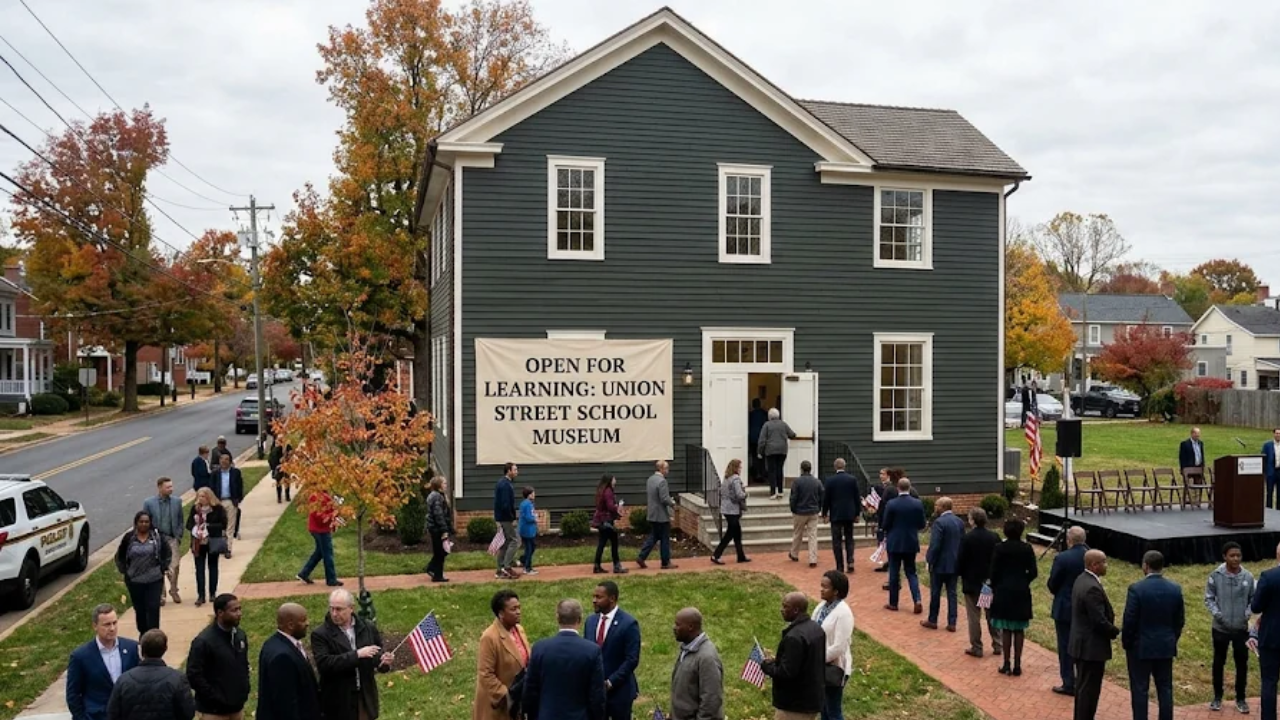
A historic Virginia school built to educate Black children during the Jim Crow era has officially reopened as a public museum following a $6.2 million restoration. Located in Northern Virginia, the rehabilitated building preserves one of the rare surviving structures from an era when Black communities had to fund, construct, and defend their own educational institutions against systemic state neglect. The project rescues a physical monument to educational self-determination from decades of structural decay and commercial redevelopment pressure, turning original classrooms into permanent exhibition spaces that document local Black history, segregation-era schooling, and the legal battles that dismantled separate-but-equal education.
Most surface-level coverage treats a restoration like this as a straightforward feel-good story. You see the ribbon-cutting photos, the $6.2 million price tag, and a few polite paragraphs about honoring the past. That framing misses the real story. Historic preservation in rapidly developing parts of Virginia is a bruising, high-stakes fight over land, memory, and public money. When a segregated schoolhouse survives into the twenty-first century, it is rarely because local institutions protected it. It survives because a small group of aging alumni, descendants, and local preservationists refused to let bulldozers erase the evidence of how their community built an education system out of nothing. For another perspective, check out: this related article.
Why Historic Black Schools Disappeared Across Virginia
To understand why a single restored building commands $6.2 million, you have to look at what happened to the rest of them. Across Virginia and the broader American South during the late nineteenth and early twentieth centuries, public funding for Black schools was deliberately starved by white-controlled county school boards. Black families paid property taxes that funded gleaming brick high schools for white students while their own children were relegated to overcrowded, poorly heated wooden structures with hand-me-down textbooks and shortened academic calendars.
Communities refused to accept that arrangement. Parents held fish fries, church rallies, and subscription drives to raise cash. They donated timber, cleared land by hand, and pooled meager wages to buy bricks and mortar. In thousands of cases across the South, these local fundraising campaigns partnered with the Rosenwald Fund, a philanthropic initiative launched by Sears, Roebuck and Co. executive Julius Rosenwald and Booker T. Washington. Between 1912 and 1932, that partnership helped build nearly 5,000 schools, teacher homes, and vocational shops for Black children across 15 Southern states, including hundreds in Virginia. Even where a specific schoolhouse predated the Rosenwald program or was funded purely through local church and civic networks, the operating model was identical. Black citizens taxed themselves twice—once through the county treasurer and a second time out of their own pockets—just to put a roof over their children's heads. Similar insight on this trend has been published by Associated Press.
Then came desegregation, and with it an unintended wave of architectural erasure. Following the Supreme Court's 1954 ruling in Brown v. Board of Education and the slow, contentious collapse of Virginia's Massive Resistance campaign in the late 1950s and 1960s, county school boards closed Black schools across the state. Integration in Virginia rarely meant merging two traditions on equal footing. It almost always meant shuttering the Black school, firing or demoting Black principals, discarding trophies and yearbooks, and busing Black students into formerly white facilities.
Once closed, the buildings were treated as surplus real estate. Some were sold off at auction for pennies on the dollar and converted into storage sheds, auto repair garages, or private residences. Others sat empty until roof leaks rotted the floor joists and county officials condemned them as eyesores. In fast-growing suburban corridors, rising land values finished the job. Developers bought up old school lots for townhomes, strip malls, and office parks. By the time preservationists began systematically inventorying historic Black schoolhouses in the early 2000s, roughly four out of five had already been demolished or altered beyond recognition.
What $6.2 Million Actually Buys in Historic Preservation
Sticker shock is a predictable reaction whenever a public or philanthropic preservation budget crosses the $6 million mark. Critics routinely ask why stabilizing a modest historic schoolhouse costs as much as constructing a brand-new municipal building from scratch. Anyone who has spent time examining public capital budgets knows the answer. Restoring a neglected century-old structure to modern museum standards is vastly more complex than pouring fresh concrete on an empty lot.
A historic schoolhouse built on a shoestring budget in the segregated South was never engineered to last a hundred years without intervention. Foundations were often laid directly on soil or shallow fieldstone footings. Structural framing suffered decades of water intrusion, termite damage, and differential settling after the building was abandoned or stripped of maintenance budgets. Stabilizing the envelope alone requires lifting framing, repointing historic masonry with lime-based mortar that will not crack old brick, and installing hidden steel reinforcement that carries modern structural loads without destroying the visual integrity of the original walls.
Then come the modern regulatory mandates that every public museum must meet:
- Accessibility compliance: Historic schoolhouses were built with steep wooden steps, narrow doorways, and zero accommodation for mobility devices. Adding elevators, compliant ramps, and accessible restrooms without disfiguring a historic floor plan requires custom architectural engineering.
- Climate and artifact protection: Turning a drafty classroom into a museum capable of displaying original photographs, fragile paper records, and oral history equipment demands commercial-grade HVAC systems with strict humidity controls, all concealed behind historic plaster or beadboard paneling.
- Environmental remediation: Buildings maintained through the mid-twentieth century almost universally contain lead paint and asbestos insulation. Abating those hazards safely while preserving original woodwork, chalkboards, and window sashes drives labor costs sharply upward.
- Site infrastructure: Upgrades to municipal water lines, stormwater retention, fire suppression sprinklers, and parking access frequently consume up to a third of the total capital budget before a single exhibit case is fabricated.
When you strip away the headlines, $6.2 million is not an extravagance. It is the baseline price of decades of deferred maintenance compounded by modern building codes and the specialized craft labor required to repair historic materials rather than rip them out.
The Structural Flaws in How America Funds Black History Sites
Even when a community successfully raises millions to restore a landmark, the financial battle is only half over. In the preservation industry, capital money is far easier to raise than operating money. Politicians love showing up for groundbreakings and ribbon cuttings. Philanthropic foundations love funding tangible capital campaigns where their name goes on a plaque in the lobby. Almost nobody wants to write recurring checks to pay the electric bill, insure the roof, and fund a full-time archivist five years after the cameras leave.
This funding asymmetry has quietly crippled dozens of small historic sites across the country. Consider a hypothetical example of how this plays out in practice. A local preservation coalition spends eight years assembling $5 million in state grants, municipal bonds, and private donations to restore a historic community landmark. On opening day, the building looks immaculate. Two years later, the volunteer board realizes that ticket sales cover less than fifteen percent of annual operating expenses. Without an endowment or dedicated line-item funding from the county, the museum cuts its hours to two Saturdays a month, defers roof maintenance, and relies on unpaid retirees to unlock the doors.
Historic Black institutions face an even steeper uphill climb because of historical wealth disparities. Elite white house museums and Civil War battlefields often sit atop multi-million-dollar endowments accumulated over a century of generational wealth and institutional backing. Black preservation groups rarely start with that cushion. They rely heavily on competitive grants from programs like the National Park Service's African American Civil Rights grant program, state historic preservation funds, and municipal capital budgets. Every dollar comes with strict reporting requirements, matching-fund hurdles, and multi-year bureaucratic delays.
For the newly reopened Virginia museum to avoid the post-opening slump that plagues small historic sites, long-term governance matters just as much as architectural restoration. Sustainable museums pair physical preservation with institutional anchoring—whether through county park authority management, university partnerships for archival curation, or dedicated municipal operating support that shields the building from the whims of annual fundraising.
Beyond Nostalgia What the Museum Actually Documents
There is a persistent temptation in American public history to sand down the sharp edges of segregation. Too many local exhibits turn Jim Crow schooling into a sentimental tale of smiling children, strict but loving teachers, and quaint wooden desks, conveniently skipping over the political violence and legal theft that made those schools necessary in the first place. A credible museum cannot afford that kind of amnesia.
The educational environment inside Virginia's segregated Black schools contained a profound contradiction that deserves honest examination. On one hand, the physical conditions were an indictment of white supremacy. Students walked miles past white schools they were legally barred from entering. They studied out of torn textbooks stamped with the names of the white schools that had discarded them. School boards routinely paid Black teachers a fraction of what white teachers earned with identical credentials.
On the other hand, those underfunded classrooms functioned as intellectual incubators. Because Jim Crow locked educated Black professionals out of corporate, legal, and government jobs, public school teaching attracted some of the sharpest minds in the community. Black principals and teachers held their students to relentless academic standards, drilled them in public speaking and civic history, and insulated them from a broader society that insisted they were inferior. Many of the students who organized sit-ins, filed desegregation lawsuits, and dismantled Jim Crow in the 1950s and 1960s learned their constitutional rights inside those segregated classrooms.
Preserving the physical building allows visitors to confront both truths simultaneously. You can stand inside a modest classroom space, see the exact physical constraints teachers worked within, and examine the primary records showing how parents petitioned recalcitrant school boards for basic repairs, bus transportation, and equal salaries. That combination of physical space and documentary evidence does something a textbook chapter never can. It proves that civil rights progress was not handed down from enlightened courts. It was built brick by brick by working-class families who refused to let their children's futures be written off.
The Gentrification Paradox Around Historic Landmarks
There is an uncomfortable irony built into almost every major historic restoration in Northern Virginia and similar high-growth regions. The same economic boom that generates the tax base and philanthropic capital needed to fund a $6.2 million museum project also drives the real estate displacement that pushes out the very communities whose history is being memorialized.
Across Northern Virginia, historically Black neighborhoods—many founded by formerly enslaved people immediately after the Civil War—have been steadily hollowed out over the past three decades. Rising property assessments, aggressive teardown-and-rebuild zoning, and transit-oriented development have transformed working-class Black enclaves into affluent suburban neighborhoods where median home prices routinely clear seven figures. Descendants of the families who built the original schoolhouses often can no longer afford to live within ten miles of the landmarks bearing their grandparents' names.
When a restored schoolhouse reopens in that kind of environment, it risks becoming a commemorative island—a beautifully preserved monument surrounded by luxury developments with no living connection to the neighborhood that created it. Avoiding that trap requires deliberate programming choices:
- Active oral history collection: Recording the testimonies of surviving alumni and elders before that living memory disappears permanently.
- Curriculum integration: Partnering directly with public school districts so local fourth- and eighth-graders visit the museum as part of mandatory Virginia history coursework rather than treating it as an optional weekend attraction.
- Living community space: Keeping the building accessible for descendant reunions, civic forums, and local cultural events rather than locking it behind velvet ropes.
Architecture alone cannot hold a community together once displacement has occurred. A museum only stays alive when the people connected to its history still have a seat at the table governing what happens inside its walls.
What Comes Next for Endangered Black Schoolhouses
Across Virginia, dozens of surviving Rosenwald schools, one-room county schoolhouses, and early Black high schools remain in limbo. Some are stabilized shells waiting for interior funding. Others are privately owned structures sitting behind chain-link fences while local nonprofits scramble to raise purchase money before a developer files a demolition permit.
Every single one of those surviving buildings represents a narrowing window of opportunity. The generation that actually sat in those wooden desks, carried coal for the potbelly stove, and lived through the trauma and triumph of school desegregation is now in its seventies, eighties, and nineties. Once those alumni are gone, the institutional memory required to identify photographs, decode handwritten attendance ledgers, and explain the unwritten rules of segregated school life vanishes with them.
The $6.2 million restoration in Virginia proves that when public money, preservation expertise, and community persistence align, an endangered landmark can be pulled back from the brink. Yet a single completed project is not a victory lap—it is a blueprint that dozens of other neglected sites are still waiting to use before the bulldozers arrive.