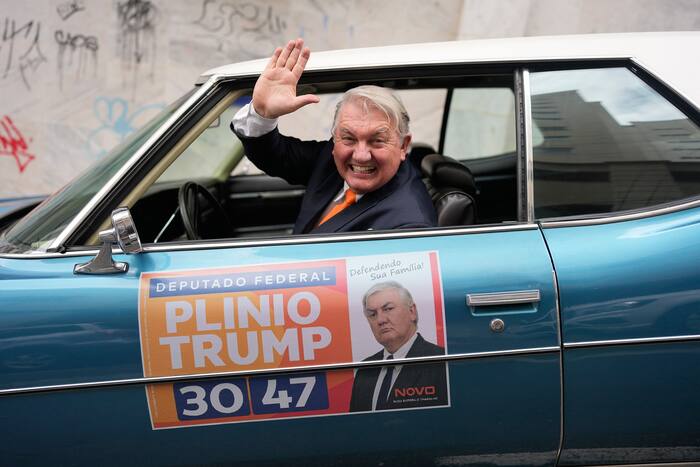
Democracy often smells like stale beer, sweat, and cheap printer ink. In Brazil, it also smells like satire. Every election cycle brings a fresh crop of figures who file for office with no intention of governing, armed with slogans that mock the political establishment while weaponizing the very mechanics of representation. This phenomenon is frequently dismissed abroad as folkloric eccentricity or mere tropical absurdity. That dismissal misses the point entirely. These candidacies function as pressure release valves for a fractured electorate, a public middle finger to professional politicians who treat public office as a hereditary estate.
Consider the lineage. Decades ago, voters cast ballots for a rhinoceros named Cacareco to protest municipal corruption in São Paulo. The rhino received more votes than any
The Ballot Box Jest That Exposes Democracy
news, politics
Brazil possesses a peculiar electoral machinery. It allows citizens to cast ballots for Plínio Trump, Mick Jagger, or a fictional samurai taxi driver, turning compulsory voting into an arena of mass satire. This phenomenon is rarely an accident. It serves as a calculated pressure release valve for a voting populace exhausted by entrenched corruption, systemic decay, and ideological stagnation.
The mechanics behind Brazil's joke candidates reveal an electorate utilizing the electronic voting terminal as a megaphone for mass protest. When a voter punches in a randomized sequence of numbers to elect a cartoon character or a local eccentric, they are not merely wasting a vote. They are exposing a deep institutional crisis.
The Anatomy of Protest at the Ballot Box
Under Brazilian electoral law, voting is compulsory for literate citizens between the ages of eighteen and seventy. Millions are legally forced to the polls every two years, regardless of whether they find a single candidate palatable. When trust in the political class collapses to historic lows, compulsory attendance breeds resentment.
Voters barred from abstaining without penalty turn to tactical absurdity. They use the electronic ballot to register discontent. If every viable politician represents a compromised status quo, choosing a fictional persona or a satirical local figure becomes the only clean expression of democratic will left.
Consider the historical precedent. In 1988, the citizens of São Paulo elected a chimpanzee named Tião to the city council as a prank orchestrated by a satirical newspaper. Tião garnered over three hundred thousand protest votes, finishing second in the municipal race. Decades later, the spirit of Tião lives on through digital campaigns, absurd monikers, and cultural icons splashed across electronic voting screens from Rio Grande do Sul to Amazonas.
[Voter Dissatisfaction]
       │
       ▼
[Compulsory Voting Laws]
       │
       ▼
[Protest Ballots / Joke Candidates]
       │
       ▼
[Institutional Exposure of Discontent]
This structural defiance transforms the voting booth into a theater of the absurd. Yet, dismissing these votes as mere silliness misses the diagnostic value they hold for political scientists and structural analysts.
When the Clown Wins
Sometimes, the joke stops being funny because the candidate actually wins. The most famous modern instance involves Francisco Everardo Oliveira Silva, better known by his clown persona Tiririca. Running for federal deputy in São Paulo under the slogan, "It can't get any worse, vote for Tiririca," he secured nearly one and a half million votes in 2010, the highest tally for any congressional candidate in the country that cycle.
Mainstream pundits predicted legislative chaos. Critics argued that electing a professional clown degraded the dignity of the National Congress.
The reality proved more complex. Once inside the Brasília beltway, Tiririca turned out to be remarkably disciplined. He maintained a high attendance record, shied away from the sprawling corruption scandals that swallowed his colleagues, and quietly focused on legislative minutiae related to his platform.
His tenure laid bare an uncomfortable truth. The professional politicians wearing tailored suits often caused far more institutional damage than the literal clown who ran on an explicit ticket of total transparency about his own political incompetence. The joke candidates serve as mirrors, reflecting the absurdity of a political elite that takes itself far too seriously while failing the basic metrics of governance.
The Digital Evolution of Electoral Satire
Social media platforms supercharged this phenomenon. In past decades, a satirical candidate relied on word of mouth, pamphlets, and fleeting radio spots. Today, viral TikTok clips, meme pages, and algorithmic amplification turn local eccentrics into national sensations overnight.
A candidate posing as a fictional samurai taxi driver can bypass traditional campaign financing restrictions entirely. They rely on organic digital distribution. Voters share the absurdity because it feels authentic in an era where traditional political messaging feels heavily scripted by high-priced consultants.
This digital shift alters the political economy of campaigning. Traditional parties spend millions on media strategies designed to manufacture charisma. Satirical candidates manufacture virality by playing directly into the cynicism of the digital native.
Yet, this weaponized irony carries systemic risks. When the entire democratic process is treated as a meme, policy debates get drowned out by viral stunts. Governance requires grinding, unglamorous compromises over tax codes, infrastructure budgets, and regulatory frameworks. Memes do not pave highways or stabilize currency values.
The Institutional Blind Spot
Political establishments typically respond to joke candidates with predictable condescension. They blame the voter. They lecture the electorate on civic responsibility and the sanctity of democratic institutions.
This paternalistic stance only deepens the divide. When citizens feel unheard by technocrats in capital cities, lecturing them about proper electoral etiquette merely validates their alienation.
The presence of Plínio Trump or a cinematic samurai on the ballot is a symptom, not the disease. The disease is a widening chasm between the governed and the governing class. Until traditional parties address the structural grievances driving voters toward absurdity, the ballots will continue to double as middle fingers.
Democracy thrives on accountability, but it survives on humor. When the humor turns dark and cynical, the institutional architecture is fracturing from within. The ballot box remains open, and as long as trust remains scarce, the jesters will keep claiming their seats.