Wildfire suppression economics are defined by a severe asymmetry: the marginal cost of deployment rises exponentially while the marginal benefit of containment decays rapidly past the initial containment window. When initial attack vectors fail, agencies are forced into a protracted war of attrition against thermal energy release rates that frequently exceed the baseline output of standard municipal power grids. Within this operational bottleneck, traditional aerial assets—specifically heavy airtankers and manned rotary-wing aircraft—encounter rigid safety thresholds, pilot fatigue limits, and prohibitive flight-hour costs. Unmanned aerial systems represent an alternative structural architecture, but evaluating their viability requires moving past speculative endorsements of autonomy and analyzing the hard mechanical, regulatory, and physical constraints governing modern wildfire management.
The Physical and Operational Envelope of Aerial Suppression
The primary constraint in aerial firefighting is not payload capacity, but rather airspace deconfliction and thermal turbulence. Wildfires generate intense localized updrafts, erratic wind shears, and dense particulate matter that severely degrade both visual flight rules and sensor arrays.
Manned aircraft operate under strict Federal Aviation Administration guidelines that limit night operations and heavy smoke penetration, leaving critical overnight windows—when relative humidity typically rises and ambient temperatures drop—largely unexploited by aviation. This creates a strategic deficit during the exact hours when fire behavior is most susceptible to containment lines.
Unmanned systems alter this equation by decoupling the vehicle from human physiological vulnerability. Without a pilot on board, small-to-medium aerial platforms can operate in low-altitude, high-smoke environments where visibility prevents manned flight. However, autonomy does not exempt hardware from aerodynamic physics.
Rotary platforms face severe endurance penalties when operating in superheated air, as lower air density reduces rotor lift efficiency. Fixed-wing unmanned systems require runway infrastructure or specialized launch-and-recovery mechanisms that are rarely present in remote, rugged terrain.
To evaluate where uncrewed platforms fit, one must examine the specific functional failures of current suppression tactics:
- Information Latency: Incident commanders frequently make tactical deployments based on intelligence that is thirty to ninety minutes old, gathered by manned reconnaissance flights or satellite passes that suffer from high orbital revisit times.
- Initial Attack Suppression Decay: The probability of containing a wildfire at under ten acres drops precipitously with every passing hour of delayed water or retardant drop.
- Capital Resource Scarcity: Heavy airtankers are capital-intensive assets with finite hourly life spans, making their deployment a high-stakes gamble often reserved for protecting high-value structural zones rather than remote timberland perimeter establishment.
Functional Decomposition of Unmanned Interventions
Deploying uncrewed technology in high-intensity fire environments requires categorizing capabilities into distinct operational tiers rather than treating drones as a monolithic solution.
Reconnaissance and Thermal Mapping
The most mature application of uncrewed aerial systems lies in persistent intelligence, surveillance, and reconnaissance. Equipped with dual optical and long-wave infrared sensors, autonomous drones can pierce thick smoke plumes to map fire perimeters, identify spot fires, and locate unburned fuel pockets with high spatial accuracy.
Unlike manned scout planes, persistent drone orbits provide real-time telemetry directly to geographic information systems, shortening the feedback loop between observation and tactical ground deployment.
Ignition Operations for Backburning
Controlled ignition is a primary tool for creating fuel breaks ahead of an advancing front, traditionally executed via helitorches or ground crews on foot. Uncrewed platforms equipped with specialized thermal ball dispensers can execute prescribed burns and tactical backfires with high precision in steep, inaccessible canyons where putting human crews at risk is strategically unjustifiable.
This shifts the risk profile entirely: personnel are removed from high-consequence entrapment zones and positioned behind secure anchor points.
Direct Suppression and Retardant Delivery
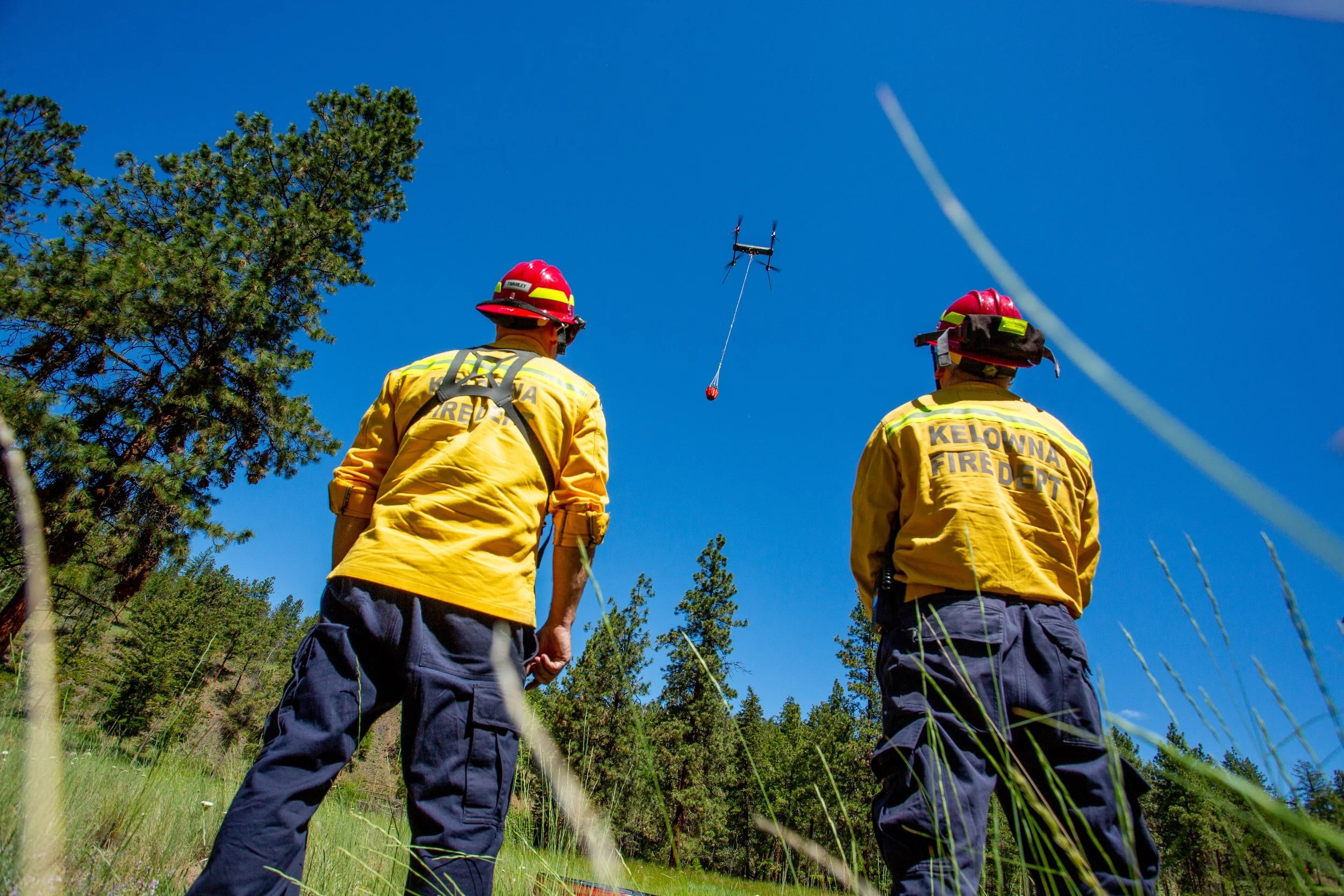
Direct attack—dropping water or chemical retardant via drone—remains the most technologically demanding and economically inefficient tier. Current heavy-lift multirotor systems possess payloads measured in tens of gallons, whereas a standard heavy airtanker delivers thousands.
For an uncrewed platform to match the volume delivery of a single large airtanker, an expansive swarm architecture would be required, introducing massive software complexity, command-and-control overhead, and airspace management bottlenecks. Consequently, uncrewed direct suppression is economically viable only for spot-fire suppression during the nascent phase of a flare-up, before thermal energy release scales beyond micro-payload thresholds.
The Regulatory and Logistical Bottlenecks
Scaling uncrewed operations faces institutional friction that matches or exceeds technical hurdles. Airspace over active wildfires is temporarily restricted under strict emergency regulations, but integrating autonomous or Beyond Visual Line of Sight operations alongside mixed fleets of manned scooper planes, helicopters, and private hobbyist drones creates severe collision risks.
Command structures must evolve to manage automated flight paths. Incident command posts are traditionally structured around hierarchical, voice-driven radio communications. Injecting high-bandwidth data streams, real-time video feeds, and autonomous telemetry into an already overwhelmed command structure can induce cognitive overload unless supported by automated decision-support software.
Furthermore, the mechanical durability of uncrewed hardware in corrosive, ash-laden, high-heat atmospheres remains an under-analyzed variable. Avionics cooling, optical sensor degradation from soot accumulation, and electromagnetic interference from intense thermal ionization layers present engineering challenges that standard commercial drones are not built to withstand.
Strategic Resource Allocation
Capital deployment in wildfire mitigation must be evaluated through the lens of return on investment relative to containment velocity. Pouring capital into massive drone swarms for direct water delivery ignores the fundamental physics of fire energy release, which dwarfs the cooling capacity of minor water drops.
Instead, the highest marginal utility lies in distributed sensor networks and tactical ignition platforms. By deploying autonomous reconnaissance assets to achieve continuous perimeter visibility and utilizing uncrewed ignition systems to secure control lines proactively, agencies can redirect scarce human and manned aviation capital toward structural defense and high-risk operational sectors.
The future of aerial firefighting is not defined by replacing heavy airtankers with robotic equivalents, but by deploying precision-guided, low-cost autonomous nodes to eliminate the information asymmetries that allow small ignitions to cascade into catastrophic events.