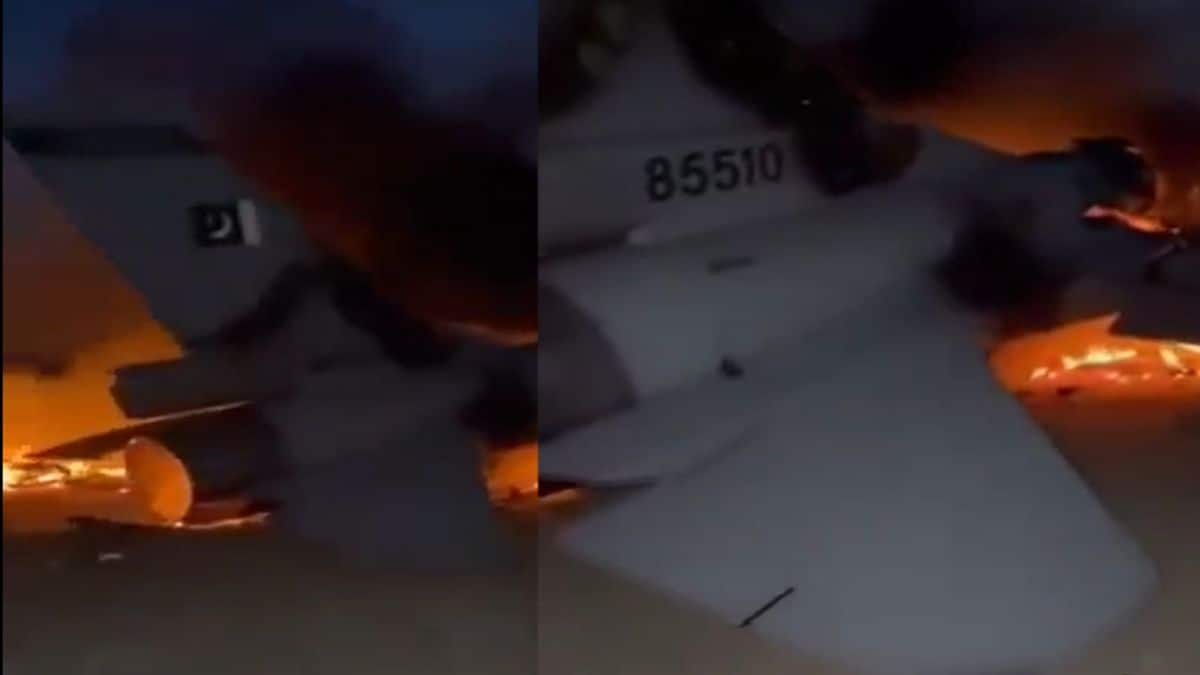
The rumors began as a frantic surge of social media posts and blurry Telegram footage. Claims that the Taliban’s fledgling air defense forces had managed to swat a Pakistani F-16 out of the sky during a border skirmish spread like wildfire. To be clear, there is no verified wreckage and no official confirmation from Islamabad that an airframe has been lost. However, the sheer persistence of the report highlights a shift in the regional power balance that has nothing to do with propaganda. The border between Afghanistan and Pakistan, specifically the Durand Line, has transformed from a porous insurgent crossing into a high-stakes laboratory for modern hybrid war.
Pakistan’s F-16 fleet is the crown jewel of its conventional military might. These American-made jets represent a level of technological sophistication that the Taliban, largely a ground-based guerrilla force turned national army, should not be able to touch. If an F-16 were actually downed by the Taliban, it would mean one of two things. Either the Taliban has successfully integrated advanced Man-Portable Air-Defense Systems (MANPADS) left behind by Western forces, or Pakistan’s operational security has degraded to the point of catastrophic failure. Meanwhile, you can read similar events here: The Calculated Silence Behind the June Strikes on Iran.
The Technical Reality of Surface to Air Engagement
To understand why a shootdown is technically difficult but not impossible, one has to look at the hardware currently littering the Afghan landscape. When the US departed in 2021, they didn't just leave behind Humvees. They left a vacuum now filled by black-market arms and specialized Soviet-era equipment that the Taliban has spent decades learning to operate.
The primary threat to a multi-role fighter like the F-16 at low altitudes isn't a complex radar-guided missile battery. It is the infrared-seeking missile. To explore the complete picture, we recommend the detailed article by The New York Times.
Heat-seeking missiles like the FIM-92 Stinger or the Russian-made Igla-S track the thermal signature of a jet engine. In the jagged, mountainous terrain of the Afghan-Pakistani border, an F-16 pilot must fly lower to identify targets or provide close air support. This brings the aircraft into the "kill envelope" of a soldier standing on a ridge with a tube on his shoulder.
The Problem of Low Altitude Maneuvering
An F-16 is a beast of the high skies. It thrives where it can use its AN/APG-68 radar to track targets from miles away. But when tasked with "deterrence" flights or precision strikes against insurgent hideouts in narrow valleys, that advantage evaporates. The pilot is forced to fight the terrain as much as the enemy.
In these narrow corridors, the kinetic energy required to outmaneuver a missile is hard to find. A pilot has seconds to react to a launch. If the Taliban have secured modern night-vision optics or improved tracking sensors, the window for a pilot to deploy flares and break away shrinks to almost zero.
The Political Calculus of Denial
Why wouldn't Pakistan admit to a loss? The answer lies in the complex relationship between Islamabad and Washington. The F-16s are governed by strict End-User Monitoring (EUM) agreements. Using these jets for domestic counter-insurgency or against the Afghan state is a sensitive issue that frequently draws fire from the US Congress. Admitting that a jet was lost in a skirmish with the Taliban would invite a level of scrutiny into Pakistan’s flight operations that the military leadership is desperate to avoid.
Conversely, the Taliban has every reason to fabricate a win. Their legitimacy rests on the image of the "giant slayer." After defeating a superpower, the narrative of taking down the most advanced weapon of their neighboring rival serves as a potent recruiting tool and a warning to domestic opposition.
The Evolution of the Durand Line Skirmish
The friction between these two nations is no longer about ideology; it is about physical control. Pakistan has spent years fencing the border, a move that the Taliban views as an illegal bisection of Pashtun lands. This physical barrier has forced the conflict into the air.
Drones and the New Reconnaissance
While the F-16 grabs the headlines, the real work is being done by Unmanned Aerial Vehicles (UAVs). Pakistan uses its Wing Loong and Burraq drones to monitor the border 24/7. These drones provide the targeting data that the F-16s eventually use. If the Taliban are targeting Pakistani assets, they are likely starting with these slower, more vulnerable drones.
There is a high probability that what social media accounts claimed was an F-16 was actually a large-format drone. To a civilian on the ground, a falling Wing Loong II, with its wide wingspan and engine fire, looks remarkably like a fighter jet.
The loss of a drone is a financial sting; the loss of an F-16 is a national crisis. The ambiguity of the "shootdown" reports often stems from this visual confusion. But even a drone kill marks a significant leap in Taliban capability. It shows they can bridge the gap between "hiding from the sky" and "clearing the sky."
Logistics and the Black Market Factor
We have to look at where the Taliban might be getting the "teeth" to bite back. The withdrawal from Kabul left an estimated $7 billion worth of military equipment in the country. While much of this was "demilitarized" or rendered useless by departing contractors, the global arms market is efficient.
Reports have surfaced of advanced anti-aircraft components flowing through Central Asia and into Taliban hands. These are not 1980s leftovers. They are modern, integrated systems that can detect an F-16's thermal signature and lock on with high-speed infrared seekers.
Modern Tactical Realities
If we examine a hypothetical scenario in which a Pakistani F-16 is truly lost, we must look at the flight patterns. Most "show of force" missions are performed in a predictable "racetrack" pattern along the border. This predictability is a death sentence in the age of MANPADS.
- Low Altitude Intercepts: Engaging at altitudes below 10,000 feet.
- Predictable Patrol Paths: Flying the same routes daily for border monitoring.
- Terrain Masking: Insurgents using the high mountain peaks to hide from a jet's downward-looking radar.
A Calculated Escalation
The silence from both capitals regarding any specific tail number or pilot name is the most revealing part of the mystery. If the Taliban had a pilot or wreckage, they would have displayed it in the center of Kabul within hours. If Pakistan had lost a jet, their silence would be a desperate attempt to avoid a PR disaster at a time of domestic political turmoil.
The real story isn't a single downed jet. It is the end of Pakistani air superiority over the Durand Line. For decades, Islamabad could fly its F-16s with impunity, knowing the Taliban had nothing but AK-47s and light machine guns. That era is over. Whether or not an F-16 fell this week, the "deterrence" that these jets once provided has been shattered by the mere possibility that they can be reached.
The Taliban's military transformation from a ragtag insurgency into a state-like entity with an air defense capability is nearly complete. The border is no longer a one-way street for Pakistani airpower. It is a contested zone where even a $30 million fighter jet is a target that can be reached by a single man on a mountain top. This shifts the entire strategic map of South Asia, forcing a rethink of how border security is maintained when the sky is no longer safe.
The silence that follows these rumors is a strategic choice by both sides, hiding a tectonic shift in the region's military reality.