Military helicopters are facing a brutal reality on the modern battlefield. Cheap, explosive-laden drones are knocking out multi-million dollar armored vehicles, scouting positions with impunity, and targeting infantry squads. Now, those same drones are aiming for the skies. Helicopters operating at low altitudes are sitting ducks for a swarm of loitering munitions. Airbus Helicopters isn't waiting around to see how that plays out.
The aviation giant is shaking up battlefield dynamics by integrating small, hard-kill drone interceptors directly onto its H145M light utility helicopter. This isn't just a minor hardware upgrade. It represents a fundamental shift in how military forces plan to protect air assets in contested airspace.
If you fly low to avoid long-range radar, you enter the hunting grounds of commercial quadcopters turned weapons. Airbus wants to turn the hunter into the hunted.
The Massive Problem With Helicopters Facing Cheap Drones
For decades, the main threats to a helicopter were anti-aircraft guns and shoulder-fired missiles. Countermeasure systems evolved to handle them. Flares fool heat-seekers. Chaff disrupts radar. Directed infrared countermeasures blind optical trackers.
Drones changed everything. A $500 quadcopter carrying a shaped charge doesn't emit a massive thermal signature. It doesn't rely on radar tracking that aircraft sensors easily spot. It can hover quietly behind a tree line, wait for a helicopter to approach a landing zone, and strike from an blind spot.
Current aircraft defense suites are useless against this. You can't fire a $100,000 air-to-air missile at a plastic drone. It won't lock on, and you'll run out of ammunition in minutes. Standard machine guns mounted on the side of a helicopter rely on human eyes and manual aiming. Hitting a fast-moving, erratic drone from a vibrating helicopter platform is mostly luck.
Airbus recognized this glaring vulnerability in modern air combat. Their solution brings the counter-unmanned aerial system technology directly onto the helicopter frame.
How The Airbus H145M Drone Interceptor Works
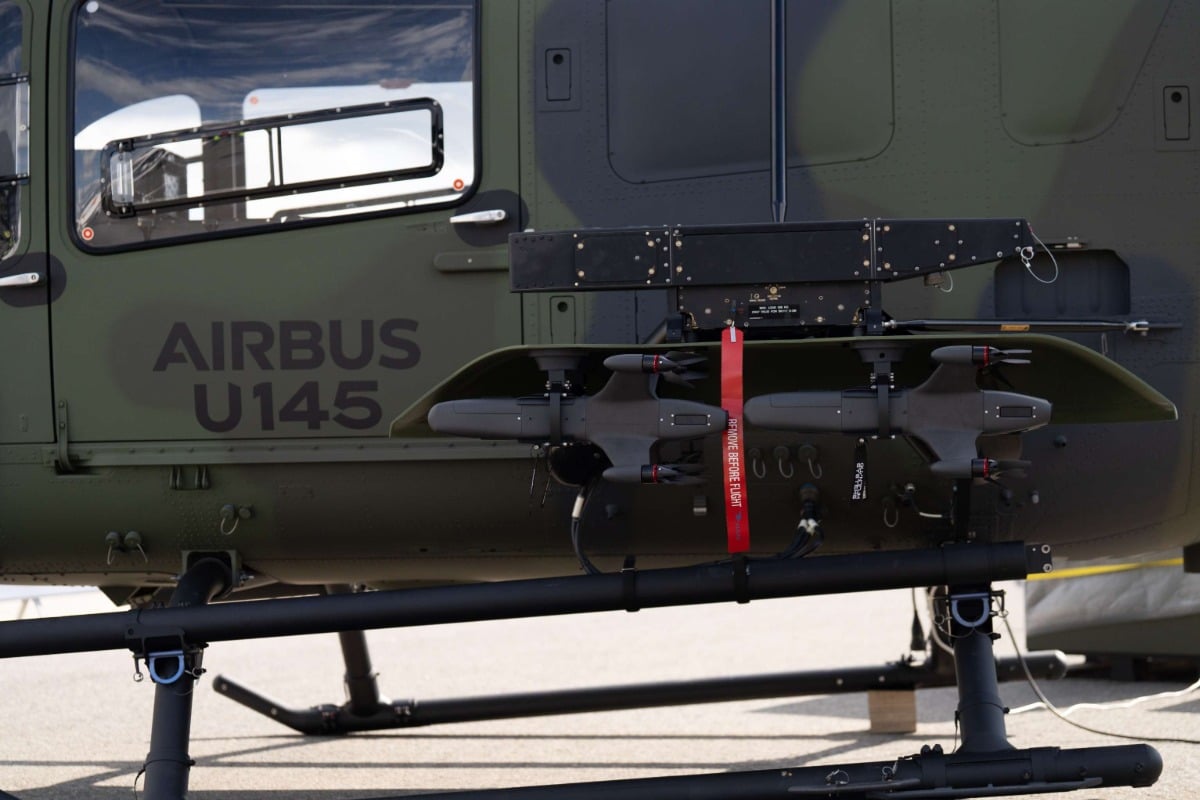
Airbus teamed up with defense tech specialists to mount a dedicated drone defense pod onto the H145M. The core concept relies on a containerized launcher that fires small, high-speed interceptor drones.
The system works through a tight loop of detection and rapid response. The helicopter's onboard sensors, including electro-optical systems and compact radar panels, scan the surrounding airspace for small radar cross-sections. Once the system identifies an incoming threat, it doesn't alert a door gunner. It launches an interceptor.
The interceptor drone is built for speed and agility. It climbs rapidly, guided by the helicopter's tracking system until its own internal sensors lock onto the target. When it gets close enough to the enemy drone, it detonates a small warhead. The resulting blast fragment cloud shreds the target's rotors and electronics.
This creates an active shield around the helicopter. The pilot can focus on the primary mission while the automated system handles the low-altitude swarm threats. It treats enemy drones like incoming missiles, neutralizing them hundreds of meters away before they can threaten the crew.
What This Means For Light Utility Missions
The H145M is a workhorse. Special forces use it for rapid insertion. Medical teams use it for casualty evacuation. Commanders use it for battlefield reconnaissance.
All of these missions share a common trait: they happen close to the ground.
When special forces operators fast-rope into a compound, the helicopter is incredibly vulnerable. It has to hover stationary for thirty to sixty seconds. In modern combat, that is a lifetime. A single enemy operator with a first-person view drone can fly directly into the main rotor blade, causing a catastrophic crash.
By adding drone interceptors to H145M helicopters, Airbus gives these crews a fighting chance during the most critical phases of flight. It allows the helicopter to clear its own airspace before and during an insertion.
This capability also changes the economics of the battlefield. Instead of forcing a massive, expensive attack helicopter like an Apache to escort every transport mission, the H145M can protect itself against the most common tactical threats it will encounter.
The Tactical Tradeoffs Airborne Interceptors Create
No military hardware comes without a cost. Adding an active drone interception system to a light helicopter introduces severe engineering challenges that crews will have to manage.
Weight is the eternal enemy of aviation. Every pound allocated to a drone launching pod is a pound removed from fuel, armor, or troop capacity. The H145M is a capable aircraft, but it is still a light helicopter. Operators will have to choose between carrying a full squad of soldiers or carrying a complete defensive suite.
Power consumption is another major hurdle. Running advanced radar arrays and target tracking computers strains the helicopter’s electrical system. Airbus engineers had to ensure the system could operate continuously without degrading the performance of core flight systems or primary communications gear.
There is also the issue of magazine depth. A pod can only hold a few interceptor drones. In a saturation attack where an enemy deploys dozens of cheap drones simultaneously, the helicopter will still face overwhelming odds once its interceptors are spent. It's a stopgap measure, not an invincible shield.
Integrating Active Defense Into Future Air Fleets
Airbus isn't designing this system in a vacuum. The integration on the H145M serves as a testbed for broader applications across Western militaries. The lessons learned here will likely influence the development of larger transport helicopters and next-generation attack platforms.
Military planners are watching these developments closely. The conflict trends we see globally demonstrate that passive defense is dead. You cannot just bolt more armor onto an aircraft and hope for the best. Active interception is the only viable path forward when threats evolve faster than traditional defense procurement cycles can handle.
For defense acquisition teams, the next step involves evaluating how these interceptor pods perform in dusty, high-vibration, and electronially jammed environments. True operational capability requires the system to distinguish between a hostile explosive drone and a friendly reconnaissance quadcopter operating in the same airspace.
If you are involved in fleet planning or tactical doctrine development, start analyzing your low-altitude vulnerability metrics now. Evaluate the power and payload margins of your current fleet to see if they can support containerized active-defense pods. The era of ignoring the drone threat from the cockpit is officially over, and retrofitting existing platforms should be a top priority before the next deployment cycle.