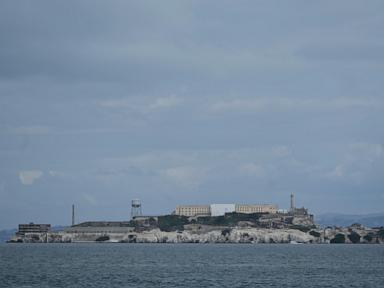
A solitary male coyote recently shattered biological assumptions by swimming nearly two miles through the treacherous, bone-chilling currents of the San Francisco Bay to reach Alcatraz Island. This wasn't a casual dip. The crossing requires navigating the Golden Gate’s brutal tidal flushes—waters that have claimed seasoned open-ocean swimmers and kept federal prisoners trapped on "The Rock" for decades. Biologists previously capped the coyote’s swimming range at roughly half that distance. By doubling the expected limit, this animal has forced a total recalibration of how we perceive urban wildlife movement and the supposed safety of our geographic boundaries.
This isn't just a story about a resilient canine. It is a data point in a shifting reality where the walls between "wild" and "urban" have completely disintegrated.
The Physics of a Two Mile Survival Swim
To understand the magnitude of this feat, you have to look at the hydrodynamics of the Bay. We aren't talking about a stagnant lake. The San Francisco Bay is a massive drainage basin where the Pacific Ocean meets the runoff of the Sierra Nevada. At peak tide, millions of gallons of water surge through the narrow gap under the Golden Gate Bridge.
A coyote weighs between 25 and 45 pounds. They are lean, built for endurance running, not aquatic propulsion. Their fur, while somewhat insulating, becomes a heavy, waterlogged anchor in a sustained swim. For a coyote to navigate from the San Francisco shoreline or the Marin Headlands to Alcatraz, it had to contend with:
- Hypothermic Temperatures: The water hovers between 53°F and 58°F. For a mammal with high surface-area-to-mass ratio, every minute in the water is a gamble against muscle failure.
- Variable Currents: The "rip" can pull an object toward the sea at speeds exceeding five knots.
- Shipping Traffic: The Bay is a high-traffic industrial corridor. A coyote sitting low in the water is invisible to the pilots of massive container ships and high-speed ferries.
Biologists once viewed the two-mile stretch to Alcatraz as a hard border. It was a functional moat. By crossing it, this coyote proved that our maps of "animal territory" are based on our own limitations, not theirs. It suggests that if a coyote can reach Alcatraz, no coastal island is truly isolated from the mainland’s apex predators.
Why Alcatraz Became a Target
Animals do not risk their lives for a change of scenery. They move for two reasons: biological pressure or resource acquisition.
The San Francisco coyote population is reaching a saturation point. In the Presidio and Golden Gate Park, territorial disputes are becoming more frequent. A young male, likely a "transient" looking to establish his own domain, would find the mainland increasingly hostile. Other established packs defend their territory with lethal force. For a low-ranking male, the open water—despite the risk of drowning—offered a path to a place with zero competition.
Alcatraz is a buffet. The island is a protected sanctuary for thousands of nesting seabirds, including cormorants, snowy egrets, and black-crowned night herons. To a coyote, the smell of bird colonies drifting across the water isn't just a scent; it’s a beacon.
The Ecological Fallout of the New Arrival
When an apex predator arrives in a closed ecosystem like Alcatraz, the impact is immediate and devastating. The island’s bird populations have evolved to nest there specifically because of the lack of land-based predators. They are "naive." They don't have the defensive instincts required to handle a hunter that can navigate the craggy cliffs and ruins of the old prison.
The National Park Service (NPS) now faces a logistical nightmare. Alcatraz is a National Historic Landmark and a major tourist destination, drawing over a million visitors a year. It is also a sensitive bird habitat. Introducing a coyote into this mix creates a three-way conflict:
- Public Safety: While coyotes rarely attack humans, an animal trapped on an island with thousands of tourists will eventually lose its fear. Habituation leads to conflict.
- Conservation: One coyote can wipe out hundreds of nests in a single season. The "natural" arrival of a predator doesn't make the destruction any less catastrophic for endangered or sensitive species.
- Management Ethics: Should the NPS remove the animal? Some argue that because the coyote got there on its own, it is a natural migration. Others point out that the coyote population itself is artificially inflated by urban food waste, making this "natural" event a byproduct of human expansion.
The Myth of the Urban Barrier
We like to think of our cities as fortresses. We build roads, bridges, and walls, assuming they dictate where nature stops and "civilization" begins. The Alcatraz swim exposes this as a comforting lie.
In the last decade, we have seen coyotes in New York’s Central Park, mountain lions under the Hollywood sign, and bears in suburban garages. We assumed water was the final, firm boundary. We were wrong. This coyote didn't use the Golden Gate Bridge; it went under it.
This behavioral shift points to a broader trend in evolutionary adaptation. Urban wildlife is getting smarter, bolder, and more physically capable. They are learning to navigate the specific obstacles of the 21st-century environment. If a coyote can calculate the tides to reach an island two miles offshore, we are dealing with an animal that has moved beyond simple instinct into a realm of tactical problem-solving.
Mismanagement and the Price of Sentimentality
The reason this coyote is on Alcatraz is partly due to our failure to manage urban populations on the mainland. In San Francisco, a culture of "coexistence" has often blurred into "enabling." Residents leave food out, fail to secure trash, and treat these predators like neighborhood pets.
When a population is allowed to grow unchecked in an urban park, the "overflow" animals are forced into increasingly desperate maneuvers. The swim to Alcatraz was an act of desperation born from overcrowding.
If we continue to ignore the density of predators in our urban centers, we will see more of these "impossible" migrations. Today it is Alcatraz. Tomorrow it could be Angel Island or the various small communities dotted along the California coast that thought they were protected by the sea.
The Biological Redline
We need to stop treating these events as "cute" or "inspiring" stories of animal perseverance. They are warnings. When a species exceeds its biological expectations by 100%, it indicates a massive shift in the environment.
The coyote on Alcatraz is a pioneer. It has found a loophole in the geography of the Bay Area. If it survives and thrives, it provides a blueprint for others. We are currently watching the expansion of a species that has learned to ignore the boundaries we spent a century building.
Infrastructure as a Wildlife Corridor
It isn't just the water. Our entire infrastructure is being repurposed.
Coyotes use railway lines as high-speed transit corridors. They use drainage culverts as hidden tunnels to bypass busy intersections. Now, they are using the Bay itself as a highway. This requires a total rethink of island conservation. You can no longer assume an island is safe just because it’s an island.
Management agencies must now consider aquatic barriers as "permeable." This means more monitoring, more frequent patrols of offshore sanctuaries, and a willingness to intervene before a single pioneer turns into a resident population.
The coyote on Alcatraz isn't a fluke. It is the new baseline. We are living in a world where the wild is no longer "out there"—it is swimming toward us, and it is much stronger than we thought.
Secure the trash cans on the pier. The water won't save the birds.