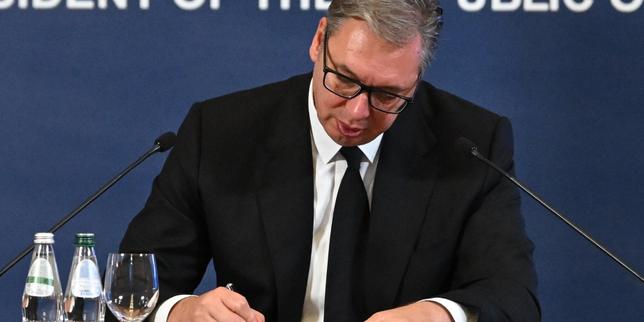
They want you to look at the photographs.
Look at the somber expression. Look at the formal resignation papers. Look at the carefully choreographed theater of a leader "stepping down" from the presidency of Serbia to seek the office of Prime Minister. Mainstream European outlets love a neat visual narrative. They frame Aleksandar Vučić’s resignation as a dramatic political shakeup, a sudden pivot, or a response to mounting street pressure.
That reading is completely backwards.
If you analyze Balkan politics through the lens of Western constitutional etiquette, you will miss the entire board. Vučić is not retreating. He is not relinquishing control. He is executing the oldest, most effective constitutional maneuver in modern European politics—the Putin-Medvedev castling move, adapted for Belgrade.
To understand why this resignation in pictures is pure political theater, you have to stop looking at the title on the door and start looking at where the actual levers of power sit in the Serbian constitution.
The Illusion of the Serbian Presidency
Most international observers suffer from a severe case of institutional projection. Because the United States and France operate under strong presidential systems, journalists assume a president stepping down to become prime minister is taking a demotion.
In Serbia, the exact opposite is true.
Under the 2006 Constitution of the Republic of Serbia, the presidency is largely ceremonial. The President represents the state at home and abroad, commands the army in peacetime, promulgates laws, and proposes a candidate for Prime Minister to the National Assembly. That is where the formal paper power ends. The real executive authority—control over the budget, the police, the security services, state-owned enterprises, and the legislative agenda—resides entirely within the Government, headed by the Prime Minister.
For years, Vučić bypassed this constitutional reality through sheer force of personality and total control over the Serbian Progressive Party (SNS). As President, he functioned as the de facto Prime Minister, overshadowing his handpicked premier, Ana Brnabić, and later Miloš Vučević, to such an extent that the public barely registered the constitutional distinction. He dominated the media, dictated economic policy, and managed foreign negotiations from Andrićev venac, the presidential palace.
So why trade a throne for a desk? Because constitutional term limits do not care about your approval ratings.
The Term Limit Trap and the Castling Playbook
Having won two consecutive five-year presidential terms (2017 and 2022), Vučić hit a hard constitutional wall. Article 116 of the Serbian Constitution explicitly limits a person to two terms as President. No exceptions. No easy amendments without triggering a massive, destabilizing referendum that would unite a fragmented opposition and invite relentless scrutiny from Brussels.
When an entrenched strongman hits a term limit, he faces three choices:
- Change the constitution to abolish limits (high friction, triggers international sanctions and mass protests).
- Retire and hand the keys to a successor (suicidal for a leader whose political network relies on personal patronage to survive).
- Shift seats to an unlimited executive office while installing a loyalist in the ceremonial chair.
Option three is a proven blueprint. Vladimir Putin executed it in 2008 when he moved from the Kremlin to the Russian White House as Prime Minister, leaving Dmitry Medvedev to warm the presidential seat for four years. Recep Tayyip Erdoğan spent over a decade as Turkey’s Prime Minister before engineering a shift to an executive presidency.
By resigning from the presidency before his term expires and running for Prime Minister, Vučić solves two massive problems at once. First, he neutralizes the lame-duck effect. A president nearing the end of a final term loses leverage over his own oligarchs and party lieutenants, who start hedging their bets on his successor. Second, he moves into an office with zero term limits. In Serbia, a Prime Minister can theoretically serve forever, provided their party maintains a parliamentary majority.
Decoding the Photo Op
Look again at those viral images of the resignation. In political communications, visuals are never accidental, especially not under an administration that treats media management as an exact science.
I have spent years watching political operatives across Central and Eastern Europe manufacture consent through curated imagery. When a leader wants to project vulnerability or a historic sacrifice, they strip away the grandiosity. They show the pen on paper. They emphasize the burden of office. The message to the domestic base is clear: I am giving up the highest title in the land to get into the trenches and work for you.
Meanwhile, the international press eats up the drama of "the resignation," treating it like a rupture rather than a transition. By framing the event around the act of stepping down, the narrative obscures the reality of stepping up into direct administrative control.
What the Mainstream Coverage Misses
If you read standard wire reports on this transition, you will see endless speculation about whether domestic protests, lithium mining controversies, or EU accession deadlocks forced Vučić’s hand. Let us dismantle those assumptions one by one.
- Did street protests force this? No. While Serbia has seen massive, recurring waves of anti-government demonstrations—from the "Serbia Against Violence" marches to the fierce backlash against the Rio Tinto lithium project in the Jadar Valley—opposition forces have consistently failed to translate street energy into a unified electoral machine capable of fracturing the SNS voter base. Vučić does not make structural career moves out of panic; he makes them to preempt future vulnerabilities.
- Is this a concession to the European Union? Hardly. Brussels and Washington value stability in the Western Balkans above democratic purity. Whether it is managing tensions in northern Kosovo, supplying ammunition that indirectly reaches Ukraine, or signing critical raw materials memoranda with Germany, Western diplomats view Vučić as the only guy in Belgrade who can actually deliver on a deal. Moving to the Prime Minister’s office actually makes it easier for him to sign binding international agreements without constitutional ambiguity.
- Does this weaken his party? On the contrary, it forces a discipline check. Whenever the SNS faces internal fatigue or local corruption scandals, Vučić uses snap elections or major institutional reshuffles to purge underperforming ministers, keep ambitious rivals off-balance, and remind every mayor and state-enterprise director that their paycheck depends on his name on the ballot.
The Structural Reality of Serbian Power
To grasp why this maneuver works so effortlessly, you have to understand the architecture of modern competitive authoritarianism—a term coined by political scientists Steven Levitsky and Lucan Way to describe regimes where formal democratic institutions exist, elections are held regularly, and opposition parties are legal, yet the playing field is so heavily tilted that real alternation of power is nearly impossible.
In Serbia, that tilt is maintained through three interlocking mechanisms:
| Power Pillar | How It Operates | Why the PM Role Strengthens It |
|---|---|---|
| Media Dominance | National frequency broadcasters and major tabloids operate in near-total alignment with the ruling coalition, framing political events around a single central figure. | As Prime Minister, Vučić gains daily, granular control over state announcements, infrastructure ribbon-cuttings, and economic subsidies, feeding the news cycle directly. |
| Public Sector Patronage | Hundreds of thousands of jobs in state-owned enterprises, municipal administrations, and public utilities are tied to party loyalty. | The Prime Minister directly oversees government ministries and public enterprise boards, tightening the leash on patronage networks. |
| Fragmented Opposition | Ideological divides between pro-EU liberals and hardline nationalists prevent the opposition from forming a durable, single-front coalition. | Calling or resetting parliamentary dynamics forces the opposition into reactive campaign mode on Vučić’s timeline. |
Notice what happens when Vučić moves to the Prime Minister’s seat: the formal legal structure of Serbia finally aligns with its informal reality. For the past decade, Serbia operated with a shadow prime minister sitting in the presidency. Now, the man pulling the strings actually holds the constitutional title that matches his behavior.
The Hidden Risks of the Pivot
As brilliant as this consolidation play looks on paper, it is not without severe structural vulnerabilities. Even the sharpest political operators introduce friction when they centralize this much authority into a single administrative choke point.
First, there is the scapegoat deficit.
For years, having a separate Prime Minister served a vital political function for Vučić: whenever inflation spiked, an infrastructure project stalled, or a corruption scandal erupted, the Prime Minister and cabinet ministers absorbed the public anger. Vučić could step in as the benevolent father of the nation, scolding his own government on live television and promising to fix their mistakes. Once he takes the Prime Minister’s chair himself, that buffer evaporates. Every economic downturn, every utility price hike, and every administrative failure lands squarely on his desk. There is nobody left below him to throw under the bus.
Second, he must find a loyalist who will not betray him.
Putting a placeholder into the presidency sounds easy until you realize the President still commands the military, signs off on legislation, and holds veto power over laws (which can only be overridden by an absolute majority in parliament). If Vučić installs a weak technocrat, the opposition might actually have a shot at winning the presidential race if they unite behind a single, non-partisan consensus candidate. If he installs a heavyweight SNS insider, he risks creating a rival power center—a classic mistake that has undone strongmen from Latin America to Central Asia.
Third, international optics get trickier.
While Western pragmatists will deal with whoever holds the keys in Belgrade, the European Parliament and human rights watchdogs are already hyper-critical of Serbia’s democratic backsliding. Executing a transparent term-limit dodge invites direct comparisons to Kremlin-style governance. At a time when Serbia is trying to balance its traditional ties to Moscow with its need for EU investment and access to European markets, looking like a textbook autocrat carries real diplomatic costs.
Stop Asking the Wrong Question
If you are following Balkan geopolitics, business risk in Southeast Europe, or EU enlargement, stop asking: "Why did Aleksandar Vučić resign?"
That question traps you in the theater. It forces you to react to the press release instead of the power dynamic.
Instead, ask these three questions:
- Who gets the presidential nomination? The profile of the SNS candidate for the presidency will tell you immediately whether Vučić feels secure enough to appoint a purely ceremonial bureaucrat, or threatened enough that he needs a high-polling populist to block an opposition upset.
- Which ministries get purged in the cabinet reshuffle? Watch the portfolios for Energy, Infrastructure, Finance, and Internal Affairs. Whoever controls those four ministries controls the lifeblood of Serbian state capital and security.
- How fast does the government move on major foreign concessions? A newly minted Prime Minister Vučić with a fresh parliamentary mandate will have maximum leverage to push through unpopular but strategically lucrative deals—whether that means finalizing European lithium extraction agreements or making quiet concessions on Kosovo normalization in exchange for EU funding tranches.
The Verdict on the Theater
History does not repeat itself, though political consultants certainly plagiarize each other. What we are witnessing in Belgrade is not a fall from grace, a crisis of confidence, or a democratic opening. It is a cold, calculated migration of power from a chair with an expiration date to a chair without one.
The photographs of the resignation were designed to make you believe a chapter was closing. In reality, the ink on the resignation letter was just the signature on a long-term lease.