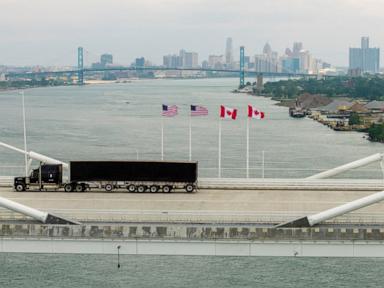
Cross-border trade prohibitions do not operate like standard tariffs; they function as binary supply chain severances that immediately invalidate existing procurement contracts and force rapid, high-cost supplier substitution. When executive trade policy abruptly halts nearly $1 billion in specific Canadian imports into the United States, the primary economic impact is not merely the headline dollar figure, but the acute operational friction introduced across interdependent manufacturing, agricultural, and industrial distribution networks.
Understanding the true cost of this restriction requires moving past surface-level product lists and analyzing the underlying mechanics of North American market integration. The affected goods—spanning targeted agricultural outputs, specialized industrial materials, and specific consumer commodities—represent critical nodes in just-in-time inventory systems. Because the United States and Canada share deeply integrated production lines, an import ban operates as an immediate supply shock to domestic downstream buyers who lack pre-qualified alternative vendors.
The Structural Mechanics of an Import Ban versus a Tariff
Standard trade commentary routinely conflates import bans with protective tariffs, yet their operational realities for corporate supply chains are fundamentally distinct. A tariff alters the price elasticity of a good by introducing a predictable tax wedge, allowing firms to absorb the margin compression, pass costs to consumers, or gradually shift sourcing over several quarters. An outright ban sets the available supply from a designated origin to zero overnight.
This binary shift triggers three immediate operational failures for US importers:
- Contractual Force Majeure and Legal Friction: Existing purchase orders and long-term supply agreements become legally unenforceable upon customs entry. Procurement teams must immediately audit contracts to determine liability for goods already in transit, leading to costly demurrage fees at border crossings and port facilities.
- Inventory Depletion Velocity: Firms operating under lean manufacturing principles typically hold between 15 and 45 days of safety stock. Once a border closure takes effect, the countdown to line-down scenarios begins immediately for facilities reliant on specialized Canadian inputs.
- Spot Market Price Spikes: As dozens of domestic buyers simultaneously enter the secondary market to secure non-Canadian substitutes, spot prices for domestic or third-country equivalents surge disproportionately to the actual volume of the banned goods.
Categorizing the Affected Product Vectors
While the headline valuation approaches $1 billion, the operational vulnerability varies drastically depending on the specific Harmonized System (HS) codes targeted by the executive action. Categorizing these affected products by their substitution elasticity reveals where the acute economic pain actually lands.
High-Friction Industrial and Manufacturing Inputs
Specialized metals, chemical precursors, and processed forestry products represent the highest-risk category within the restricted volume. Unlike raw commodities, industrial inputs are frequently manufactured to exact technical specifications required by US aerospace, automotive, and construction standards. Replacing a Canadian supplier for a precision-milled component or a specific chemical grade is not a procurement exercise; it is an engineering qualification process. Testing, certifying, and onboarding a new vendor frequently requires six to eighteen months, creating an unavoidable production bottleneck during the interim.
Perishable Agricultural and Food Commodities
Targeted agricultural imports—including specific dairy derivatives, regional produce, and processed food ingredients—face an immediate biological clock. Unlike durable goods that can be warehoused in bonded facilities while legal challenges or exemption requests play out, agricultural products spoil. The economic loss here is absolute: Canadian producers lose the crop value entirely if domestic absorption is impossible, while US food processors face immediate recipe reformulation costs or packaging halts when a single ingredient disappears from the bill of materials.
Finished Consumer Goods and Retail SKUs
Consumer-facing products within the ban carry the lowest systemic manufacturing risk but the highest immediate margin impact for retail distributors. Retailers operating on thin net margins face sudden shelf-space vacancies. Filling those gaps requires expedited air or ground freight from alternative global hubs in Asia or Latin America, eroding gross margins through elevated logistics expenditures.
The Three Pillars of North American Trade Vulnerability
The disruption caused by removing $1 billion in bilateral trade exposes three structural vulnerabilities inherent to the United States-Mexico-Canada Agreement (USMCA) ecosystem.
- Geographic Proximity as a Single Point of Failure: Over decades, US firms optimized logistics by treating southern Ontario, Quebec, and British Columbia as extensions of domestic freight networks. Rail lines and highway corridors run north-south rather than east-west. Pivoting away from Canadian suppliers forces US companies to re-route freight through congested maritime ports, shifting from low-cost, short-haul trucking to complex multimodal ocean shipping.
- Regulatory and Standards Alignment: Canadian and US regulatory bodies share extensive mutual recognition agreements covering safety, environmental compliance, and food inspection. Pivoting to third-country suppliers outside North America introduces severe regulatory drag, requiring fresh FDA, EPA, or USDA clearances before a single unit can clear customs.
- Asymmetric Market Concentration: In several affected niche categories, Canadian producers account for a disproportionate share of total North American production capacity. When a single region holds 30% to 50% of continental supply for a specialized input, banning that origin creates an immediate global deficit that third-party producers cannot physically fill without massive capital expenditure to expand plant capacity.
Second-Order Economic Effects and Downstream Contagion
Direct trade figures only capture the customs valuation of the goods at the border; they systematically ignore the multiplier effect as those inputs move through the domestic economy. A $10,000 shipment of a restricted industrial adhesive or specialized alloy can halt a $10 million assembly line if no substitute is readily available.
This downstream contagion manifests through working capital distortion. Chief Financial Officers at affected US enterprises are forced to hoard cash and inflate inventory buffers across unaffected product lines to hedge against potential retaliatory measures from Ottawa. Retaliatory tariffs or counter-bans by the Canadian government historically target politically sensitive US exports—such as bourbon, motorcycles, agricultural machinery, and regional farm goods—turning a targeted $1 billion import restriction into a broader, multi-sector liquidity crunch.
Furthermore, customs enforcement friction slows down compliant trade. When US Customs and Border Protection (CBP) implements heightened scrutiny to catch transshipment—where banned Canadian goods are routed through third countries like Mexico to disguise their country of origin—inspection times increase across all northern border crossings. Legitimate, unrestricted cargo experiences multi-day delays, degrading the efficiency of the entire northern logistics corridor.
Limitations of Corporate Mitigation Strategies
Supply chain executives attempting to navigate this restriction face severe structural constraints, and standard risk-management playbooks often fail under binary trade bans.
The Illusion of Rapid Nearshoring: Moving production from Canada to Mexico or the US South is frequently proposed as a straightforward solution. In reality, industrial real estate vacancy rates in key manufacturing hubs remain tight, skilled labor shortages persist, and power grid capacity limits new heavy industrial hookups. Nearshoring is a multi-year capital allocation strategy, not a tactical response to an immediate import ban.
Tariff Engineering and Substantial Transformation: Firms often attempt to bypass origin restrictions by routing components through a third country for minor assembly, hoping to legally alter the product's country of origin under customs rules. Under strict USMCA rules of origin and CBP enforcement, minor processing does not meet the legal threshold for "substantial transformation." Companies attempting aggressive origin-shifting face severe financial penalties, retroactive duties, and permanent loss of trusted-trader status (CTPAT), which further slows their entire supply chain.
Exemption Lobbying Bottlenecks: Seeking product-specific exclusions from the executive branch is a resource-intensive process dominated by large enterprises with dedicated Washington lobbying infrastructure. Small and mid-sized enterprises (SMEs) lack the capital to navigate the administrative petition process, leaving them exposed to full market disruption while larger competitors secure temporary carve-outs.
Execution Protocol for Supply Chain Leaders
Firms exposed to the restricted Canadian product categories must immediately transition from passive monitoring to aggressive supply chain triage. Waiting for diplomatic resolution or judicial injunctions exposes the balance sheet to unacceptable operational risk.
- Conduct Bill of Materials (BOM) Tier-N Mapping: Immediately audit not just Tier-1 Canadian suppliers, but Tier-2 and Tier-3 sub-suppliers. A domestic US vendor may still be relying on banned Canadian raw materials, creating a hidden single point of failure that will surface 30 to 60 days after the ban's effective date.
- Execute Pre-Emptive Spot Purchases from Alternative Origins: Secure available global inventory from pre-qualified European, Asian, or Latin American vendors immediately, locking in fixed-price contracts before broader market panic drives spot rates higher.
- Initiate Dual-Sourcing Engineering Qualifications: Deploy engineering resources to qualify secondary domestic or third-country inputs, relaxing non-critical aesthetic or packaging specifications where necessary to accelerate regulatory and internal quality approval.
- Restructure Customs Bond and Freight Forwarding Protocols: Instruct customs brokers to segregate restricted SKUs from compliant shipments immediately to prevent entire multi-product freight loads from being seized or delayed at northern ports of entry.