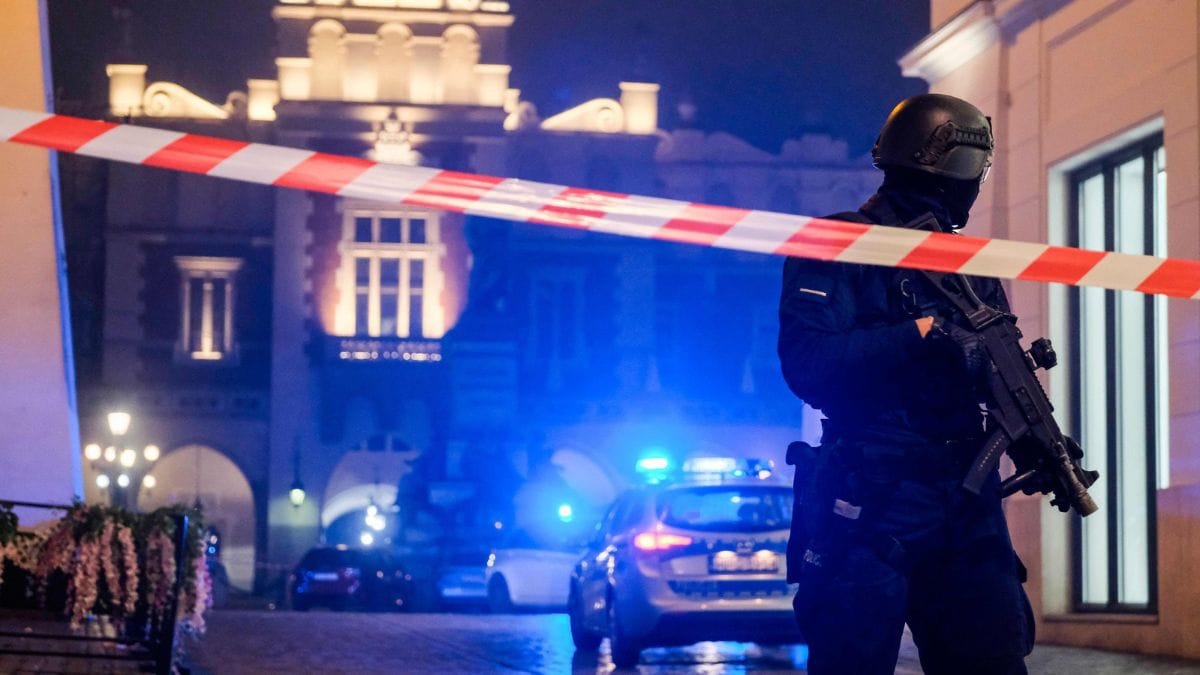
Public mass violence occurring immediately before a major national holiday exposes the operational friction between civil liberties, threat intelligence, and rapid law enforcement containment. In Krakow, the detention of a gunman following a fatal shooting days before Poland's Independence Day demonstrates how localized tactical response operates under elevated national security thresholds. Analyzing this event requires separating confirmed operational facts from the broader structural mechanics of pre-holiday threat environments in Central Europe.
The Structural Mechanics of Pre-Holiday Security Posture
National holidays—specifically November 11 in Poland, marking the restoration of sovereignty in 1918—create predictable shifts in public assembly density and state security allocation. In major urban centers like Krakow, security apparatuses operate on a tiered escalation model during the 72 to 96 hours preceding large-scale civic gatherings.
This pre-event window introduces three distinct operational vulnerabilities:
- Resource Asymmetry: Law enforcement and internal security agencies (such as the Policja and the Internal Security Agency, ABW) concentrate intelligence, surveillance, and tactical units around designated parade routes, political venues, and critical infrastructure. Secondary urban zones experience relative thinning of visible deterrence.
- Temporal Compression: Public attention and media bandwidth narrow onto the impending national event. Any violent incident occurring within this timeframe is immediately evaluated through the lens of political extremism, terrorism, or foreign hybrid interference, even before a motive is established.
- Crowd Density Pre-Loading: Tourism, domestic travel, and logistical staging increase baseline foot traffic in municipal hubs days before the official holiday begins, expanding the target surface for non-state actors.
In the Krakow incident, the critical operational variable was not the prevention of the initial breach, but the compression of the Time-to-Containment (TTC) metric. When an active threat emerges outside the primary security perimeter of a major civic event, the speed of suspect detention dictates whether the incident remains a localized criminal event or cascades into a city-wide paralysis.
Separating Confirmed Operational Facts from Analytical Hypotheses
Standard breaking news coverage frequently conflates immediate tactical outcomes with unverified strategic motives. Rigorous analysis requires partitioning the data into verified facts and conditional hypotheses.
Confirmed Operational Parameters:
- Geographic Vector: The incident occurred within Krakow, Poland's second-largest city and a primary cultural and economic hub.
- Lethality Threshold: Multiple fatalities were confirmed at the scene, classifying the event as a mass casualty shooting under standard criminological definitions (typically defined as four or more victims shot, excluding the perpetrator, though European classifications vary by jurisdiction).
- Tactical Resolution: Law enforcement successfully detained the suspect alive. Alive apprehension is a critical data point; it shifts the post-incident workflow from forensic reconstruction alone to direct interrogation, device exploitation, and network mapping.
- Temporal Context: The event transpired days prior to Poland's Independence Day celebrations, an annual event historically associated with large-scale nationalist marches in Warsaw and significant civic assemblies in Krakow.
Conditional Hypotheses Requiring Verification:
- Ideological vs. Interpersonal Motivation: Proximity to November 11 creates a strong prior probability that investigators will screen for political, nationalist, or anti-state motives. However, European mass shootings frequently stem from severe psychiatric decompensation, personal grievances, or organized criminal disputes rather than ideological terrorism. Until digital footprints and interrogation transcripts are processed, assigning a political motive remains speculative.
- Weapon Acquisition Pathway: Poland maintains some of the strictest firearm ownership laws in the European Union. Under the Act on Weapons and Ammunition (Ustawa o broni i amunicji), civilian access requires rigorous psychological screening, background checks, and demonstrable cause (such as sport shooting or hunting). A multi-fatality shooting indicates one of three acquisition failures: illegal trafficking across Schengen or eastern borders (exacerbated by the ongoing conflict in neighboring Ukraine), theft from a licensed holder, or a failure in the medical-psychological vetting of a legal permit holder.
The Containment Lifecycle and Law Enforcement Execution
Detaining an active shooter without further loss of life or prolonged siege conditions relies on the execution of a four-stage tactical protocol. Unlike historical policing models that prioritized perimeter containment and waiting for specialized counter-terrorism units (such as Poland's Central Counter-Terrorist Subdivision, BOA), modern European urban policing mandates immediate intervention by first-arriving patrol units.
1. Detection and Dispatch Latency
The interval between the first gunshot and the dispatch of units determines the shooter's unrestricted operating window. In dense urban environments like Krakow, acoustic confusion (mistaking gunfire for fireworks, which are common ahead of November 11) often introduces a 60-to-180-second delay in emergency reporting.
2. Rapid Deployment and Contact
First responders bypass casualty evacuation to locate and neutralize the threat. The detention of the Krakow gunman indicates that responding officers successfully closed the distance, isolated the suspect's movement corridors, and forced surrender or executed a non-lethal incapacitation.
3. Secondary Threat Clearance
Once the primary actor is detained, protocols require treating the scene as a potential complex coordinated attack. Tactical teams must clear the immediate perimeter for secondary shooters, improvised explosive devices (IEDs), or booby-trapped vehicles—a standard precaution given the proximity to a major national holiday.
4. Information Quarantine
Securing the suspect alive allows authorities to immediately execute search warrants on the suspect's residence and telecommunications data. Suppressing premature leaks regarding the suspect's identity prevents copycat mobilization and avoids inflaming political tensions ahead of public marches.
Systemic Constraints on Firearm Violence Prevention in Central Europe
The Krakow shooting highlights a persistent structural tension within European internal security frameworks: low baseline gun ownership reduces the frequency of mass shootings, yet it does not eliminate the tail-risk of high-lethality events.
Regulatory frameworks in Poland restrict civilian firearm penetration to roughly 2.5 firearms per 100 residents—among the lowest rates in the developed world. This baseline suppresses impulsive, low-planning gun violence. However, strict regulation creates a specific analytical blind spot: detection bias. Because firearm acquisition is difficult, security services rely heavily on licensing databases and cross-border customs intelligence to flag high-risk individuals.
When an actor bypasses these mechanisms—either by utilizing unregulated black-market channels or by maintaining a clean behavioral profile until the moment of the attack—traditional preventative surveillance fails. Furthermore, the geopolitical reality of Central Europe in recent years has altered the illicit arms market. Prolonged warfare on Poland's eastern frontier increases the theoretical supply of diverted military-grade weaponry, forcing Polish border guards and internal intelligence services to dedicate disproportionate resources to smuggling interdiction.
Limitations of Pre-Holiday Security Escalation
Deploying visible police units and intelligence assets ahead of national celebrations yields diminishing returns against decentralized or lone-actor threats. Three inherent limitations constrain state security effectiveness:
- The Soft-Target Dilemma: Hardening every commercial street, transit hub, and residential district in a major city is economically and logistically impossible. Pushing security perimeters outward merely displaces a motivated attacker toward unguarded civilian clusters.
- Signal-to-Noise Degradation: In the days leading up to November 11, intelligence agencies experience a surge in threat tips, online extremist rhetoric, and suspicious activity reports. Filtering genuine operational plots from high-volume political noise strains analytical capacity.
- Legal Thresholds for Preemptive Detention: Within a democratic framework governed by EU human rights standards, law enforcement cannot detain individuals solely on the basis of behavioral anomalies or unverified suspicion prior to a criminal act. Intervention remains structurally reactive until an overt threshold is crossed.
Strategic Imperatives for Post-Incident Stabilization
With the gunman in custody and Independence Day celebrations imminent, municipal and national authorities face an immediate dual mandate: maintaining public order during scheduled assemblies while executing a forensic audit of the security breach.
First, security planners must decouple the Krakow investigation from routine November 11 crowd-control operations. Reassigning specialized investigative units to parade security degrades the speed of the forensic timeline, which is essential for determining whether the suspect acted alone or within a broader cell.
Second, public communications from the Ministry of the Interior and Administration must prioritize verifiable facts over speculative framing. Releasing confirmed data regarding the weapon's origin (legal vs. illegal) and the absence of co-conspirators within the first 24 hours is the most effective mechanism to prevent political actors from weaponizing the tragedy during holiday speeches.
Finally, Polish law enforcement must audit the detection-to-dispatch timeline of the Krakow response. Identifying whether acoustic misidentification (confusing gunfire with pre-holiday pyrotechnics) delayed the initial emergency calls will provide actionable data for updating urban acoustic sensor networks and dispatch protocols ahead of future high-density civic events.