The failure of localized or incomplete armistice agreements is a predictable function of asymmetric territorial distribution and structural ambiguity in operational boundaries. When a diplomatic framework leaves a militant adversary in possession of a fraction of its baseline territory while the counter-insurgent retains defensive and offensive control over the remainder, the resulting operational matrix does not produce peace; it establishes an unstable equilibrium characterized by continuous kinetic friction.
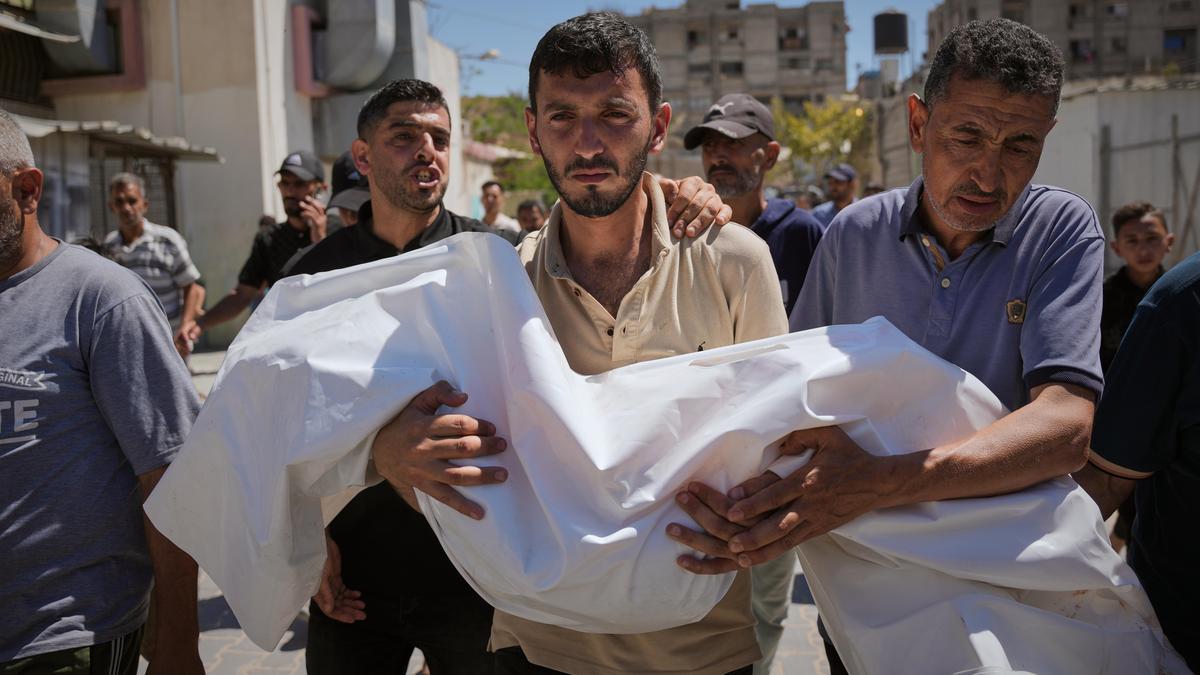
The strike by two Israeli helicopters in the Mawasi region of Khan Younis—which resulted in the deaths of a six-year-old child, a 31-year-old woman, and the injury of 17 civilians—highlights the operational mechanics governing post-ceasefire environments. To understand why such strikes persist despite an active diplomatic agreement, one must evaluate the conflict through three distinct structural elements: the geometry of the asymmetric enclave, the logic of persistent targeting frameworks, and the breakdown of Phase II diplomatic implementations.
The Geometry of Asymmetric Enclaves and High-Density Displacement
The October ceasefire framework distributed territorial governance into a highly distorted ratio: Israel maintains direct operational control over more than 50 percent of the Gaza Strip, while Hamas retains administration over a narrow coastal sliver. This geographical compression creates a profound bottleneck in terms of civilian distribution and defensive optimization.
When a civilian population is concentrated into designated humanitarian zones, such as the Mawasi tent encampment, the physical density of the area scales exponentially. This reality modifies the variables of kinetic target selection:
- Proximity Coefficients: High civilian density decreases the physical distance between non-combatant infrastructure (tents, temporary shelters) and transient military assets or personnel.
- Collateral Radii: In a dense encampment composed of soft-skinned temporary structures, the effective lethal blast and fragmentation radius of standard aviation ordnance expands relative to an urban environment with reinforced concrete barriers.
- Verification Latency: The constant movement of displaced individuals introduces noise into reconnaissance networks, complicating the distinction between combatants and non-combatants.
Under these conditions, any kinetic action aimed at a high-value or tactical military asset carries an inflated collateral cost. The state military's assertion that it targeted "militants in the area" points to an operational rule of engagement wherein target verification takes precedence over proximity risk mitigation in high-density zones.
The Targeting Framework and Kinetic Friction Mechanisms
The occurrence of targeted actions during an official truce reflects a deliberate policy of preventative kinetic attrition. State military operations in this phase do not aim for total territorial seizure, but focus on two core operational mandates:
- Armistice Line Interdiction: Preventing the unauthorized approach of individuals to the newly established demographic and military dividing lines.
- Capability Degradation: Neutralizing personnel linked to high-consequence technical capabilities before those capabilities can be deployed or scaled.
This mechanism was demonstrated concurrently in the central Gaza Strip via an airstrike in Nuseirat targeting Mohammad Abu Mallouh, identified by intelligence as a key operative within the weapons production department of Hamas. The operational logic dictates that neutralizing high-tier technical specialists outweighs the localized political friction caused by the strike.
However, this strategy operates under a significant information deficit. Because Hamas does not publish real-time casualty data for its military wings, the external verification of target success remains asymmetric. The counter-insurgent measures success by intelligence confirmations and structural degradation, while the insurgent measures impact through the amplification of non-combatant casualties, creating an unbridgeable narrative gap.
The Phase II Diplomatic Deadlock
The baseline cause of continued kinetic friction is the structural flaw inherent to the October ceasefire architecture. The transition from an active cessation of hostilities to a durable political settlement requires the execution of Phase II protocols. These protocols are currently deadlocked by two mutually exclusive operational requirements:
[Phase II Implementation Deadlock]
       │
       ├──► Israel Demand: Absolute Disarmament of Insurgent Forces
       │
       └──► Hamas Demand: Complete Withdrawal of Counter-Insurgent Troops
This gridlock changes the nature of the ceasefire from a transitionary peace mechanism into a static front line. For the state military, a pause without disarmament allows the adversary to reconstitute its manufacturing and command structures. For the insurgent group, a pause without state withdrawal solidifies a permanent foreign military footprint on more than half of the enclave's territory.
Consequently, the truce does not function as a termination of conflict but as a shift in operational intensity. The statistics compile this reality: since the implementation of the truce, approximately 900 Palestinians have been killed in localized strikes, while four Israeli soldiers have been killed in insurgent actions. These figures demonstrate that kinetic interactions have not ceased; they have merely shifted from maneuvers for territorial conquest to fixed-position attrition.
Structural Adjustments for Boundary Stabilization
To prevent continuous kinetic spillovers into high-density civilian zones, the operational architecture of the armistice lines must be altered. Relying on vague verbal or geographical agreements guarantees ongoing friction.
First, the establishment of clear, mutually verified buffer corridors with predefined de-escalation protocols is required to replace the current system of reactive interdiction.
Second, the verification of target matrices must include a density-threshold calculation that adjusts the choice of weapon system based on infrastructure vulnerability, shifting away from rotary-wing unguided or wide-area fragmentation ordnance in temporary tent zones.
Without these structural adjustments to the physical and diplomatic boundaries, the current framework will continue to generate localized kinetic actions, rendering the term "ceasefire" a nominal rather than functional reality.