Epidemiological containment fails when transmission velocity outpaces the operational deployment of public health interventions. In the Democratic Republic of Congo (DRC), the Ebola virus disease (EVD) outbreak crossing the threshold of 500 deaths signifies more than a tragic statistic; it exposes a systemic breakdown in the traditional ring vaccination and contact tracing frameworks. When an outbreak reaches this scale within a highly volatile conflict zone, the primary constraint shifts from medical efficacy to operational execution. Resolving this crisis requires shifting away from aggregate casualty tracking toward a rigorous analysis of transmission mechanics, localized security dynamics, and institutional distrust.
The Triad of Transmission Vectors in Complex Humanitarian Emergencies
To understand why standard containment protocols degrade in the eastern DRC, the epidemic must be decomposed into three distinct operational vectors. Each vector introduces unique variables that distort the traditional reproductive rate ($R_0$) of the virus.
Community-Based Transmission and Mobility Networks
The geography of the Kivu region features high population density and fluid cross-border trade networks. Traditional epidemiologic models assume a static or semi-contained population where contact networks can be mapped linearly. In reality, the regional population relies on informal trade routes connecting North Kivu, Ituri, and neighboring Uganda.
When symptoms manifest, individuals frequently bypass formal transit checkpoints where thermal screening occurs, opting instead for secondary footpaths. This movement pattern creates geographical fragmentation, scattering secondary and tertiary cases across vast areas before public health teams can establish a baseline line-list. The virus leverages these micro-mobility networks, turning economic corridors into transmission corridors.
Nosocomial Amplification within Unregulated Healthcare Providers
A significant percentage of transmission occurs within informal healthcare facilities, known locally as tradipraticiens (traditional practitioners) and unregistered private clinics. When patients exhibit early-stage, non-specific symptoms such as fever and fatigue, they consistently seek care within these decentralized networks first.
These facilities rarely possess personal protective equipment (PPE) or adequate isolation infrastructure. Consequently, a single undiagnosed Ebola patient can infect multiple healthcare workers and patients, transforming a localized infection into a super-spreader event. The formal health zone system loses visibility because these private providers operate outside the state reporting mechanism, creating a critical blind spot in early detection.
Insecure Burial Logistics and Ritualized Exposure
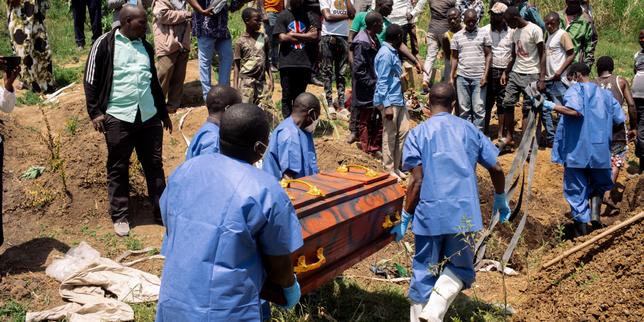
Post-mortem transmission remains a highly potent vector for EVD due to the extreme viral load present in deceased bodies. Traditional burial customs involve washing, dressing, and touching the deceased. Safe and Dignified Burial (SDB) teams, deployed to mitigate this risk, encounter severe resistance because their protocols disrupt deeply entrenched cultural mandates.
When communities circumvent SDB protocols through clandestine night burials, the exposure index spikes exponentially. A single unmanaged burial can generate dozens of high-risk contacts, resetting the containment clock for an entire health zone.
The Strategic Failure of Contact Tracing Frameworks
Contact tracing is the cornerstone of Ebola elimination. The protocol requires identifying 100% of individuals exposed to a confirmed case, monitoring them for 21 days, and isolating them immediately if symptoms emerge. In the current DRC operational environment, this system encounters structural bottlenecks that reduce its efficacy below the critical threshold required to suppress the outbreak.
The first bottleneck is the erosion of the denominator. Effective contact tracing depends on the honesty and memory of the confirmed patient. In areas characterized by deep-seated institutional distrust and fear of forced isolation, patients systematically withhold the identities of their contacts. Epidemiologists find themselves tracking an incomplete fraction of the actual exposure network.
The second limitation is security-induced blindness. Active conflict involving armed groups like the Allied Democratic Forces (ADF) and local Mai-Mai militias regularly forces response teams to suspend operations. When a health zone goes into lockdown for 48 to 72 hours, the daily monitoring cycle is broken. Contacts who develop symptoms during these blackouts flee the area or self-medicate in secret, completely severing the chain of custody required for ring vaccination.
Decentralized Ring Vaccination Mechanics and Resistance
The deployment of the rVSV-ZEBOV vaccine represents a massive technological milestone, yet its utility is bounded by the logistics of the ring strategy. Ring vaccination dictates that a "ring" of first-degree contacts, followed by a second ring of contacts-of-contacts, be vaccinated around every confirmed case to create a human firewall.
This strategy breaks down under three specific pressures:
- The Cold Chain Constraint: The vaccine requires ultra-cold storage temperatures between $-60^\circ\text{C}$ and $-80^\circ\text{C}$. Maintaining this chain in rural equatorial environments with non-existent grid electricity requires a heavy reliance on solar-powered freezers, generators, and specialized transport logicians. The operational footprint required to maintain these temperatures restricts the mobility of vaccination teams, forcing them to operate from centralized hubs and making deep rural deployment slow and rigid.
- Geographical Definition Failure: In urban centers like Beni and Butembo, defining a clear "ring" is impossible. High-density markets, shared transport, and informal housing mix populations so thoroughly that identifying distinct boundaries fails. The response teams end up vaccinating arbitrary groups, leaving massive gaps through which the virus continues to circulate.
- Weaponized Misinformation: The introduction of a novel vaccine by foreign entities and state actors creates fertile ground for political manipulation. Local actors leverage existing political marginalization to frame the vaccine as a tool of population control or political subversion. This results in direct physical resistance, attacks on healthcare infrastructure, and a widespread refusal to participate in the vaccination rings.
Reconfiguring the Intervention Architecture
To reverse the trajectory of an outbreak that has breached the 500-death threshold, the strategic paradigm must shift from a top-down, centralized medical response to a decentralized, operationally adaptive model.
[Centralized, Top-Down Model] -> Fails in high-conflict, low-trust zones
                                       |
                                       v
[Decentralized, Adaptive Model] -> Integrates local networks, minimizes visibility footprint
Integration of Informal Healthcare Networks
Instead of attempting to shut down or penalize unregistered clinics and traditional healers, response authorities must integrate them into the surveillance apparatus. This involves equipping these informal providers with basic infection prevention control (IPC) kits, infrared thermometers, and non-contact training.
By transforming these trusted local nodes into triage points rather than transmission hubs, the response apparatus can capture early-stage cases days before they would normally present at a formal Ebola Treatment Center (ETC).
Neutral Humanitarian Space Architecture
The militarization of the response—demonstrated by armed escorts for medical teams—has definitively backfired by aligning public health with contested state authority. The intervention must systematically decouple medical logistics from state security forces.
Negotiating access with local armed factions through neutral humanitarian intermediaries is a prerequisite for operational stability. Security must be derived from community buy-in and radical transparency regarding intent, rather than the threat of kinetic force.
Transition to Targeted Geographic Vaccination
Where traditional ring vaccination fails due to urban density and contact tracing breakdowns, the strategy must transition to targeted geographic vaccination. This entails vaccinating entire high-risk neighborhoods or specific demographic cohorts (such as all public transport operators and market traders in an affected zone) regardless of whether they have a confirmed link to a known case. This approach bypasses the bottleneck of imperfect patient testimony and builds a broader base of community immunity in high-density transit nodes.
The continuation of the current trajectory will not be halted by the mere availability of vaccines or international funding. The limiting factor is, and remains, the operational interface between the medical intervention and the complex socio-political reality on the ground. Until the response architecture treats community distrust and conflict dynamics as core epidemiological variables rather than external inconveniences, containment will remain mathematically impossible.


.jpg?width=1200&auto=webp&trim=0%2C0%2C0%2C0)