The asphalt on Belmont Road does not care about identity politics. It is a quiet, residential stretch in Southampton, the kind of place where university students walk home beneath the amber hum of streetlights, their breath misting in the cold December air. On one such night, an eighteen-year-old finance student named Henry Nowak was walking down that road. He was singing songs into his phone, recording a lighthearted Snapchat video for his friends, carrying nothing but the optimism of a young man whose life was just beginning.
Minutes later, Henry was on the ground. He had been stabbed five times. If you liked this piece, you might want to look at: this related article.
What followed in the dark of that Southampton night, and the subsequent days that bled into June, is a story about the collapse of institutional common sense, the weaponization of narrative, and the terrifying speed with which a human tragedy can be hijacked by opposing political forces. When the facts of a murder are replaced by ideological scripts, justice becomes a casualty of the noise.
Consider the sheer weight of what happened before the blue lights even arrived. Henry’s attacker, a twenty-three-year-old named Vickrum Digwa, possessed what prosecutors later described as a weapon obsession. On his belt, he carried a large Sikh dagger—not the small, concealed ceremonial kirpan required by his faith, but a secondary, massive blade. When Henry casually asked Digwa if he was a "bad man," likely startled by the weapon, Digwa responded with chilling certainty: "I am a bad man." He grabbed Henry's phone. Then, he unleashed a brutal, unprovoked attack, piercing Henry's chest, catching a lung, and severing a vital vein. For another look on this story, refer to the latest update from The New York Times.
But the violence did not stop with the knife. As Henry lay bleeding on the pavement, a secondary, psychological cruelty began. Digwa did not call for medical help. Instead, he pulled out his own phone to record close-up videos of the dying teenager. When Digwa’s family arrived at the scene, the priority was not salvation, but a cover-up. His mother hid the murder weapon. His brother called 999, spinning a calculated fiction. When the police arrived, Digwa loudly claimed that he was the victim, alleging that Henry had racially abused him and knocked off his turban.
It was a lie. A total fabrication designed to exploit the deepest anxieties of modern law enforcement.
And it worked.
Imagine the confusion of those first few minutes on Belmont Road. Put yourself in the shoes of someone witnessing the breakdown of absolute truth. When the officers arrived, they were met with a loud, confident accusation of a hate crime. Under the immense pressure of contemporary policing, where the fear of mishandling a racial incident carries career-ending weight, the institutional reflex kicked in. They believed the accuser. They looked at Henry, who was slipping away, gasping for air, and they handcuffed him.
"I’ve been stabbed," Henry pleaded. "I can’t breathe. Call an ambulance."
The response from one officer, captured on bodycam footage that would later ignite a city, was devastatingly dismissive: "I don't think you have, mate."
For three agonizing minutes, Henry remained in handcuffs, his genuine physical torment treated as the standard resistance of an aggressive suspect. By the time the officers realized the catastrophic reality of his internal bleeding, it was too late. Pathologists would later state that the chest wound was so severe that Henry could not have been saved even with immediate intervention. Yet, the image of that boy dying in handcuffs, his final breaths dismissed because an institutional system was primed to see a specific narrative, left a profound, festering wound on the community.
Justice was eventually served in the courtroom. Digwa was sentenced to life in prison, ordered to serve a minimum of twenty-one years. His mother was convicted for assisting an offender. Outside the court, Henry’s father, Mark Nowak, stood before the cameras. His grief was palpable, a heavy, suffocating thing. He did not blame the police for the murder—he held Digwa 100 percent responsible. But he spoke a truth that echoed across the country: "Henry did not die with dignity. The way he was treated was inhumane and degrading." He pleaded with the public not to use his son’s death to sow division or hatred.
But the modern world rarely honors the wishes of grieving fathers.
Once the bodycam footage was released to the public, the tragedy ceased to belong to the Nowak family. It became fuel. It was swept up into a larger, raging culture war regarding "two-tier policing" and the perception that law enforcement had become so paralyzed by identity politics that they could no longer see a dying human being right in front of them. Political leaders weighed in. High-profile online influencers broadcasted calls to action.
The response was swift, volatile, and entirely detached from Henry's memory.
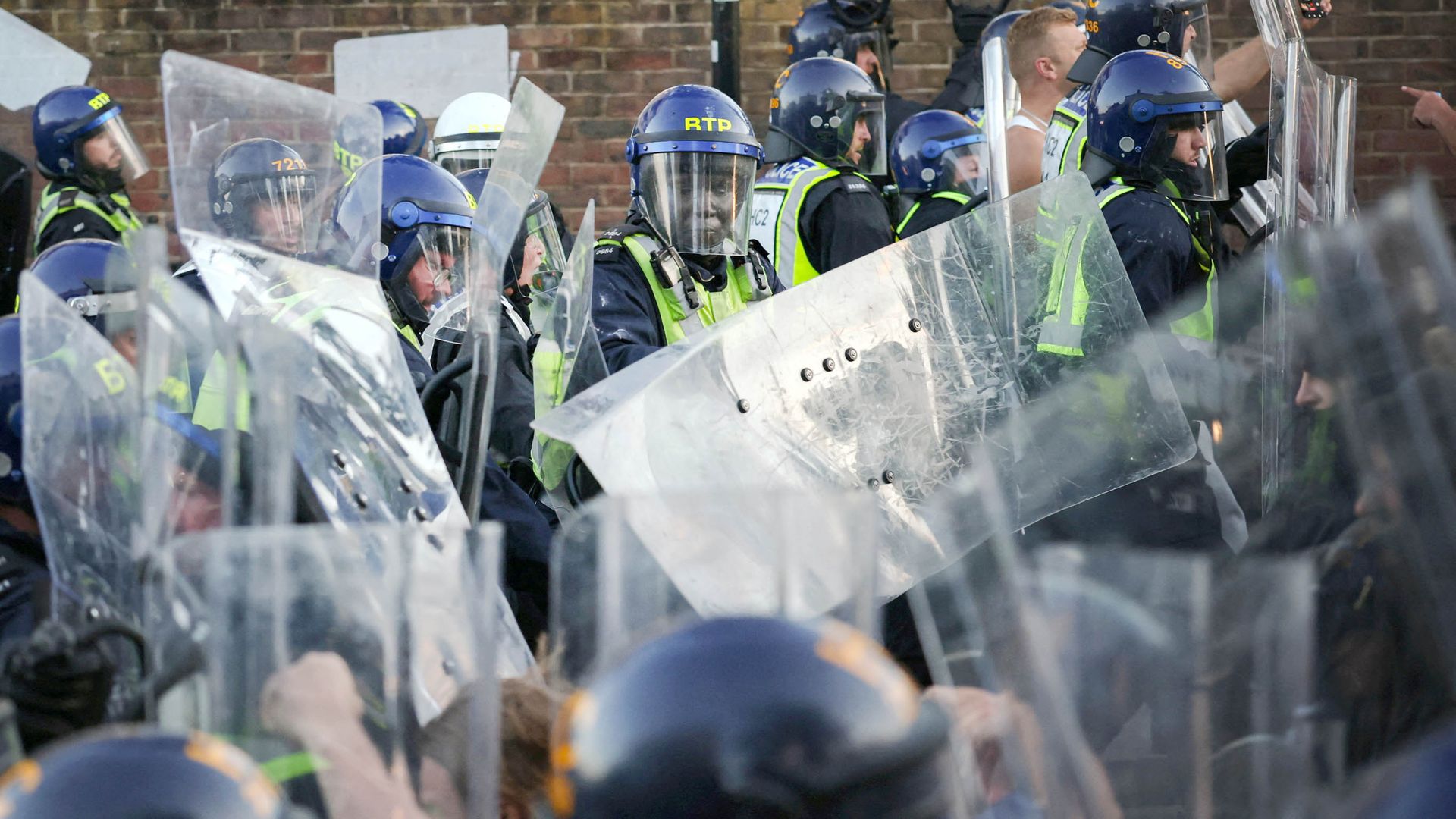
On June 2, a crowd of roughly one thousand people gathered outside the Southampton Central Police Station. It was supposed to be a protest against police conduct, but anger is a highly contagious currency. Within hours, the gathering morphed. Far-right agitators and political figures arrived, sensing an opportunity to channel local grief into systemic fury. The crowd fractured, and a contingent of several hundred people moved toward the Portswood area—the very neighborhood where Henry had been killed.
By 8:00 PM, the atmosphere had soured into something ugly. The grief was gone, replaced by adrenaline and tribal rage. A baying mob surrounded police lines.
Consider what happens next when a crowd loses its humanity. Eleven police officers and a police dog were injured in the ensuing chaos. Missiles flew through the air—wheelie bins, garden chairs, bricks. This was no longer a vigil for a boy who sang songs on his way home from a night out with his football team. It was a riot.
Men like forty-one-year-old Leon O’Leary from Basingstoke didn't know Henry. They didn't feel the intimate, shattering loss that Henry’s sister Olivia described when she called him her best friend. Yet, O’Leary was there in the thick of the crowd, launching a smoke grenade at officers. When police later searched his home, they found a samurai sword in his bedroom. Another man, twenty-four-year-old Connor Bishop, hurled a yellow traffic cone into the backs of police support unit officers.
There was Daniel Frost, a father of two, who stood in a camouflage face covering, throwing garden furniture into the road before ostentatiously wrapping a dog lead with a metal carabiner around his hand to form a makeshift knuckleduster. There was Reece Robinson, just twenty-one, throwing bricks.
The terror of that night was carried by people who had nothing to do with the original crime. Ruby Stephenson, a British Transport Police officer with twelve years of experience, found herself running for her life. "I was chased by protesters who were calling us traitors and scum," she later stated, recalling the sheer vulnerability of being surrounded. "I was terrified, and I did not think I would make it out of there alive."
When the smoke cleared, the judicial system reacted with the swiftness it reserves for civil unrest. At Southampton Crown Court, Judge William Mousley KC looked down at the men standing in the dock. There was no leniency for the narrative they claimed to defend.
O’Leary was jailed for three years and one month. Bishop was handed two years and eight months. Frost received two years and four months. More than twenty others faced the conveyor belt of magistrates' courts, pleading guilty to violent disorder. The judge noted that the violence was a hate crime in its own right, born out of a raw hatred for the police. He reminded them that they always had the choice to walk away, to step back from the mob. They chose the bricks instead.
The tragedy of Henry Nowak is a heavy, multi-layered grief. It is the tragedy of an innocent life stolen by a man obsessed with weapons. It is the tragedy of a police force so ensnared by the fear of ideological missteps that they failed to provide basic human empathy to a dying teenager. And finally, it is the tragedy of a society so deeply fractured that it cannot even allow a family to bury their son without turning his gravesite into a battlefield.
Everyone wanted to own Henry’s story. The killer wanted to use it to escape prison. The political factions wanted to use it to prove a point about the state of the nation. The rioters used it as an excuse to break things and terrify innocent people.
Lost beneath the prison sentences, the political rhetoric, the smashed bricks, and the smoke grenades is the quiet room of a home in Essex that Mark Nowak helped his eldest son pack up just weeks before he died. There are no protestors there. There are no policy debates or ideological points to prove. There is only an empty desk, a family tradition broken, and the permanent, deafening silence left behind when a human being is reduced to a talking point.