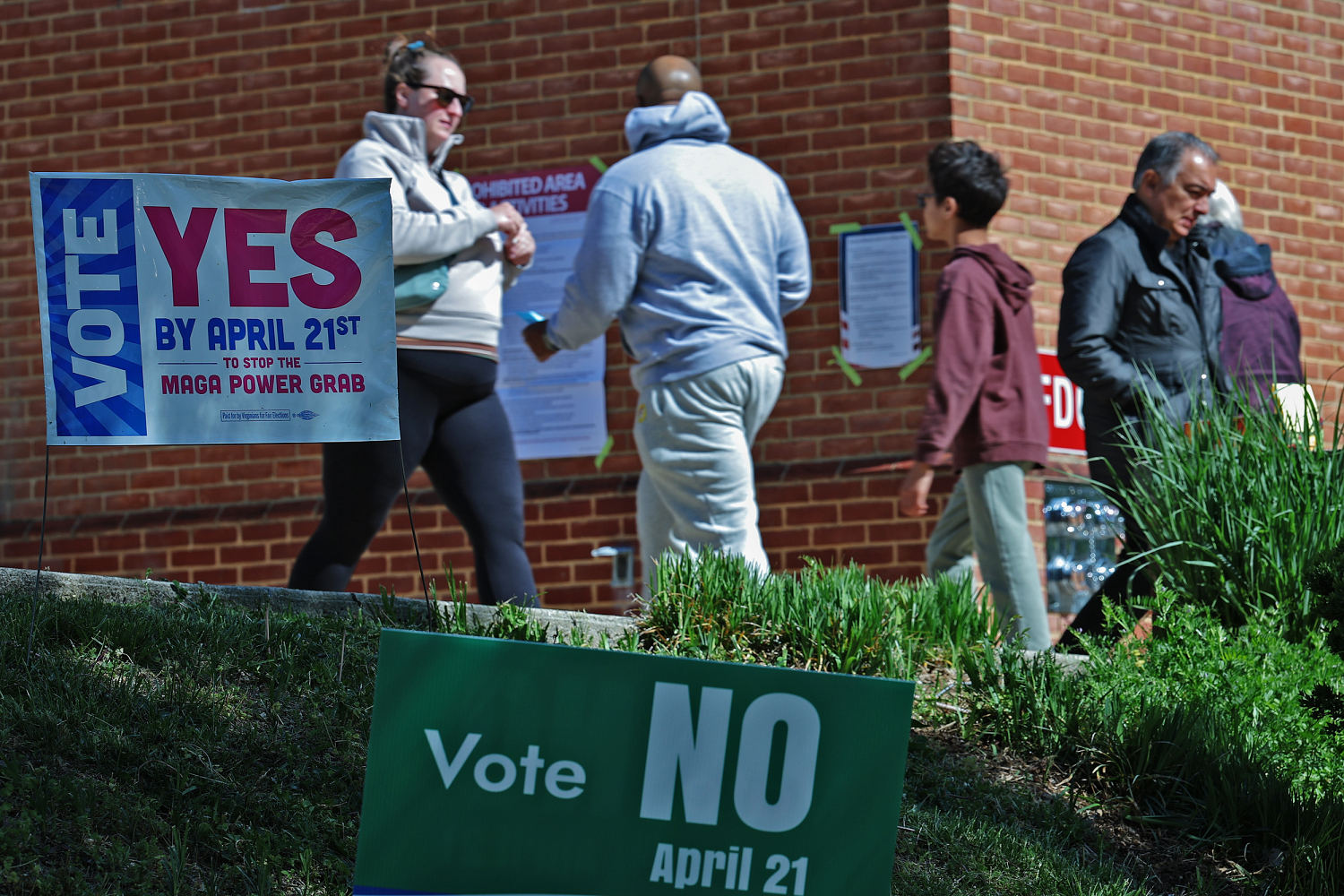
The United States Supreme Court’s denial of the emergency appeal by Virginia Democrats ends a multi-million-dollar structural play to alter the partisan baseline of the state's congressional delegation. By refusing to revive a voter-approved constitutional amendment that would have facilitated an immediate redrawing of the state’s electoral map, the high court solidified the pre-existing 2021 map for the upcoming midterm elections. While popular analysis characterizes this outcome as a purely political setback for the Democratic party, a rigorous structural review reveals it as a systemic failure of legislative execution, a strategic miscalculation of judicial deference, and a demonstration of how procedural friction dictates federal power.
To understand the breakdown, one must map the interaction between state constitutional design, structural sequencing, and the institutional incentives governing the judiciary. The failure was not a function of shifting voter sentiment, but rather a structural breakdown across three distinct pillars: constitutional amendment sequencing, federal-state jurisdictional boundaries, and the operational timeline of election administration.
The Structural Mechanics of the Virginia Map Failure
The core conflict traces back to a 2020 constitutional amendment that established an advisory redistricting commission composed of eight legislators and eight citizens. The architecture of that commission included an explicit fallback mechanism: if the commission deadlocked, authority automatically ceded to the Virginia Supreme Court. When that deadlock occurred in 2021, the state court appointed two special masters to draft the current map, resulting in a balanced 6-5 Democratic-to-Republican seat distribution.
To bypass this court-mandated equilibrium ahead of the midterms, state legislative Democrats sought to pass a new constitutional amendment via an emergency referendum. This new measure aimed to claw back redistricting authority to the General Assembly, enabling a map that projected a 10-1 Democratic advantage.
The strategy collapsed because the legislative majority failed to satisfy the state constitution's rigid amendment cost function. The Virginia Constitution dictates a strict, multi-step sequence designed to prevent rapid, mono-partisan alterations to the foundational law:
- First Legislative Pass: An amendment must pass a majority vote in both chambers of the General Assembly.
- Intervening Electoral Filter: A general election for the House of Delegates must occur, allowing the electorate to alter the composition of the legislature based on the proposed constitutional change.
- Second Legislative Pass: The newly elected General Assembly must pass the exact same amendment text.
- Popular Referendum: The measure is submitted to the electorate for final ratification.
The legislative bottleneck occurred when the General Assembly attempted to compress this timeline. The initial legislative vote took place on October 31, 2025, during a special session. The second vote occurred in early 2026, without an intervening general election of the House of Delegates.
The legislature argued that the voting window spanning September to November 2025 constituted the necessary electoral separation. However, the Virginia Supreme Court, in a 4-3 decision, ruled that a general election is an indivisible temporal block. Because the first vote occurred during that active election cycle rather than before it, the constitutional sequence was broken, rendering the subsequent April 21 referendum null and void.
The Jurisdictional Bottleneck and the Limits of Independent State Legislature Theory
When Virginia Democrats filed an emergency appeal to the U.S. Supreme Court, they encountered a structural jurisdictional barrier. Federal courts operate under a doctrine of profound deference to state supreme courts on matters concerning the interpretation of state constitutions.
To overcome this hurdle, the appellate strategy attempted a highly unusual deployment of a modified independent state legislature framework. Historically advanced by conservative litigants, this theory posits that the U.S. Constitution grants state legislatures near-plenary authority to set rules for federal elections, insulated from state judicial review.
The structural irony of the appeal created a logical contradiction that the U.S. Supreme Court declined to entertain. The plaintiffs argued that the Virginia Supreme Court’s invalidation of a voter-approved amendment infringed upon the legislature’s federal constitutional prerogative to manage congressional maps. This argument failed due to two fatal structural flaws:
- The Scope of Judicial Invalidation: The Virginia Supreme Court did not strike down a legislative act regulating a federal election; it struck down an invalid attempt to alter the state’s internal power-sharing structure via a flawed constitutional amendment process.
- The Precedent of Deference: Having narrowed the extreme version of the independent state legislature theory in 2023, the U.S. Supreme Court maintained its institutional baseline, refusing to intervene in a state court's interpretation of its own procedural mandates.
The Operational Cost Function of Late-Stage Cartography
Beyond the legal and constitutional architecture, the attempt to implement a new map weeks before an election created severe operational friction. In election infrastructure, changes to geographic boundaries incur significant data processing and administrative overhead.
[Old Map: 6D - 5R] ---> [Proposed Map: 10D - 1R]
                             |
                    (Procedural Error)
                             |
            [Virginia Supreme Court Invalidation]
                             |
             [U.S. Supreme Court Deference]
                             |
       V
[Result: Retain 2021 Map (6D - 5R Baseline)]
The administration of an election requires the precise mapping of voter registration data against newly drawn census blocks. When boundaries shift, local registrars must reassign millions of individual voter profiles to new precincts and congressional districts, split existing precincts, update digital pollbooks, and print highly customized ballots.
This administrative reality created an absolute deadline. Governor Abigail Spanberger recognized this operational bottleneck, noting that irrespective of the U.S. Supreme Court’s ruling, the state would proceed under the 2021 map due to looming statutory deadlines for ballot preparation and military overseas voting. The risk of administrative chaos, voter confusion, and subsequent equal protection litigation under the Fourteenth Amendment served as a powerful stabilizing force, disincentivizing any late-stage judicial intervention.
Strategic Realities of the New Baseline
The preservation of the 2021 map fundamentally alters the national optimization strategy for both major political parties. The proposed map was engineered to deliver a predictable four-seat net gain for Democrats, which would have single-handedly shifted the balance of power in a closely divided federal House of Representatives.
Instead, the retention of the status quo forces both parties to allocate scarce capital toward competitive, marginal districts rather than relying on structural advantages.
- The 1st and 2nd District Variable: Rather than operating under safe partisan boundaries, Democratic capital must now be deployed defensively and offensively within the existing 1st and 2nd Congressional Districts. These districts remain highly competitive under the 2021 court-ordered map, requiring intensive resource allocation that could have otherwise been deployed to expand the national map.
- The Asymmetric National Landscape: This structural failure occurs alongside recent shifts in national voting jurisprudence, specifically the contraction of certain federal voting rights protections that enabled mid-decade redistricting optimizations in several Southern states. Because Virginia failed to execute its structural counterweight, the national baseline shifts in favor of the current congressional majority.
Parties seeking to alter electoral cartography cannot rely on downstream popular validation to cure upstream procedural defects. The judiciary will prioritize structural sequencing and administrative finality over raw voter output when the underlying legislative mechanism is flawed. Future redistricting plays must execute constitutional mechanics with absolute precision, as the courts will not bail out strategic maneuvers that bypass structural guardrails.
For a deeper dive into the legal arguments surrounding state-level redistricting disputes and how federal courts assess emergency stays on election maps, see this analysis of recent Supreme Court redistricting orders, which details the national battle over congressional lines leading into the current election cycle.