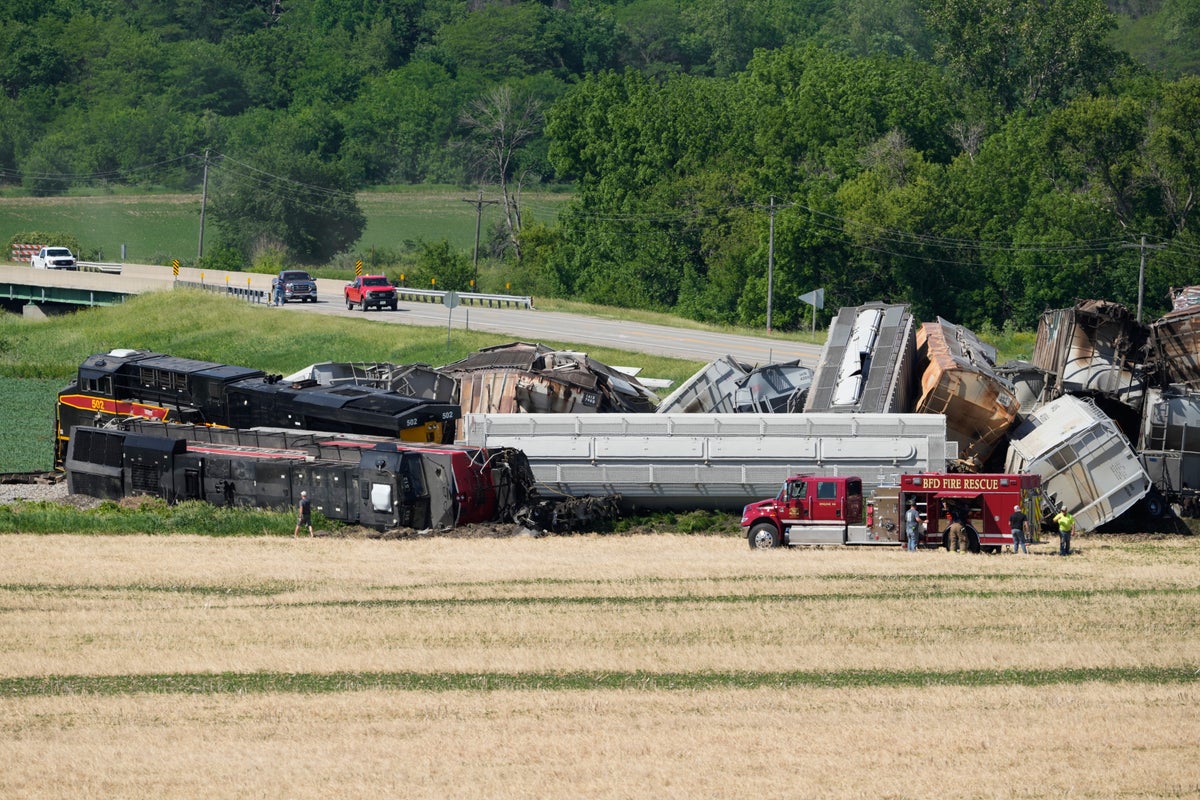
The collision between an Iowa Interstate Railroad freight train and a commercial semi-truck near Victor, Iowa, highlights a persistent vulnerability in North American supply chain infrastructure: the at-grade highway-rail intersection. Standard accident reporting typically frames these events as isolated driver errors or unfortunate logistics anomalies. A rigorous engineering and operational analysis reveals they are predictable outcomes of intersecting, high-mass transport systems operating with minimal kinetic buffer zones.
When a multi-ton freight train intersects with an 80,000-pound commercial motor vehicle, the physical laws governing momentum and braking distance guarantee catastrophic outcomes if structural separation fails. The Victor incident resulted in one fatality, one critical injury, the derailment of two locomotive power units, and the destruction of 17 railcars. To mitigate these systemic risks, industrial operators and transport regulators must analyze the physical, mechanical, and infrastructural variables that dictate grade-crossing safety performance.
The Physics of High-Mass Track Contamination
The fundamental challenge of grade-crossing safety is the stark asymmetry in mass and stopping capability between rolling stock and highway vehicles. A standard fully loaded freight train can weigh anywhere from 3,000 to over 10,000 tons. The kinetic energy ($E_k$) of an object in motion is expressed by the formula:
$$E_k = \frac{1}{2}mv^2$$
Where $m$ represents mass and $v$ represents velocity. Because mass is exceptionally high in rail operations, the kinetic energy that must be dissipated to bring a train to a complete stop is orders of magnitude greater than that of a highway vehicle, even one as large as a semi-truck.
This kinetic reality manifests in the emergency braking profile of freight locomotives. Unlike passenger vehicles that rely on pneumatic tires gripping high-friction asphalt, trains utilize steel wheels on steel rails. This interface features an exceptionally low coefficient of friction—typically between 0.15 and 0.30 depending on moisture, rust, and rail conditions.
When an engineer initiates an emergency brake application (known as slipping the train into "emergency"), air is rapidly vented from the brake pipe running the length of the train. This drop in pressure causes the control valves on each individual car to direct pressurized air from auxiliary reservoirs into the brake cylinders, forcing brake shoes against the wheel treads.
This process is subject to two major physical bottlenecks:
- Pneumatic Signal Propagation Delay: The brake command travels down the brake pipe at the speed of sound through air (roughly 900 to 1,000 feet per second). On a mile-long train, it can take several seconds for the rear cars to even begin applying braking force.
- Adhesion Limitations: Because steel-on-steel adhesion is low, applying too much braking force causes the wheels to lock and slide, which destroys the wheels via flat-spotting and actually reduces braking efficiency.
The practical result of these constraints is that a freight train traveling at 40 to 50 miles per hour requires anywhere from a third of a mile to more than a full mile of clear track to execute a complete stop after the emergency brake is pulled. When a semi-truck enters a crossing ahead of an oncoming train, the engineer cannot stop the train manually in time to prevent a collision. The collision is entirely predetermined by the geometry and timing of the truck's entry into the fouling circuit of the track.
Derailment Mechanics and Kinetic Energy Dissipation
The Victor, Iowa collision was not a clean deflection; it triggered a major derailment involving 17 cars and two locomotive units. Understanding why a highway vehicle can derail an object hundreds of times its weight requires an analysis of track mechanics and the structural vulnerabilities of locomotive wheel flanges.
The lateral stability of a train relies on a small steel lip on the inside of each wheel called the flange. The flange extends approximately one inch below the top of the railhead, preventing the wheelset from sliding off the track laterally.
When a lead locomotive strikes a semi-truck, the debris from the truck—such as axles, frame rails, or heavy cargo—can get wedged beneath the locomotive's snowplow and pilot. If this debris passes under the wheels, it lifts the wheel tread above the height of the railhead. Once the wheel flange clears the top of the rail, the immense forward momentum of the train forces the wheelset out of alignment, causing it to drop onto the ties and ballast.
Once a locomotive or leading car derails at speed, it creates a sudden anchor point for the trailing cars. The cars behind the point of derailment are still carrying massive kinetic energy forward. This forces a structural failure chain:
- Coupler Jackknifing: The high compressive forces (buff forces) exceed the lateral stability limits of the couplers connecting the cars.
- Accordion Effect: The cars are forced sideways off the track center line, stacking into the compact, vertical heaps observed in the Poweshiek County incident.
- Ballast and Tie Destruction: The weight of the derailed equipment tears up the underlying track structures, rendering the line impassable and compounding infrastructure repair costs.
In this specific instance, Iowa State Patrol officials confirmed that no hazardous materials were breached, which prevented a complex environmental remediation phase from being added to the recovery timeline. However, the physical destruction of 17 cars highlights how a single point of failure at a rural highway crossing can scale into a multi-million-dollar asset loss event.
Infrastructure and Signage Frameworks in Rural Corridors
The incident occurred at a state highway crossing in a rural area. Rural grade crossings feature specific risk profiles dictated by traffic patterns, local topography, and the type of warning infrastructure deployed. Crossing protections are generally categorized into two regulatory tiers.
Passive Crossings
These intersections rely entirely on the driver's situational awareness and sightlines. They are marked by standard crossbucks, advance warning signs, and pavement markings, but lack active warning devices. Drivers must look and listen for approaching trains before proceeding.
Active Crossings
These installations feature automated detection systems, including flashing lights, bell systems, and physical crossing gates that drop to block highway traffic when a train approaches.
The decision to install active warning systems at a specific intersection is guided by data-driven formulas, most notably the * there-and-back exposure index* or the Peabody Dimmick formula. These frameworks calculate risk based on several operational variables:
- Average Daily Traffic (ADT): The number of highway vehicles utilizing the crossing per 24-hour period.
- Train Volume and Speed: The number of scheduled and unscheduled rail movements across the intersection daily, along with maximum allowable track speeds.
- Sight Triangles: The unobstructed distance a motorist can see down the tracks in both directions from a safe stopping point on the highway.
- Crash History: Historical data recording near-misses or previous impacts at the specific location.
In rural environments, agricultural and industrial trucking routes frequently cross rail lines that cut through undulating terrain or fields with tall crops. These factors can degrade the available sight triangles. If a crossing lacks active gates and relies on passive signage, or if a driver misjudges the speed of an oncoming train due to visual foreshortening, the probability of track contamination increases dramatically.
Supply Chain Degradation and Line Clearance Timelines
When a Class II regional line like the Iowa Interstate Railroad suffers a dual-locomotive, 17-car derailment, the economic consequences extend well beyond the immediate damage to rolling stock. The incident creates an immediate logistical bottleneck that disrupts regional and national supply chains.
The operational response to a major derailment follows a strict, sequential protocol designed to minimize downtime while maintaining structural safety standards:
[Phase 1: First Response & Safety Clearance]
                │
                ▼
[Phase 2: Heavy Equipment Mobilization]
                │
                ▼
[Phase 3: Rolling Stock Mechanical Mitigation]
                │
                ▼
[Phase 4: Fixed Infrastructure Rebuilding]
                │
                ▼
[Phase 5: Line Recertification & Speed Restrictions]
Phase 1: First Response and Safety Clearance
Local emergency services extract victims, extinguish any localized fires from ruptured locomotive diesel tanks, and verify that the manifest matches the actual car contents to rule out hazardous material exposure.
Phase 2: Heavy Equipment Mobilization
Specialized derailment response contractors (such as Hulcher Services or Cranemasters) are dispatched to the scene. These teams deploy heavy side-booms—specialized, high-capacity tracked tractors equipped with side-mounted cranes—along with large excavators and rerailing ramps.
Phase 3: Rolling Stock Mechanical Mitigation
Contractors must systematically clear the right-of-way. Damaged railcars that cannot be rerailed easily are flipped away from the track centerline into the ditch zone using side-booms. Cars that can still roll are separated and pulled back to nearby sidings. The focus during this phase is purely on clearing the track path, not salvaging equipment.
Phase 4: Fixed Infrastructure Rebuilding
Once the wreckage is cleared, railroad track forces must repair the "significant damage" noted by local authorities. This involves removing twisted rails, replacing shattered wooden or concrete ties, leveling the crushed stone ballast using a ballast tamper, and laying new continuous welded rail (CWR).
Phase 5: Line Recertification and Speed Restrictions
Before normal operations can resume, track geometry vehicles or inspectors must verify that the rail gauge, alignment, and surface profile meet Federal Railroad Administration (FRA) standards. Initial train movements over the repaired section typically operate under "slow orders" (reduced speed limits) until the new ballast compacts under the weight of live traffic.
While this sequence executes over 24 to 72 hours, all scheduled traffic along the line must be either re-routed over competing rail networks or staged at distant sidings. Re-routing introduces significant transit delays and incurs trackage-rights fees paid to third-party railroads. Staging trains causes a cascading backlog of crews timing out under statutory hours-of-service laws, creating a secondary deficit of available personnel across the wider rail network.
Strategic Mitigations for Grade Crossing Vulnerabilities
Eliminating the risk of train-vehicle collisions requires shifting from reactive incident response to proactive infrastructure and technological intervention. Because complete grade separation (building overpasses or underpasses for every crossing) is financially unfeasible across thousands of rural miles, freight operators and logistics fleets must deploy a layered mitigation strategy.
Commercial motor vehicle carriers should implement strict in-cab telematics and routing constraints. Fleet management software can be programmed to map routes that prioritize grade-separated crossings or intersections equipped with active warning gates, entirely bypassing passive rural crossings where sightline issues exist. Furthermore, defensive driving curricula for commercial drivers must emphasize the "dead-space" reality of long-wheelbase vehicles: a standard tractor-trailer requires significantly more time to clear the physical boundaries of a crossing from a dead stop than a standard passenger vehicle.
On the infrastructure side, rail operators can accelerate the deployment of advanced crossing illumination and connected vehicle technology. Incorporating grade-crossing status alerts directly into Intelligent Transportation Systems (ITS) allows approaching commercial vehicles to receive real-time, in-cab notifications when a train has entered the approach circuit. This digital warning layer bypasses human visual errors and provides a crucial buffer for heavy trucks to execute a controlled stop well before reaching the physical fouling line of the track.


