Resource constraints do not stifle technical creation; they dictate its boundaries. When standard capital investments and grid infrastructure fail, alternative mechanical topologies emerge to solve immediate operational bottlenecks. The creation of the washing-cum-exercise machine by a fourteen-year-old student in rural Kerala serves as a precise case study in austere design. Faced with a acute labor shortage, an extended daily commute, and erratic grid stability, the traditional approach of procuring a motorized appliance was structurally impossible.
Analyzing this invention requires stripping away inspirational narratives to examine the underlying engineering choices, cost functions, and energy conversion mechanics that made a two-thousand-rupee device functional.
The Functional Decomposition of Domestic Laundry
A conventional automated washing machine performs three core operations: chemical agitation, fluid evacuation, and centrifugal water extraction. In a grid-tied appliance, a fractional horsepower electric motor executes these phases by driving a transmission connected to an inner wash basket.
The primary architectural challenge of off-grid design is replacing the prime mover—the electric motor—without sacrificing rotational velocity or torque. Human muscular output can supply continuous mechanical energy, but direct hand-cranking introduces ergonomic fatigue and limits sustained RPMs.
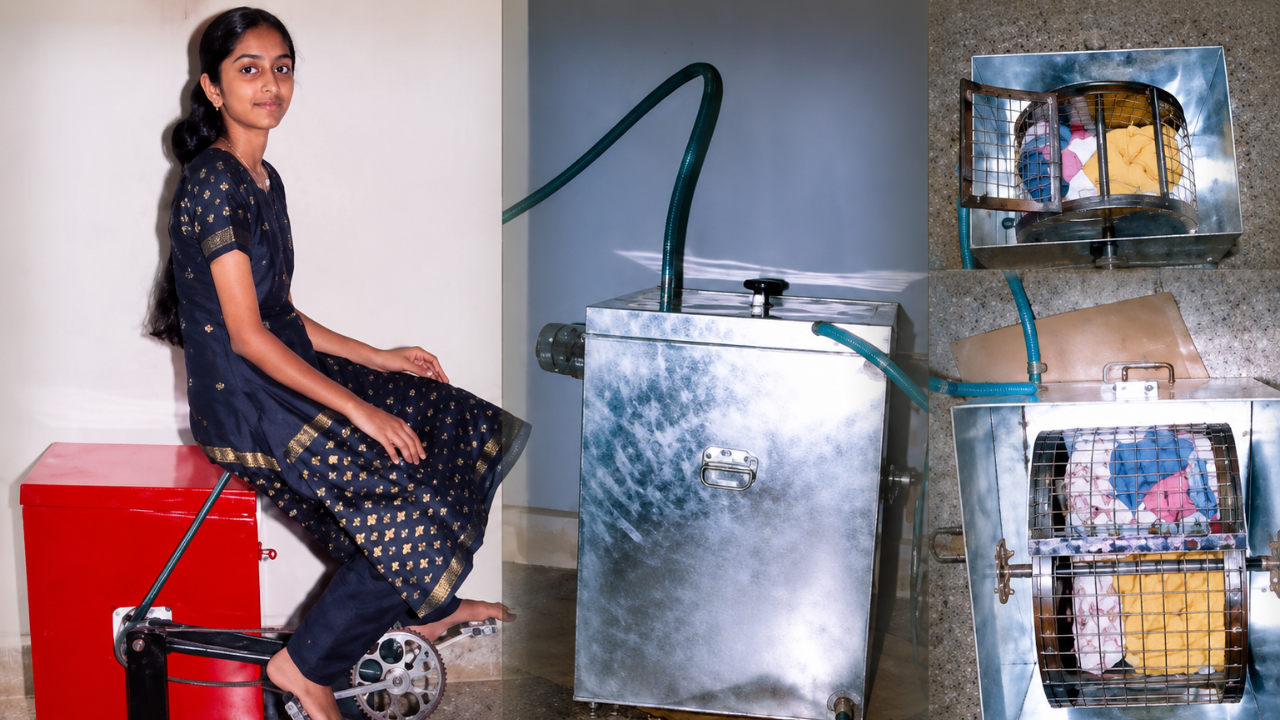
By substituting the motor with a bicycle drivetrain, the design leverages human lower-limb biomechanics. The larger front chainring connected to hand pedals or foot cranks turns a smaller rear sprocket via a roller chain, achieving a gear ratio that multiplies rotational speed. This mechanical advantage allows the inner cylinder to spin fast enough to agitate textiles and, upon draining, generate the centrifugal force necessary for partial water extraction.
The Cost Function and Supply Chain Constraints
Capital expenditure dictates the scalability of any rural intervention. Commercial appliances present high upfront costs compounded by recurring maintenance overhead and dependency on continuous electricity tariffs.
The pedal-powered washing machine bypassed these market barriers through local supply chain integration:
- Material Inputs: Utilized standard aluminum sheeting for the outer housing and wire mesh for the internal rotating cylinder.
- Power Transmission: Sourced recycled bicycle components including chains, sprockets, and shafts, minimizing custom fabrication costs.
- Manufacturing Labor: Avoided industrial assembly plants by contracting local automobile mechanics to weld and assemble the chassis based on hand-drawn specifications.
The resulting capital expenditure remained anchored at approximately two thousand rupees. This low cost point eliminated financial risk and ensured that the asset could be repaired using ubiquitous automotive tools rather than proprietary manufacturer parts.
Operational Workflow and Energy Efficiency
The thermodynamic and kinetic efficiency of the device depends on a strict procedural workflow divided into three distinct phases.
The first phase is chemical soaking. Textiles are placed inside the wire-mesh drum alongside water and detergent, remaining static for roughly ten minutes to allow surfactant molecules to break down organic bonds on fiber surfaces.
The second phase is mechanical scrubbing. The user pedals for three to four minutes. This action rotates the perforated drum through the soapy solution, forcing fluid through the fabric matrix to dislodge suspended particulate matter via shear stress.
The third phase is extraction. After opening a manual drain valve to evacuate the graywater, the user resumes pedaling with the chamber empty. The high angular velocity creates a centrifugal field that drives residual moisture out through the mesh cylinder, achieving an estimated eighty percent dryness metric.
This sequential design solves a dual optimization problem. It replaces grid electricity with human kinetic output while simultaneously converting a sedentary domestic chore into physical exercise.
Systemic Limitations and Scalability Boundaries
Every frugal engineering model contains operational boundaries that prevent universal deployment. The pedal-powered architecture introduces explicit user-effort dependencies. Unlike automated systems where labor input is fixed to a power switch, off-grid mechanical systems tie throughput directly to human stamina.
For households with high daily laundry volumes, the physical exertion required to drive the mechanical resistance over multiple cycles creates a human fatigue bottleneck. Furthermore, the absence of thermal heating elements means the system relies entirely on pre-heated water input or ambient fluid temperatures, limiting grease and oil removal efficiency compared to industrial hot-water cycles.
Standardization also presents a structural hurdle. Because units are built bespoke in local workshops using recycled or generic components, quality control varies between builds, precluding mass manufacturing without industrial tooling redesigns.
To scale similar grassroots innovations across rural economies lacking reliable power infrastructure, manufacturing protocols must transition from localized fabrication to modular kit assemblies. Standardizing the frame geometry and utilizing universal drive linkages will allow regional technicians to assemble high-efficiency mechanical utilities without requiring custom structural engineering for each unit produced.