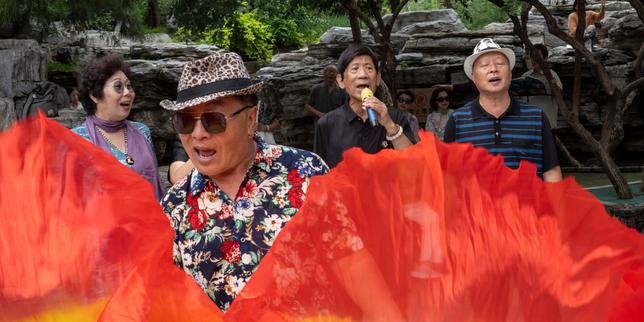
In the public green spaces of Beijing, pockets of retirees assemble daily to perform revolutionary anthems from the mid-twentieth century. These vocal gatherings are frequently misread by external observers as spontaneous outbursts of political nostalgia or indicators of deep-seated ideological compliance. This interpretation commits a fundamental category error. Human behavior under authoritarian political structures does not operate on simple binaries of endorsement or dissent. Instead, these park assemblies represent a finely tuned psychological optimization strategy—a mechanism for identity preservation, social cohesion, and trauma compartmentalization among a cohort that experienced the structural upheavals of the Cultural Revolution and the Great Leap Forward.
Deconstructing this phenomenon requires examining the intersection of gerontology, behavioral psychology, and state-society relations in contemporary China. The persistence of red songs is governed by three distinct structural variables: institutional security, collective memory compartmentalization, and the economics of urban public space. Building on this topic, you can also read: Why Blaming Demographics For Saxony Anhalt is Intellectual Laziness.
The Institutional Security Function of Public Performance
For citizens who entered their formative years during the Maoist era, ideological expressions function as a form of social armor. Modern urban centers in China have experienced rapid, hyper-capitalist development, creating an environment of intense socioeconomic anxiety. Retirees face fixed pensions, shifting family structures due to demographic compression, and the erosion of traditional community safety nets.
Within this context, vocalizing revolutionary chants in public spaces acts as a public signaling mechanism. It aligns the individual with the foundational mythology of the ruling party, thereby securing implicit social license. By engaging in state-sanctioned historical expression, participants neutralize potential political friction. This behavior is not evidence of active policy endorsement by the state apparatus; rather, it is a risk-mitigation strategy deployed by aging citizens to claim physical space and communal legitimacy without triggering administrative interference. Observers at The New York Times have also weighed in on this situation.
The Mechanics of Selective Collective Memory
Human memory under conditions of historical trauma relies heavily on sanitization and compartmentalization. The generation currently gathering in Beijing's parks survived severe socio-political turbulence, including mass mobilization campaigns, food insecurity, and localized violence. Yet, the oral and performative culture they maintain edits out these systemic failures.
This cognitive filtering operates through several distinct channels:
- Temporal Displacement: The songs transport participants back to their youth, divorcing the melodies from the catastrophic policy outcomes that accompanied them.
- Peer Validation: Gathering in a chorus creates an echo chamber of shared lived experience, transforming individual suffering into collective endurance.
- Generational Silence: Many participants deliberately withhold historical trauma from their descendants to shield younger family members from psychological burdens, leaving public performance as the sole outlet for their formative memories.
The songs are stripped of their historical terror and repurposed as artifacts of youth. The performance serves an emotional maintenance function, allowing aging cohorts to dignify their survival without confronting the structural violence that characterized the period.
The Urban Micro-Economics of the Beijing Park
Public parks in Chinese megacities function as vital social infrastructure. As family units nuclearize and retirement ages lock citizens out of traditional labor markets, public squares fill a critical institutional void.
Urban planners design these green spaces to accommodate massive population densities, but retirees have effectively retrofitted them into informal social cooperatives. Choirs, dance troupes, and instrumental groups require organization, scheduling, and territorial negotiation. The revolutionary repertoire provides a ready-made institutional framework for these activities. Selecting red songs provides a universally recognizable template that lowers transaction costs for group formation. No complex social negotiation is required to justify the gathering; the shared cultural baseline of the repertoire immediately legitimizes the assembly to park administrators and onlookers alike.
The Intergenerational Transmission Breakdown
A critical miscalculation in external analysis involves the assumption that this ideological behavior transfers horizontally to younger demographics. Field observation reveals the opposite. The grandchildren of these retirees operate within a completely different economic and digital reality, characterized by global market integration, consumer nationalism, and hyper-digitized social structures.
The younger demographic views the park choirs through a lens of detached curiosity or indifference. The ideological transmission vector is broken. While the state maintains macro-level control over historical narratives in educational curricula, the micro-level transmission of revolutionary sentiment via familial channels has ceased. The retirees sing to each other, for each other, enclosing their history within an aging demographic bracket that will expire within a generation.
Strategic Deployment for Future Risk Assessment
Analyzing ideological persistence in contemporary autocracies requires separating surface-level cultural artifacts from underlying behavioral motivations. Observers must measure state-linked displays not by their nominal political content, but by their utility as social safety valves, coping mechanisms, and spatial negotiation tools for vulnerable populations.
When evaluating social stability in rapidly modernizing societies, analysts should monitor the institutional spaces carved out by marginalized demographics rather than the official rhetoric of the state. The longevity of a regime is less dependent on the active fervor of its oldest citizens than on how it manages the economic security of those same cohorts as public infrastructure costs rise. Ignore the lyrical content of the park performances; focus instead on the structural deficits in elderly care and social support that make such public coping mechanisms necessary.