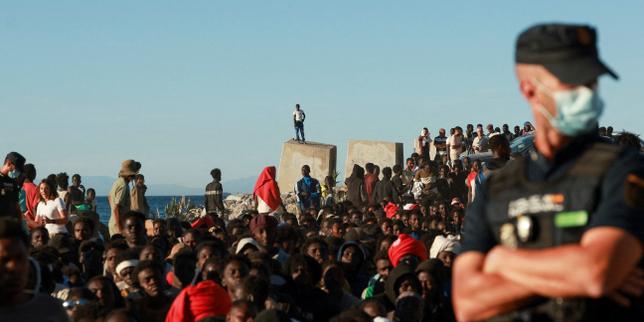
Unverified information moves faster than state verification mechanisms during geopolitical flashpoints, transforming localized anxiety into mass mobilization before institutional actors can establish a baseline of truth. When the rumor of a border opening materializes across digital channels, it triggers a predictable cascade of collective behavior that exposes structural vulnerabilities in cross-border communication.
Analyzing the mechanics of the Ceuta border rumors reveals a recurring failure mode in information governance. Rather than viewing these events as isolated episodes of panic, they operate as systemic responses to systemic opacity. This text deconstructs the operational architecture of digital rumors during border crises, mapping the precise variables that convert unverified claims into physical movement, and outlining the structural levers required to counter informational friction.
The Tripartite Engine of Rumor Propagation
The rapid escalation of migration rumors relies on three distinct structural pillars that amplify signal velocity while degrading signal verification. Understanding these mechanics requires examining how digital distribution networks interact with high-stakes environments.
Asymmetry of Verification Speed
Official channels operate on bureaucratic verification cycles. Information must be vetted, translated, legally reviewed, and formally published through institutional hierarchies. Conversely, informal digital networks operate on engagement-driven distribution algorithms.
An unverified claim regarding a border opening bypasses structural friction entirely. The marginal cost of publishing a digital rumor approaches zero, while the cost of verifying that rumor for an isolated observer is functionally infinite. This asymmetry ensures that the rumor occupies the informational vacuum long before any authoritative rebuttal can be formulated.
Psychological Amplification Loops
High-uncertainty environments alter risk assessment frameworks. Populations residing in economically distressed peripheral zones operate under chronic baseline stress. When a claim aligns with a desired outcome—such as freedom of movement or economic opportunity—cognitive biases systematically discount contrary evidence.
Confirmation bias is further accelerated by peer-to-peer validation loops within encrypted messaging applications. Once an individual observes trusted peers discussing an unverified event as an emergent reality, the perceived social cost of skepticism outweighs the risk of acting on false intelligence.
Decentralized Channel Architecture
Modern information transmission no longer relies on centralized broadcasting nodes. The migration of discourse to decentralized messaging platforms creates dark social traffic that bypasses traditional regulatory oversight and fact-checking apparatuses.
Because these networks lack public indexing, institutional actors cannot easily inject corrective data into the primary stream of transmission. The message spreads laterally through closed nodes, acquiring a spurious aura of insider knowledge simply because it arrived via private transmission rather than public broadcast.
The Cost Function of Institutional Silence
When authorities encounter a nascent rumor, standard operating procedure frequently defaults to silence or delayed denial, under the assumption that addressing a rumor grants it unwarranted legitimacy. Economic and operational analysis demonstrates that this strategy produces a catastrophic failure of resource allocation.
$$\text{Total Cost} = \text{Cost of Verification} + (\text{Velocity of Rumor} \times \text{Delay in Response})$$
As institutional delay approaches infinity, the total cost of managing the resulting physical crowd surge escalates exponentially. Silence does not suppress the signal; it cedes absolute monopoly over the narrative to malicious actors or unverified amplifiers.
Furthermore, delayed rebuttals suffer from the elusive truth effect. By the time an official denial is broadcast, the target audience has already invested cognitive and physical capital into the premise. Corrective information is systematically rejected because accepting it requires cognitive dissonance—acknowledging that physical movement or resource expenditure was based on an error.
Systemic Vulnerabilities in Border Zone Infrastructure
Physical border infrastructure is fundamentally designed to manage regulated flow, not informational volatility. When digital panic strikes, the operational bottleneck shifts from physical security checkpoints to informational intake points.
The Feedback Loop of Security Deployment
The immediate reaction to a localized rumor is the reinforcement of security perimeters. However, visible tactical deployments—such as increased military or police presence—paradoxically function as confirmation signals for the population on the move.
To the observer, heavy security does not signal deterrence; it signals that an event of extraordinary magnitude is indeed occurring. The deployment of state assets validates the rumor in the minds of participants, converting a localized digital whisper into a self-fulfilling prophecy of confrontation.
The Absence of Real-Time Frictionless Disproof
Institutional communication strategies rely on static press releases rather than dynamic, channel-specific countermeasures. To effectively neutralize a fast-moving rumor, an opposing signal must possess three operational characteristics:
- Immediacy: Deployment within the initial propagation window before network saturation occurs.
- Localization: Transmission through the exact peer-to-peer vectors where the rumor originated, rather than generalized broadcast media.
- Friction Reduction: Providing an alternative, verifiable action that satisfies the underlying motivation of the audience without requiring physical convergence on the border.
Strategic Interventions for Information Security
Mitigating the economic and human toll of border rumors requires treating information integrity as a core component of border management strategy. Operational resilience depends on shifting from reactive denial to proactive architectural design.
Establish a dedicated rapid-response verification unit tasked exclusively with monitoring dark social channels and encrypted traffic patterns for early indicators of synthetic panic. This unit must possess pre-authorized clearance to issue localized, contextualized clarifications within minutes of signal detection, bypassing traditional bureaucratic sign-off chains.
Redesign public communication interfaces to ensure that official state positions are discoverable and digestible directly within mobile messaging ecosystems. If the state relies on institutional websites while the populace relies on decentralized chat applications, the communication strategy has failed structurally before deployment.
Implement predictive modeling that treats rumor propagation as an epidemiological event. By mapping historical variables—such as regional economic pressure indexes, social media velocity markers, and historical flashpoint dates—security planners can anticipate informational outbreaks and saturate vulnerable digital nodes with stabilizing context before physical movement initiates.
Deploy dynamic friction at physical bottlenecks by establishing transparent, real-time data feeds visible directly to peripheral populations. When individuals possess continuous, undeniable visibility into actual border operational status through decentralized digital dashboards, the informational asymmetry that powers rumors collapses.
Operational Forecast
As algorithmic distribution mechanisms grow increasingly sophisticated and decentralized communication tools encrypt user data more effectively, the incidence of synthetic border panic will accelerate. Traditional physical fortification without a corresponding modernization of information governance will result in repeated operational paralysis. Future stability belongs exclusively to actors who treat digital rumor mitigation as an integrated logistical priority, recognizing that controlling the narrative velocity at the periphery is functionally identical to controlling the physical perimeter.


