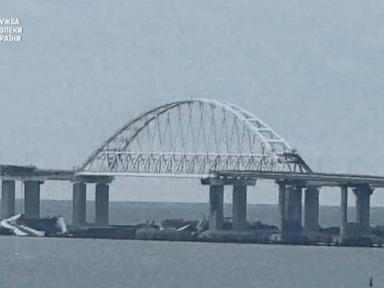
Repeated strikes against the Crimean Bridge within a single seven-day window signal a shift from sporadic symbolic disruption to systematic logistic degradation. Standard news coverage treats each incident as an isolated tactical event—counting explosions, quoting official denials or claims, and cataloging immediate traffic closures. That framing misses the operational objective. When a critical dual-use artery sustains three distinct kinetic or asymmetric pressures in one week, the goal is rarely immediate structural collapse. The true objective is a permanent increase in the cost function of sustainment, forcing the defending force to divert air defense assets, slow throughput velocity, and absorb compounding maintenance deficits across an entire theater of operations.
To evaluate the strategic reality of multi-strike campaigns on the Kerch Strait crossing, analysts must separate physical damage from systemic friction. A bridge does not need to fall into the sea to fail its primary logistical mission.
The Structural Vulnerability of Dual-Use Chokepoints
The Crimean Bridge—comprising parallel road and rail spans stretching roughly 19 kilometers across the Kerch Strait—functions as a classic single-point-of-failure chokepoint. In network theory and military logistics, a chokepoint's vulnerability is determined not merely by its physical hardening, but by the elasticity of its alternatives.
When evaluating the impact of repeated weekly attacks, three structural realities govern the outcome:
- Asymmetric Load-Bearing Profiles: Vehicular spans and railway spans exhibit vastly different tolerances to blast overpressure and thermal stress. Roadway decks made of reinforced concrete and asphalt can often be patched or bridged with temporary modular decking within days or weeks. Railway infrastructure, particularly steel box-girder spans carrying heavy rolling stock, cannot tolerate subtle warping. Even minor thermal deformation from burning fuel cars alters track geometry, rendering the line unsafe for heavy military freight until entire spans are fabricated, transported, and craned into position.
- The Redundancy Deficit: Alternative supply routes to the Crimean peninsula rely on either maritime ferry crossings or the overland coastal corridor running through occupied southern Ukraine. Ferries are slow, vulnerable to sea state conditions, and easily targeted while loading or unloading at fixed port terminals. The overland rail and road network sits well within range of precision-guided munitions and requires continuous security patrols across hundreds of kilometers. Neither alternative matches the high-volume, continuous throughput of an unimpeded Kerch rail link.
- Cumulative Fatigue vs. Single-Event Rupture: Civil engineering structures are designed for static and dynamic traffic loads, not repeated shockwaves. When an infrastructure node is struck three times in seven days, uninspected micro-fractures in support pilings, expansion joints, and tension cables accumulate. Even if official statements declare the bridge open to light passenger traffic hours after an incident, the safe load ceiling for heavy armored transport or multi-car ammunition trains drops precipitously.
Deconstructing the Three-Strike Operational Tempo
A single strike tests defenses and generates headlines. Three strikes within a week execute a deliberate operational cadence designed to overwhelm repair cycles and expose defensive blind spots. Without inventing unverified specifics about the exact munitions or classified damage assessments from the latest incidents, the tactical mechanics of a compressed, multi-strike campaign follow a clear sequence of attrition.
Phase One: Reconnaissance by Fire and Defensive Saturation
The initial strike in a compressed sequence forces the defender to activate every layer of local protection—electronic warfare (EW) emitters, surface-to-air missile (SAM) batteries, naval patrol craft, and passive smoke generators. By triggering this defensive posture, the attacker maps radar frequencies, response latencies, and interceptor trajectories. Defenders often expend high-cost interceptors against low-cost decoys or uncrewed systems, creating an immediate economic asymmetry before any structural damage occurs.
Phase Two: Disrupting Assessment and Repair Windows
When a second strike occurs within 48 to 72 hours of the first, it directly targets the post-strike recovery cycle. Structural engineers, specialized heavy cranes, and railway repair crews cannot operate under active threat envelopes. The second event forces a complete evacuation of inspection teams, halting damage assessments and extending the downtime of the span even if the physical impact is minor. Uncertainty becomes a force multiplier; commanders cannot clear heavy freight across a span whose structural integrity remains unverified.
Phase Three: Exploiting Defensive Reallocation
By the third attack within the same week, the defending force faces an acute resource allocation dilemma. Protecting a 19-kilometer maritime structure against multi-domain threats—airborne drones, cruise missiles, uncrewed surface vessels (USVs), and submersible craft—requires overlapping sensor coverage and physical barriers.
- Air Defense Cannibalization: Pulling short- and medium-range air defense systems from front-line combat zones to thicken the umbrella over the Kerch Strait leaves forward troop concentrations and ammunition depots exposed.
- Maritime Barrier Maintenance: Deploying submerged booms, sunken barges, and patrol boats to block surface and subsurface drones creates severe navigation bottlenecks for civilian and military shipping transiting between the Black Sea and the Sea of Azov.
- Electronic Warfare Self-Interference: Operating high-powered GPS jamming and spoofing arrays around the bridge degrades the defender's own communications, maritime navigation, and radar discrimination, increasing the risk of friendly-fire incidents or commercial vessel collisions.
Fact Versus Hypothesis in Official Reporting
Media narratives surrounding attacks on the Crimean Bridge suffer from severe information asymmetry. Both belligerents have compelling incentives to manipulate public perception immediately following an incident. Rigorous analysis requires separating observable physical realities from unverified claims.
Confirmed Operational Patterns:
- Traffic closures on both the road and rail spans occur routinely during air raid alerts and immediately following reported explosions, regardless of whether structural hits are confirmed.
- Smoke screens generated by specialized military units are deployed along the spans to obscure visual and electro-optical targeting sensors, which frequently leads local observers to report massive fires even when no kinetic impact has occurred.
- Heavy military logistics have increasingly shifted away from reliance on the rail bridge following previous major structural damage, utilizing it selectively rather than as an uninterrupted artery.
Analytical Hypotheses Requiring Caution:
- Complete Structural Invalidation: Claims that a specific weekly strike has permanently severed Russian logistics in southern Ukraine are almost certainly overstated. Military supply chains adapt by decentralizing depots, moving cargo at night in smaller convoys, and utilizing secondary rail spurs.
- Total Air Defense Failure: Conversely, official statements claiming that 100 percent of incoming threats were intercepted while debris caused minor damage should be treated skeptically. Falling debris from an intercepted heavy warhead or booster stage can still sever power lines, crater asphalt, or ignite fuel tanks, achieving a functional mission kill without a direct hit.
- Weapon System Attribution: Unless verified by wreckage analysis or unambiguous satellite imagery, immediate attribution of a strike to a specific missile type, naval drone variant, or sabotage team remains speculative. Multi-vector attacks deliberately blend different delivery systems to confuse attribution and complicate defensive countermeasures.
The Economics of Infrastructure Attrition
Evaluating the success of a three-strike week requires applying fundamental principles of attrition economics rather than counting collapsed spans. In modern positional warfare, victory rarely hinges on a single knockout blow; it depends on driving the adversary's marginal cost of operations beyond sustainable limits.
Consider the Asymmetric Exchange Ratio inherent in infrastructure defense:
- Capital Expenditure vs. Munition Cost: A long-range uncrewed aerial vehicle or naval drone costs a fraction of a modern surface-to-air interceptor missile, and an infinitesimal fraction of a multi-billion-dollar mega-bridge. When an attacker forces the defender to fire multiple interceptors per incoming threat three times in seven days, the financial burn rate favors the offense even if every single munition is destroyed mid-air.
- The Throughput Tax: Every hour the bridge is closed creates a cascading backlog of commercial and military transport. Trucks idling in staging areas on the Taman Peninsula consume fuel, tie up drivers, and present clustered targets. Rail cars halted at marshaling yards delay deliveries of artillery shells, spare parts, and fuel to forward units hundreds of kilometers away. This time-tax degrades combat readiness at the front without destroying a single tank at the bridge.
- Insurance and Commercial Paralysis: Repeated strikes destroy confidence in the safety of the surrounding maritime zone. Commercial shipping rates spike, maritime insurers withdraw coverage, and civilian supply chains feeding the peninsula's population require state subsidies and military escorts, further straining the state's administrative and fiscal bandwidth.
Limitations of Chokepoint Interdiction
Strategic realism demands acknowledging the boundaries of what infrastructure attrition can achieve. Focusing exclusively on the Crimean Bridge risks falling into the single-node fallacy—the belief that severing one prominent symbol will automatically collapse an entire military theater.
First, adaptive logistics degrade strike efficacy over time. Once a supply route is recognized as chronically contested, quartermasters stop routing critical single-point shipments across it. By the time a third attack occurs in a single week, the highest-value military cargo may already be moving via alternative land routes or dispersed maritime barges. The bridge retains immense political and symbolic weight, yet its marginal utility as a military bottleneck decreases as the defender builds workarounds.
Second, concrete and steel are remarkably resilient to sub-kiloton conventional warheads. Destroying reinforced bridge piers anchored deep into seabed bedrock requires massive explosive payloads delivered with pinpoint accuracy directly against load-bearing columns—a difficult feat for long-range drones carrying limited warheads. Surface strikes on the roadway deck create dramatic visual footage and temporary closures, yet they rarely threaten the foundational geometry of the crossing.
Third, escalation dynamics impose political constraints. Attacks on high-profile infrastructure frequently trigger retaliatory strikes against the attacker's own energy grid, port facilities, or urban centers. Planners must continuously weigh the logistical friction imposed at the Kerch Strait against the defensive burden of protecting their own critical national infrastructure from retaliatory barrages.
Strategic Execution for Sustained Degradation
For planners seeking to maximize the operational return on infrastructure interdiction—and for analysts forecasting the trajectory of the conflict—the lesson of three strikes in a week is clear: persistence beats magnitude. Sporadic, high-profile spectacular attacks allow the defender to absorb the shock, repair the damage, and restore normal throughput rhythms.
To convert tactical harassment into strategic paralysis, interdiction campaigns must abandon isolated strikes in favor of continuous, multi-domain pressure synchronized with ground operations:
- Synchronize Strikes with Front-Line Offensive Tempo: Infrastructure bottlenecks only create acute crises when the defender's consumption rate spikes. Attacking the Kerch Strait during quiet periods allows the defender to draw down local stockpiles while making repairs. Striking the bridge three times in a week simultaneously with high-intensity ground assaults forces forward units to burn through ammunition and fuel precisely when replenishment pipelines are throttled.
- Target the Repair and Transit Ecosystem, Not Just the Span: Shifting targeting priority from the hardened bridge deck to vulnerable adjacent nodes—electrical substations feeding the rail line, marshaling yards on the Taman approach, specialized railway cranes, and ferry loading ramps—achieves longer-lasting throughput reductions at lower munition cost.
- Maintain Unpredictable Multi-Domain Pressure: Alternating between airborne drones, low-altitude cruise missiles, and uncrewed surface vessels prevents the defender from optimizing their defensive posture. If the defender reinforces aerial radar coverage, shifting pressure to subsurface or surface maritime vectors forces another costly reallocation of assets.
The Crimean Bridge will remain standing unless subjected to a massive, sustained campaign of heavy precision munitions or catastrophic sabotage. Yet its physical survival is irrelevant to its strategic failure. By maintaining a compressed, multi-strike operational tempo that keeps repair crews off the spans, drains air defense stockpiles, and throttles heavy rail capacity, an attacker transforms a premier engineering monument into a permanent logistical liability.