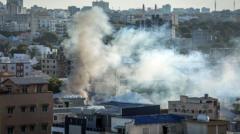
The outbreak of kinetic conflict in Mogadishu is not an isolated security failure; it is the mathematical consequence of an expired constitutional mandate meeting an uncollateralized political marketplace. When federal security forces engaged in sustained fire exchanges with opposition elements near the presidential palace and the Aden Adde International Airport perimeter, the physical violence merely manifested an underlying structural deficit. The escalation establishes a dangerous precedent where armed force becomes the default clearing mechanism for elite political disputes when institutional transition timelines fail.
To analyze this crisis beyond the superficial narrative of localized unrest requires evaluating the complex interaction between constitutional expiration, the fragmentation of the state's security monopoly, and the economic incentives that perpetuate institutional gridlock.
The Tripartite Structural Deficit
The current destabilization rests upon three structural flaws within the contemporary Somali state architecture. Each flaw functions as an independent variable that, when combined, systematically lowers the opportunity cost of political violence for both incumbent and opposition factions.
       [ Institutional Vacuum ]
       (Expired Federal Mandate)
                  │
                  ▼
    [ Fragmented Security Apparatus ] ──► [ Kinetic Flashpoints ]
      (Divided Clan / Unit Loyalties)       (Mogadishu Confrontations)
                  ▲
                  │
        [ Economic Asymmetry ]
      (Rent-Seeking vs. Revenue Deficit)
1. The Institutional Vacuum of Expired Mandates
The primary systemic trigger is the expiration of the presidential mandate without an operational successor framework. In a highly financialized political economy, an expired mandate destroys the legitimacy of the central executive's contracting power. Without a legally recognized timeline for indirect or direct elections, the implicit contract between the Federal Government of Somalia (FGS) and Federal Member States (FMS) dissolves. The executive branch undergoes a transition from a recognized legal arbiter into a competing political faction, eliminating its ability to enforce federal compliance without deploying coercive force.
2. The Fragmented Security Apparatus
The second structural vulnerability is the multi-layered composition of the security architecture operating within the capital. The state does not possess a consolidated monopoly on the legitimate use of force. Instead, the security apparatus is partitioned into distinct functional units:
- Regular Somali National Army (SNA) units.
- Specialized, externally trained counter-terrorism formations (such as the Danab and Gorgor units).
- The National Intelligence and Security Agency (NISA).
- Paramilitary clan militias integrated superficially into federal structures but fundamentally loyal to local elders and regional powerbrokers.
When the constitutional consensus collapses, these security sub-units split along ancestral and political lines. The operational reality is that an order issued by the federal executive does not automatically command uniform compliance across all sectors of the capital, transforming municipal neighborhoods into militarized zones controlled by competing factions.
3. Economic Asymmetry and Rent-Seeking
The financial architecture of the Somali state relies heavily on external budgetary support, customs duties from strategic ports, and aviation fees collected via international transit corridors. This concentration of revenue creates an intense rent-seeking incentive concentrated geographically within Mogadishu.
Control over the physical infrastructure of the capital—specifically the port and the international airport—equates to direct control over the primary liquidity engines of the nation. The opposition perceives any unilateral extension of a federal mandate as an existential threat to their financial access, while the incumbent administration views the maintenance of geographic control as critical to preserving sovereign financing streams.
The Micro-Dynamics of Capital Escalation
The transition from political stalemate to kinetic engagement follows a predictable escalatory pathway when public space is weaponized. The introduction of large-scale public demonstrations by opposition coalitions acts as an economic and security shock to the capital's equilibrium.
[Opposition Mobilization]
    │
    ▼
[State Threat Perception] ──► [Deploy Heavy Armor & Lockdowns]
    │
    ▼
[Disruption of Transit/Commerce] ──► [Airport Interdiction / Mortar Fire]
    │
    ▼
[Tactical Fracture of Security Forces]
The administration's response to opposition mobilization typically involves imposing structural lockdowns, employing armored personnel carriers to seal primary transport arteries, and restricting freedom of assembly under the justification of public safety or health emergencies. This defensive posture yields significant unintended consequences.
By closing major thoroughfares, the state disrupts the informal economic networks that sustain the capital's population. This immediate economic cost escalates local grievances, transforming a political elite dispute into broader civilian unrest.
The deployment of heavy armor inside an urban center changes the tactical calculation for opposition security details. When elite politicians—including former presidents and prime ministers—are ringed by autonomous security guards within residential or commercial sectors, the physical proximity of heavily armed state units and equally potent opposition militias guarantees accidental or premeditated escalation.
The geographic positioning of these clashes near critical infrastructure, such as the international airport, exposes the extreme vulnerability of the state's economic base. Mortar rounds landing within the airport perimeter do more than threaten immediate personnel; they trigger automated international insurance escalations, divert commercial logistics flights, and halt the inflow of foreign currency and diplomatic personnel. This immediately reduces the state’s fiscal capacity to pay regular salaries to its security forces, accelerating the rate of internal defection.
Strategic Prescriptions for Institutional Stabilization
Resolving a structural crisis of this magnitude cannot be achieved through superficial ceasefires or temporary security protocols. It requires structural adjustment of the political-military framework through calculated interventions.
Security Sector Isolation
To minimize the risk of urban warfare, specialized counter-terrorism units and conventional military battalions must be systematically decoupled from domestic political policing. These forces should be legally and logistically restricted to forward operating bases targeting external insurgent threats, such as al-Shabaab. Municipal security in Mogadishu must be transitioned entirely to a depoliticized, multi-clan police force operating under joint federal-regional oversight committees. This reduces the ability of any single political actor to leverage elite military units for domestic consolidation.
Financial Escrow of Sovereign Revenues
To lower the high financial stakes of controlling the capital, international partners and domestic financial institutions should establish a co-managed, transparent escrow framework for port and aviation revenues during electoral impasses. By binding the disbursement of state funds to explicit, verifiable milestones in the electoral process, the financial incentive to indefinitely delay elections is eliminated. This shifts the economic calculus of the incumbent administration from preservation toward transition.
Legal Standardization of Transition Protocols
The fundamental flaw exposing the state to recurrent kinetic shocks is the absence of an automated, legally binding transition protocol when parliamentary or presidential terms expire. The provisional constitution must be amended to include an explicit "caretaker governance" clause. This framework must automatically decentralize executive authority to a neutral technocratic council thirty days prior to an election, neutralizing the power of the state apparatus to skew the political playing field in favor of the incumbent.
Without the systematic execution of these structural reforms, the state will remain caught in a destructive cycle where institutional timelines are continuously challenged by tactical violence, leaving the entire sovereign architecture vulnerable to collapse or exploitation by extremist insurgencies.