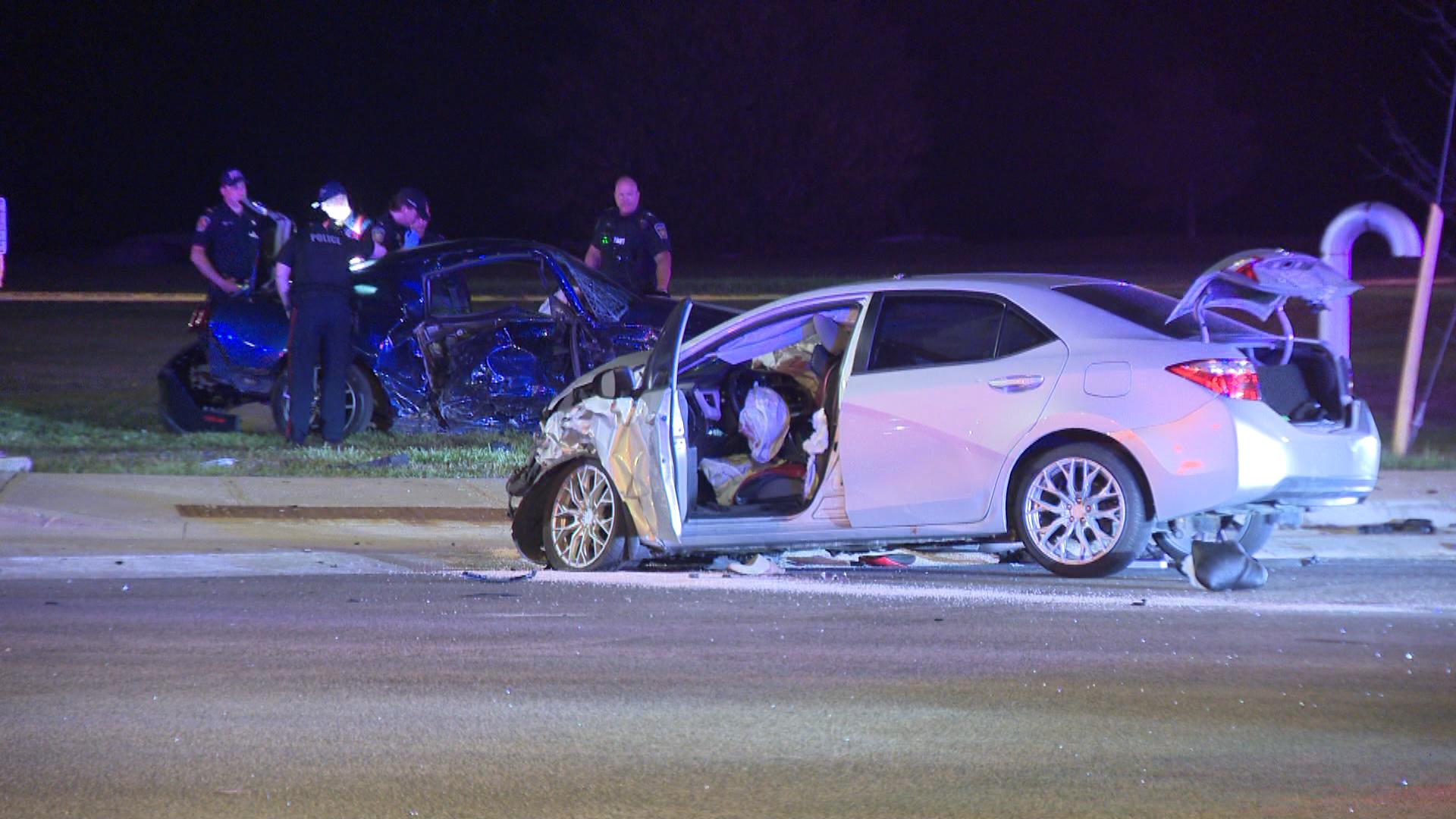
The modern suburban intersection is an optimization paradox, balancing high-velocity vehicle throughput against the absolute physical limitations of human reaction time and kinetic energy dissipation. When these systems fail, the outcome is rarely a linear sequence of events; it is a violent redistribution of momentum. This reality was demonstrated at 10:44 p.m. at the intersection of McVean Drive and Countryside Drive in Brampton, where a two-vehicle collision left one individual dead and five others hospitalized with varying degrees of trauma.
Initial diagnostic reports from Peel Regional Police indicate a foundational system failure: one vehicle, traveling southbound on McVean Drive, penetrated the intersection against a red signal, broadsiding an eastbound vehicle on Countryside Drive. The resulting impact killed a passenger in the first vehicle, inflicted life-threatening injuries on two occupants of the second vehicle, left a third with life-altering trauma, and injured two others.
To evaluate why these specific incidents yield such catastrophic failure rates, we must look beyond immediate operator error and analyze the underlying mechanics of T-bone collisions, the physics of secondary impacts, and the structural limits of regional traffic design.
The Kinematics of Perpetual Risk
The severity of an intersection collision is dictated by a multi-variable equation involving approach angle, vehicle mass, and velocity at impact. In a perpendicular or angled collision—commonly referred to as a side-impact or T-bone crash—the structural vulnerability of the target vehicle is disproportionately high. While modern automotive engineering allocates significant crumple zones to the front and rear facades of a chassis, the lateral profile offers minimal crumple depth. The distance between the exterior door panel and the occupant pelvis is measured in inches, leaving the vehicle occupants almost entirely reliant on side-curtain airbags and B-pillar reinforcement to absorb the kinetic energy.
The energy transferred during such an impact is calculated by the standard kinetic energy formula:
$$E_k = \frac{1}{2}mv^2$$
Because velocity is squared, an incremental increase in speed exponentially amplifies the destructive force delivered to the target vehicle. In suburban arterial corridors like McVean Drive, vehicles frequently operate at or above design speeds of 60 to 80 kilometers per hour. When a vehicle running a red light maintains or accelerates its speed to beat a changing signal, it introduces an unmitigated mass-energy payload into a perpendicular traffic stream that is executing its own green-light acceleration phase.
Primary vs. Secondary Impacts: The Lawn Vector
A critical differentiator between minor traffic accidents and fatal high-velocity collisions is the presence of secondary impacts. In the Brampton incident, the post-collision trajectory divided the two assets into distinct spatial zones:
- The Primary Collision Zone: One vehicle remained within the geometric boundaries of the intersection, having expended its kinetic energy entirely through the crushing of the vehicle frames and the immediate deceleration of mass.
- The Secondary Vector: The second vehicle veered completely off the roadway, crossing the curb line and terminating on the front lawn of a nearby residential property.
This secondary vector represents an uncontrolled deceleration phase. When a vehicle undergoes a primary impact, the internal occupants are subjected to intense lateral forces. If the vehicle maintains residual momentum and moves off the paved surface, the risk profile shifts to rollover hazards and collisions with fixed infrastructure such as utility poles, mature trees, or housing foundations. The fact that this vehicle traversed onto private property highlights the spatial inadequacy of standard suburban setbacks when mitigating high-velocity kinetic failures.
The Three Pillars of Intersection Failure
The structural frequency of major collisions within Peel Region—which logged three significant incidents within a single 24-hour window—points to systemic vulnerabilities. These vulnerabilities can be categorized into three distinct operational failures.
Sightline and Signal Perception Anomalies
At high speeds, human visual processing undergoes peripheral narrowing, a phenomenon known as tachistoscopy. If an operator is fatigued, distracted, or visually impaired by ambient lighting changes at late hours (such as 10:45 p.m.), the cognitive delay between identifying a red signal and deploying the braking system increases from an average of 1.5 seconds to over 2.5 seconds. At 70 kilometers per hour, a vehicle travels nearly 20 meters per second; a one-second cognitive delay translates to 20 meters of unbraked forward travel into an active conflict zone.
Structural Velocity Enablers
Suburban thoroughfares are frequently engineered using highway-grade lane widths (3.5 to 3.75 meters). While wide lanes are intended to provide a safety buffer, psychological data demonstrates they act as velocity enablers. Drivers naturally scale their speed to match the perceived safety of the visual environment. When arterial roads feature straight lines, wide surfaces, and deep setbacks, motorists routinely exceedposted speed limits. This behavior creates a baseline environment where any subsequent operational mistake escalates into a fatal event.
The Institutional Data Void
A consistent limitation in analyzing real-time suburban traffic safety is the reliance on lagging indicators. Police forces and municipal traffic departments operate primarily on reactive data—counting fatalities, serious injuries, and major property damage after they occur. Leading indicators, such as near-miss frequencies, erratic lane deployments, and sub-second red-light violations, are rarely captured systematically unless automated enforcement infrastructure is actively deployed.
Triage Metrics and Human Cost Functions
The downstream impact of an intersection failure introduces a severe burden on regional emergency response and trauma frameworks. Emergency medical services classify victim statuses using precise physiological parameters that dictate resource allocation.
- Pronounced Dead at Scene: Indicates trauma incompatible with life, requiring immediate forensic isolation and halting active medical intervention to preserve data for accident reconstruction teams.
- Life-Threatening Injuries: Identifies acute failures of the respiratory, circulatory, or neurological systems. These patients require immediate transit to specialized Level 1 trauma centers capable of advanced surgical interventions, bypassing closer community hospitals.
- Life-Altering Injuries: Refers to permanent physiological degradation, including traumatic brain injuries, spinal cord severances, or limb amputations. While stable from an immediate mortality standpoint, these injuries require multi-month clinical management and permanent economic reallocation.
- Non-Life-Threatening Injuries: Encompasses structural fractures, internal contusions, and lacerations that require clinical stabilization but do not present an immediate threat to systemic survival.
The logistical coordination required to manage five simultaneous trauma patients from a single localized coordinate grid requires the deployment of multiple paramedic units, extrication teams from fire services to cut through compromised vehicle pillars, and immediate road closures to protect the integrity of the scene for automated reconstruction scanning.
Infrastructure Re-Engineering Strategies
Relying on public appeals for driver awareness represents an outdated approach to traffic management. True system optimization requires engineering physical constraints that eliminate human error as a single point of failure.
The most effective mechanism for neutralizing high-velocity perpendicular impacts is the replacement of signalized intersections with modern roundabouts. By converting a 90-degree conflict point into a geometric deflection, roundabouts force incoming vehicles to decelerate to a controlled speed (typically 30 to 40 kilometers per hour). If a collision occurs within a roundabout, the impact geometry is restricted to a low-angle, same-direction sideswipe. This orientation completely eliminates the T-bone vectors that yield high mortality rates.
Where spatial constraints prevent roundabout conversion, automated enforcement must be integrated directly into the signal system. Red-light cameras and automated speed enforcement units alter driver psychology by creating a predictable financial penalty structure. However, the long-term solution rests on narrowing lanes, introducing physical traffic calming barriers, and deploying smart signals that automatically extend all-red phases when radar units detect an approaching vehicle traveling at an unbraked velocity that guarantees an intersection intrusion. Municipal planning departments must transition from high-throughput design models to kinetic energy management models if they intend to arrest the statistical climb of suburban road fatalities.