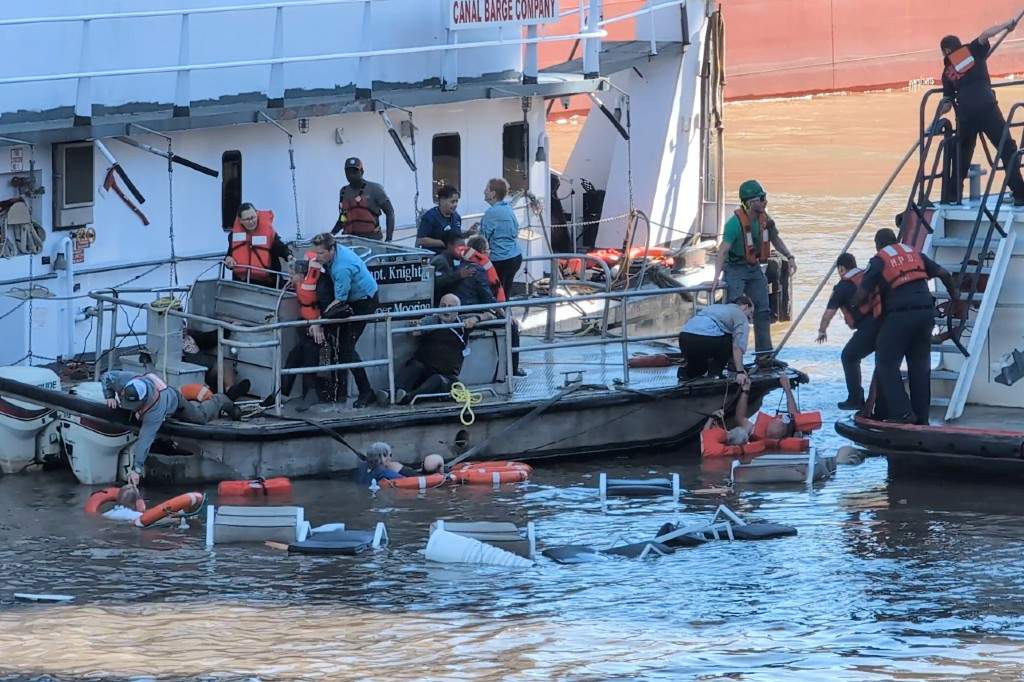
When an ocean-going tanker loses steering in the Lower Mississippi River and strikes a moored cruise ship, the event is rarely a singular mechanical fluke. It is the terminal node of a complex causal chain involving hydrodynamic forces, hydraulic redundancy failures, and compressed decision-making windows. Analyzing the New Orleans cruise ship collision requires stripping away sensationalist reporting to examine the underlying physics of restricted-channel navigation, the mechanics of electro-hydraulic steering gear, and the systemic vulnerabilities of high-density port infrastructure.
The Physics of Restricted-Channel Navigation
To understand why a steering failure in New Orleans rapidly escalates into a kinetic impact, one must first establish the environmental baseline of the Lower Mississippi River. Unlike open-ocean transit, where a vessel has miles of sea room to arrest momentum or execute wide turning circles, riverine pilotage operates within a narrow, shifting channel dictated by bathymetry and current velocity.
Hydrodynamic Constraints and Squat
A deep-draft tanker moving through the Mississippi is subject to severe hydrodynamic constraints. As the vessel's hull displaces water in a confined channel, the fluid velocity between the hull and the riverbed increases. According to Bernoulli’s principle, this spike in fluid velocity causes a corresponding drop in pressure, pulling the vessel deeper into the water—a phenomenon known as squat.
Squat reduces under-keel clearance, which directly degrades rudder effectiveness. A rudder generates lift by redirecting water flow; when the clearance beneath the keel narrows, the water flow around the rudder becomes turbulent and starved of volume. The vessel becomes sluggish, requiring larger rudder angles to achieve standard rates of turn.
Current Vectors and Stopping Distances
The Mississippi River introduces a compounding variable: a strong, unidirectional current that frequently exceeds three to five knots, depending on seasonal runoff.
- Downbound Transit: A tanker traveling with the current must maintain a speed through the water higher than the current speed just to retain steerageway—the minimum speed required for water flowing over the rudder to generate turning force. Consequently, the vessel's speed over ground (SOG) is the sum of its propulsion speed and the current velocity.
- Kinetic Energy Accumulation: Kinetic energy scales exponentially with velocity ($E_k = \frac{1}{2}mv^2$). A loaded chemical or product tanker displacing upwards of 40,000 to 80,000 deadweight tons (DWT) moving at a speed over ground of 12 to 15 knots carries immense momentum.
- The Stopping Deficit: Large commercial vessels lack friction brakes. Stopping requires reversing the main engine pitch or rotation—a process called a crash astern maneuver. Initiating a crash astern on a large diesel engine takes time to bleed off forward shaft RPMs before reverse thrust can be applied. Even at full astern, a laden tanker requires several ship lengths to come to a dead stop in slack water. With a following current in a river bend, the vessel will drift laterally and downstream long before forward momentum reaches zero.
Mechanics of Steering Gear Failure
Maritime regulations, specifically the International Convention for the Safety of Life at Sea (SOLAS), mandate strict redundancy for steering systems on ocean-going vessels. A complete loss of steering does not occur because a single wire snaps; it occurs when cascading failures overwhelm built-in backups or when a failure happens too close to a hazard for recovery protocols to take effect.
The Electro-Hydraulic Architecture
Modern tankers utilize electro-hydraulic steering gears, typically configured as either rotary vane or ram-type systems. The architecture relies on three distinct subsystems:
- The Telemotor (Control) System: Transmits the helm command from the bridge to the steering gear flat in the stern. This is almost exclusively electronic, using redundant cabling and follow-up/non-follow-up control loops.
- The Power Unit: Electric motors driving variable-delivery hydraulic pumps. SOLAS requires at least two identical power units, each capable of moving the rudder from 35 degrees on one side to 30 degrees on the other within 28 seconds.
- The Actuating Mechanism: Hydraulic cylinders (rams) or a rotary vane housing attached directly to the rudder stock, converting fluid pressure into mechanical torque.
Failure Modes and the Recovery Window
When officials report a "steering failure" prior to a collision, the root cause generally falls into one of three operational buckets:
- Loss of Control Signal: The bridge loses communication with the steering gear compartment due to a blown fuse, a degraded potentiometer, or a software fault in the autopilot/helm interface. The hydraulic pumps remain pressurized, and the rudder stays locked at its last commanded angle—often hard-over if the vessel was negotiating a river bend like Algiers Point in New Orleans.
- Hydraulic Pressure Loss: A blown seal, ruptured high-pressure hose, or catastrophic pump failure drains the hydraulic fluid reservoir. Without fluid pressure, the rudder is no longer held in place and is forced amidships—or slammed to one side—by the hydrodynamic force of the river water rushing past it.
- Electrical Blackout: A loss of main busbar power cuts electricity to the hydraulic pump motors. While emergency generators are legally required to restore power to the steering gear within 45 seconds, a vessel traveling at 12 knots covers roughly 900 feet during those 45 seconds. In the tight confines of the New Orleans harbor, 900 feet is the difference between a routine transit and a catastrophic impact.
To regain control during a bridge-level failure, the crew must transition to emergency local control. This requires an engineer to physically enter the steering gear compartment, isolate the faulty telemotor loop, and manually actuate the hydraulic solenoid valves while receiving helm orders via sound-powered telephone from the bridge. Even with a well-drilled crew, this transition requires two to four minutes—a timeline entirely incompatible with imminent collision avoidance in a narrow waterway.
The Structural Vulnerability of Moored Cruise Terminals
The secondary half of the New Orleans collision equation involves the target: a stationary cruise ship berthed at a riverfront terminal. Cruise terminals in urban ports like New Orleans (such as the Erato Street or Julia Street terminals) are positioned directly along the edge of the active shipping channel to maximize passenger convenience and logistics access.
The Kinetic Asymmetry of Impact
A moored vessel is a sitting target with zero ability to maneuver. Its mooring lines—typically high-modulus polyethylene (HMPE) or heavy polypropylene—are engineered to hold the ship against wind and current loads, not to absorb the kinetic energy of a multi-thousand-ton strike.
When a tanker's bow or quarter makes contact with a berthed cruise ship, the collision dynamics are governed by structural design differences:
- Tanker Bow Construction: Tankers feature heavily reinforced, raked bows with bulbous protrusions below the waterline designed to slice through water efficiently and withstand heavy sea slams. Internally, the forepeak is a dense grid of transverse frames, stringers, and collision bulkheads.
- Cruise Ship Superstructure: While a cruise ship's lower hull meets standard steel-plating criteria, its upper decks are lightweight, high-volume aluminum and thin-gauge steel structures optimized for passenger capacity and stability (keeping the center of gravity low).
If a tanker strikes a cruise ship at an oblique angle, the raked bow often overrides the lower hull plating and shears directly into the upper passenger decks or lifeboat davits. The damage appears visually dramatic because the tanker's rigid bow acts like a wedge against the cruise ship's lighter superstructure. Simultaneously, the impact energy snaps the cruise ship's mooring lines under extreme tension, creating a secondary lethal hazard on the pier from snapping ropes (snap-back zones) and risking the vessel drifting uncontrollably into adjacent bridges or piers.
Investigative Frameworks and Liability Attribution
Following an incident of this magnitude, the National Transportation Safety Board (NTSB) and the United States Coast Guard (USCG) initiate parallel investigations. Their objective is not merely to assign blame, but to reconstruct the exact timeline using objective data telemetry.
Data Extraction and Telemetry Reconstruction
Investigators rely on the Voyage Data Recorder (VDR)—the maritime equivalent of an aviation black box—installed on both vessels. The VDR captures:
- Bridge Audio: Microphones record verbal commands between the harbor pilot, the ship's master, and the helmsman. Investigators listen for the exact second the helmsman reports that the rudder is no longer answering the helm.
- Rudder Angle vs. Helm Order: The VDR logs both the commanded rudder angle (where the wheel was turned) and the actual rudder angle (measured by a feedback sensor on the rudder stock). A divergence between these two data streams proves a mechanical or hydraulic failure rather than human steering error.
- AIS and Radar Overlays: Automatic Identification System (AIS) pings and shore-based Vessel Traffic Service (VTS) radar plots establish the exact track, rate of turn, and speed over ground leading up to the impact.
The Pilot-Master Relationship
A critical nuance in U.S. port collisions is the legal and operational dynamic between the local harbor pilot and the vessel's captain. In the Lower Mississippi, compulsory pilotage laws require foreign-flagged tankers to take on a state-commissioned river pilot (such as a Crescent River Port Pilot) who possesses specialized knowledge of local currents, shoals, and traffic patterns.
However, the pilot acts strictly as an advisor with navigational control; the ship's master retains ultimate legal responsibility for the safety of the vessel and the integrity of its machinery. If the steering failure stemmed from deferred maintenance by the tanker's engineering crew—such as contaminated hydraulic oil, bypassed alarm sensors, or improperly bled hydraulic lines—liability rests squarely on the vessel's owner and operator, regardless of who was conning the ship at the moment of failure.
Systemic Risk Mitigation in High-Density Ports
Relying solely on vessel-level redundancy to prevent collisions in urban waterways is a flawed risk management strategy. Mechanical systems degrade, and human reaction times have hard biological limits. Ports that place high-occupancy passenger terminals adjacent to heavy industrial shipping lanes must implement structural and operational buffers to absorb single-point mechanical failures.
Mandatory Tug Escorts
The most effective kinetic mitigation tool is the tethered tug escort. Requiring laden tankers above a specific deadweight tonnage to utilize high-bollard-pull tractor tugs while transiting congested urban stretches (like the New Orleans riverfront) alters the physics of an emergency.
A tractor tug tethered to the tanker's stern acts as an auxiliary rudder and braking system. If the tanker's main steering fails, the tug can immediately apply indirect towing forces—using the hydrodynamic drag of its own hull in the river current—to steer the tanker away from the bank or arrest its forward motion within a fraction of the distance required by the tanker's own engines.
Channel Zoning and Traffic Separation
Port authorities must also evaluate the spatial separation between moored passenger vessels and active transit lanes. Where physical widening of the river is impossible, operational controls must tighten:
- Speed Restrictions: Enforcing strict speed-over-ground caps for downbound vessels passing active cruise terminals reduces kinetic energy exponentially, buying precious seconds for emergency anchors to be deployed or backup steering pumps to engage.
- One-Way Traffic Windows: Implementing strict traffic-management protocols via Coast Guard VTS to ensure tankers do not execute passing or overtaking maneuvers directly abeam of berthed cruise ships. If a steering failure occurs during a two-way passing maneuver, the tanker has zero lateral margin to recover before striking either the passing vessel or the moored terminal.
- Pre-Transit Redundancy Checks: Requiring vessels to verify that both hydraulic steering power units are running simultaneously—rather than keeping one on standby—prior to entering high-consequence zones. Running dual pumps doubles the fluid volume and hydraulic pressure response, cutting rudder actuation time in half and eliminating the startup lag if a single motor trips offline.
Strategic Imperative for Maritime Operators and Port Authorities
The New Orleans collision demonstrates that compliance with minimum international standards (SOLAS) is insufficient for high-density, high-consequence waterways. Maritime risk management must shift from reactive incident investigation to proactive kinetic containment.
Port authorities in major riverine hubs must immediately mandate dual-pump steering operation and tethered tractor tug escorts for all deep-draft tankers transiting within two miles of active passenger terminals. Concurrently, shipping operators must audit their Planned Maintenance Systems (PMS) to treat steering gear hydraulic fluid cleanliness and telemotor electrical contacts as critical safety barriers on par with main propulsion. Without physical escort buffers and enforced dual-system redundancy, a routine hydraulic fault will inevitably repeat itself as a multi-million-dollar structural collision.