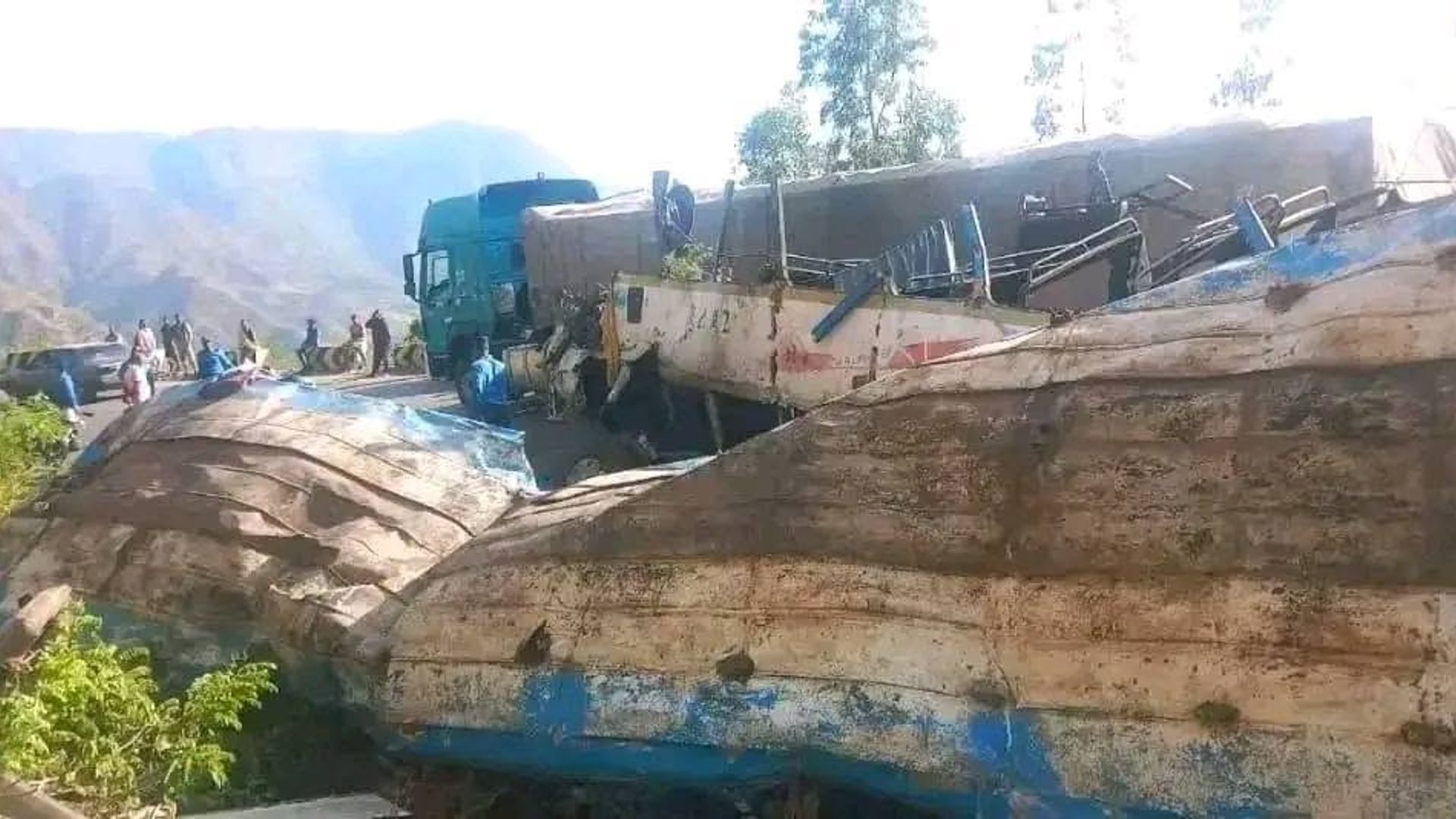
Developing economies face a systemic correlation between expanding transport networks and escalating mortality rates. When a public transit bus lost control in the early hours of Monday morning in the Amhara region of northern Ethiopia, plunged 100 meters down a ravine, and caused 31 confirmed fatalities alongside 33 injuries, it exposed a structural vulnerability common to high-altitude transit corridors. Media accounts treat these events as isolated tragedies, but engineering and logistics standards reveal them as predictable outcomes of an optimization failure across three distinct variables: rolling stock depreciation, geographical grade volatility, and institutional regulatory deficits.
Solving this public safety crisis requires moving past superficial explanations like "driver error" or "poor driving standards." Addressing transit risk requires an operational audit of the vehicle mechanics, infrastructure constraints, and economic incentives that turn a mechanical failure into a mass casualty event.
The Kinetic Mechanics of Mountain Corridors
The accident occurred on the transit corridor between Dessie City and the capital, Addis Ababa. This route traverses the Ethiopian Highlands, an environment featuring steep vertical drops, sharp curves, and sustained declines. Analyzing the event requires evaluating the kinetic energy transformation of a fully loaded public transport vehicle navigating these conditions.
The bus carried 64 individuals. Assuming an average occupant mass of 70 kilograms and a standard medium-duty bus curb weight of approximately 8,000 kilograms, the total operational mass was roughly 12,480 kilograms. When a vehicle of this mass descends a sustained mountain grade, the kinetic energy that must be managed by the braking system scales with the square of the velocity, expressed by the classic physics formula:
$$E_k = \frac{1}{2}mv^2$$
On steep declines, gravitational acceleration converts potential energy into additional kinetic energy. If the vehicle is traveling at a moderate speed of 60 kilometers per hour (approximately 16.7 meters per second), the baseline kinetic energy equals roughly 1.74 megajoules.
When a vehicle descends a mountain pass, this energy must be dissipated as heat through friction. In environments with long slopes and a lack of runaway truck ramps or engineered catchment basins, heavy vehicles face severe thermal stress on their mechanical systems.
The Three Pillars of Vehicle Braking Failure
To understand how a vehicle loses complete control on a mountain descent, we must look at the mechanical systems involved. Total control loss typically tracks back to one of three distinct failure modes within heavy vehicle braking systems.
Pneumatic Pressure Depletion: Most heavy passenger buses utilize air brake systems. These systems rely on an engine-driven compressor to maintain compressed air levels in storage reservoirs. If a vehicle experiences a major pneumatic leak, or if the driver pumps the brakes repeatedly without allowing the compressor to recover, the system pressure drops below the critical threshold required to actuate the brake shoes.
Mechanical Brake Fade: This occurs when sustained braking generates extreme friction, driving brake drum and shoe temperatures past their operational limits—often exceeding 300°C. At these temperatures, the coefficient of friction between the lining material and the brake drum drops sharply. The driver may depress the brake pedal completely, but the system cannot generate enough torque to slow the wheels.
Engine Braking Sub-Optimization: In high-altitude logistics, mechanical foundation brakes are meant to serve as secondary holding mechanisms rather than primary speed controllers. Heavy vehicles rely on compression release engine brakes or exhaust retarders to maintain a stable descent speed. If a vehicle suffers a transmission failure, gets stuck in a high gear, or has an inoperable exhaust brake, the entire energy dissipation burden shifts to the foundation brakes, rapidly triggering thermal failure.
The timing of this accident—in the early hours of Monday morning—introduces extra risk variables. Reduced visibility limits a driver's ability to anticipate sharp changes in road geometry, while lower ambient temperatures can hide early signs of brake overheating until the system fails completely.
The Structural Infrastructure Bottleneck
The severity of an accident is determined by both the initial loss of vehicle control and the surrounding environment. In this case, the vehicle plunged into a 100-meter-deep ravine. This extreme drop reveals a critical gap in regional infrastructure: the lack of passive safety systems designed to contain out-of-control vehicles.
Mountain highway design requires matching road protection to the kinetic profile of heavy traffic. Standard guardrails are built to redirect light passenger vehicles; they lack the structural integrity to stop a 12-metric-ton bus at speed.
Preventing a vehicle from leaving the roadway requires high-containment concrete barriers or deep steel-reinforced guardrails engineered to absorb and distribute heavy impacts. Without these barriers, steep mountain roads offer zero margin for error. A minor mechanical failure or steering overcorrection can quickly escalate into a catastrophic rollover.
Furthermore, economic factors in regional transport often lead to systemic overloading. Passenger buses frequently carry unweighed cargo on roof racks or in under-floor compartments, shifting the vehicle's center of gravity upward. A higher center of gravity increases the risk of rolling over when cornering tightly, making it even harder for a driver to recover control once a skid begins.
The Logistics Lifecycle Deficit
The underlying cause of mass transit failure often stems from the economics of fleet management. In developing transit networks, transportation companies face tight margins, high fuel costs, and limited access to genuine replacement parts. This financial pressure creates a breakdown in preventive maintenance.
The operational lifecycle of high-occupancy vehicles demands strict maintenance intervals. In under-regulated environments, fleet operators often run components past their safe limits.
[Operational Pressures]
       │
       ▼
[Deferred Fleet Maintenance]
       │
       ▼
[Component Failure: Air Leak / Brake Fade]
       │
       ▼
[High-Grade Mountain Descent]
       │
       ▼
[Catastrophic Run-Off-Road Event]
This dynamic creates a major policy challenge: traditional enforcement focuses on driver behavior at checkpoints rather than systemic mechanical auditing. Checking speed and licensing is necessary, but it does not catch a cracked brake drum or a fraying compressor belt.
Transitioning away from this reactive model requires implementing mandatory, data-verified vehicle inspections for all long-distance passenger carriers. Inspections must specifically target pneumatic pressure retention, brake lining thickness, and steering linkage integrity.
The Operational Path Forward
Mitigating mass casualty events on high-altitude transit corridors requires a coordinated approach across vehicle mechanics, infrastructure, and policy. Regional transport authorities can deploy several high-impact interventions to improve safety margins on vulnerable routes.
First, infrastructure planning must prioritize building emergency escape ramps on sustained downward grades. These gravel-filled ramps use rolling resistance to safely stop vehicles that lose braking power, preventing them from running off the road entirely.
Second, fleet regulations must mandate the installation and verification of auxiliary retarding systems, such as electromagnetic or hydraulic driveline retarders, for any bus operating in mountain corridors. These systems reduce the load on mechanical brakes, preventing overheating and fade during long descets.
Finally, long-distance routes should use telemetry-linked digital logbooks to monitor vehicle operation and driver rest periods. This approach targets fatigue directly, ensuring drivers remain alert during high-risk early morning windows.