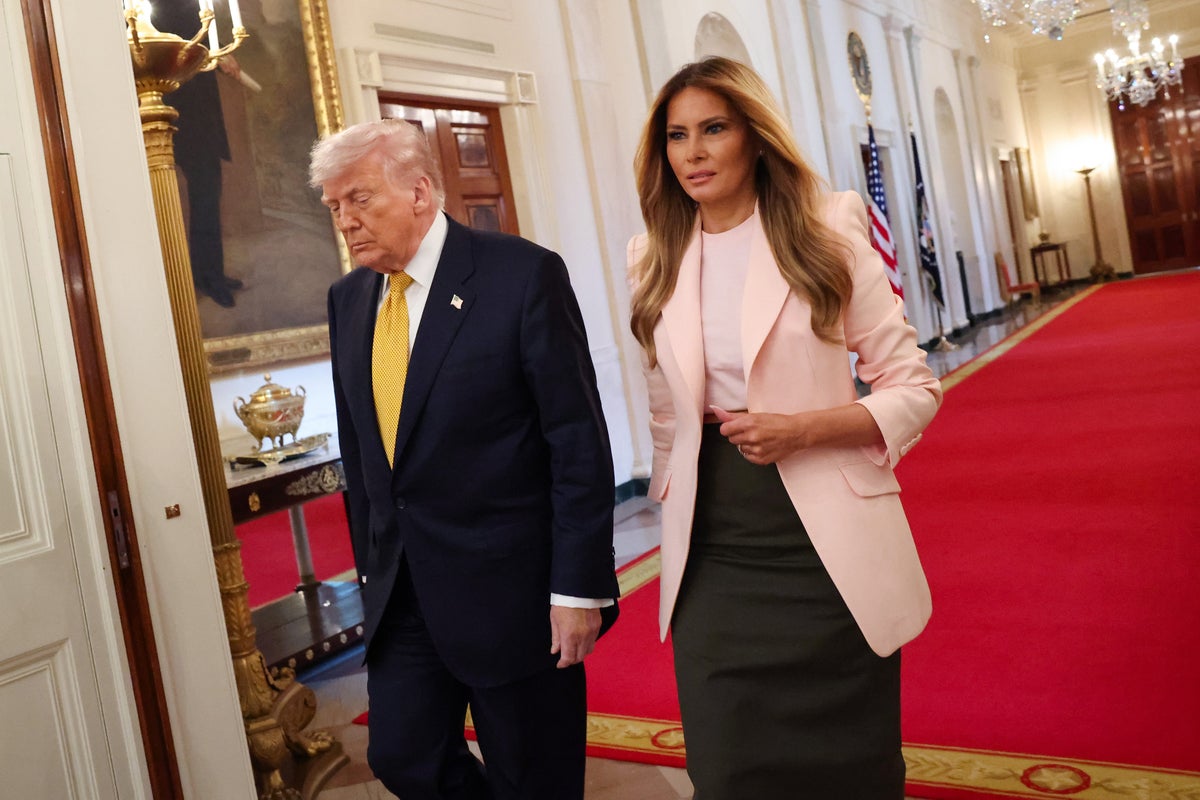
The surprise address delivered by First Lady Melania Trump from the White House Grand Foyer on April 9, 2026, represents a structural anomaly in modern political crisis management. Nominally executed to dismantle persistent rumors regarding her historic social orbit, the intervention systematically re-centered public attention on a liability that the executive branch had spent months attempting to submerge. In terms of pure communication strategy, breaking silence on a dormant or unverified vulnerability violates the fundamental rule of narrative containment. When an actor operating at the highest tier of state power voluntarily re-injects a highly toxic variable into the public cycle, the behavior cannot be understood as a mere emotional reaction. It must be analyzed as a calculated optimization problem under conditions of severe information asymmetry.
To deconstruct the strategic rationale behind this address, it is necessary to move past surface-level rhetoric and map the underlying mechanics of political risk management, information disclosure timelines, and institutional counterweights.
The Core Calculus of Unforced Disclosure
In standard public relations theory, an unforced disclosure occurs when an entity preemptively addresses a vulnerability before an external agent forces the issue. This strategy relies on a defensive optimization framework designed to minimize the impact of an inevitable disclosure.
The decision to execute an unforced disclosure depends on three distinct variables:
- The Probability of External Extraction ($P_e$): The statistical likelihood that investigative journalists, judicial discovery, or legislative bodies will uncover and publish damaging information.
- The Damage Coefficient of Controlled Revelation ($D_c$): The quantifiable political, reputational, or legal depreciation that occurs when the actor frames the narrative on their own terms.
- The Damage Coefficient of Uncontrolled Revelation ($D_u$): The exponential penalty incurred when an adversarial entity publishes the identical information under conditions optimized for maximum damage.
A rational political actor will choose to speak out only when the expected cost of remaining silent exceeds the definite cost of an immediate statement. This is expressed through a simple inequality:
$$P_e \cdot D_u > D_c$$
Applying this framework to the April 2026 address reveals a structural friction point. Reputable media outlets had not been running active or prominent investigations into the First Lady’s past social connections. The baseline public narrative was entirely dominated by the escalating war with Iran—a geopolitical event that effectively consumed the available bandwidth of major newsrooms.
This creates a distinct logical fork. The first explanation is that the internal calculation of $P_e$ suddenly spiked. The federal government had recently initiated a multi-phase document release under the Epstein Files Transparency Act. Although the Justice Department’s initial release the previous month was limited, the systematic review of millions of newly unsealed pages created an environment of rolling disclosure. The First Lady's intervention suggests that her legal and advisory teams identified an imminent narrative bottleneck—specifically, unreleased files or correspondence scheduled for imminent exposure that required immediate contextual framing.
The second explanation centers on a deliberate effort to alter the domestic political equilibrium. By reviving a highly polarizing controversy, the statement disrupted a unified media narrative, introducing a calculated internal distraction to split public focus away from the foreign policy theater.
The Asymmetry of the 2002 Correspondence Framework
A critical pillar of the address was the preemptive neutralization of specific documentary evidence, specifically a 2002 email exchange with Ghislaine Maxwell. The text of the communication, which surfaced via transparency act unsealings, featured an exchange ending with "Love, Melania" and contained polite inquiries regarding Palm Beach and a recent high-profile magazine feature.
The strategy deployed to manage this vulnerability relies on structural minimization, which works by stripping an artifact of its contextual significance.
[Documentary Evidence: 2002 Email]
       │
       ▼
[Strategic Framing Matrix]
       │
       ├─► Semantic Downgrading ──► "Trivial note" / "Casual correspondence"
       │
       └─► Contextual Dilution  ──► Overlapping NYC/Palm Beach social circles (Normalization)
The First Lady’s rhetorical defense systematically downgraded the interaction across two axes:
Semantic Downgrading
The communication was framed using terms like "casual correspondence" and a "trivial note." By explicitly defining the parameters of the text before the public could interpret it independently, the strategy attempted to establish a cognitive ceiling on how damaging the document could be. The objective was to transform a potential indicator of social proximity into an example of empty social etiquette.
Contextual Dilution
The address explicitly normalized the relationship by attributing it to the structural realities of high-net-worth social networks in New York City and Palm Beach during the late 1990s and early 2000s. The argument relies on a geographic and socioeconomic defense: when a specific demographic density exists within a closed geographic ecosystem, overlapping contact points occur by default, rather than by intent.
The structural limitation of this minimization strategy rests on the tension between public perception and legal reality. While casual social interactions do not equate to complicity or legal liability, the presence of warm sign-offs ("Love, Melania") and specific terms of endearment ("Sweet pea") from the counterparty creates a narrative vulnerability that is highly resistant to clinical, logic-based refutations.
The Burden Shifting Pivot and Institutional Re-centering
The most unexpected element of the address was the pivot from a personal defensive posture to an aggressive legislative demand. The First Lady called on Congress to immediately initiate public hearings specifically structured around the survivors of Jeffrey Epstein, asserting that each victim must be granted the opportunity to enter sworn testimony into the Congressional Record.
This maneuver reflects a sophisticated understanding of narrative redirection. It shifts the operational burden through a three-stage structural evolution:
Narrative Repositioning
By stepping forward as an advocate for congressional transparency and survivor testimony, the individual transitions from the subject of an inquiry to a facilitator of the inquiry. This creates a psychological buffer, making further scrutiny of the speaker appear politically motivated or adversarial to the broader cause of transparency.
The Institutional Bottleneck
Demanding that a highly polarized legislature coordinate and execute public hearings introduces structural friction. The immediate response from the House Oversight Committee—where minority leadership demanded instant hearings while majority leadership managed the logistics—demonstrates how a personal liability can be converted into a partisan gridlock. The story ceases to be about an individual's past social circle and becomes a bureaucratic conflict over scheduling, scope, and political capital.
Victim Testimony Delution
The strategy introduces a complex secondary effect. While framed as an avenue for justice, representatives for Epstein survivors quickly identified the structural risks of the proposal. Forcing survivors to testify under highly politicized, televised congressional conditions shifts the psychological and operational burden back onto the victims. It transforms a systematic judicial investigation into a public spectacle, effectively shielding high-profile figures by drowning specific data points in an overwhelming wave of public performance.
Executive Disconnect and the Coordinated Narrative Theory
A significant source of confusion surrounding the April 9 address was the apparent contradiction in executive alignment. Immediately following the speech, the President stated to reporters that he possessed zero prior knowledge of the intervention, reinforcing his public stance that the administration and the country should move past the entire controversy. Conversely, separate statements from the First Lady's communications team indicated that the West Wing had been notified well in advance.
This apparent disconnect can be explained through two distinct operational frameworks:
The Independent Brand Strategy
This framework assumes the contradiction was authentic. In this scenario, the First Lady’s office operated as an insulated island of decision-making, prioritizing the long-term protection of her personal brand, future literary properties, and independent legal standing over the immediate, short-term message control of the West Wing. Given previous retractions secured against major publishing houses and media entities, this aligns with a historical pattern of aggressive, independent legal posturing designed to preserve personal reputation regardless of current West Wing political priorities.
The Controlled Asymmetry Model
This framework views the contradiction as an intentional strategic division. By presenting the President as unaware and focused entirely on the conflict in Iran, the administration preserves his executive focus and avoids tying the office directly to a toxic scandal. Simultaneously, the First Lady’s independent execution allows the administration to test a high-risk defensive strategy. If the speech successfully neutralizes the impending document drops, the liability is managed. If it backfires, the fallout remains isolated to the First Lady's office, leaving the President insulated by a layer of plausible deniability.
Strategic Forecast and Long-Term Structural Fallout
The long-term impact of the April 9 address will not be determined by the immediate reactions of media analysts, but by the structural dynamics it set in motion. By deliberately accelerating the timeline of this controversy, the First Lady permanently altered the risk landscape for the executive branch.
The call for public congressional hearings has established an inescapable policy trap. Because opposition lawmakers immediately seized upon the demand, the issue can no longer be quietly managed within the Department of Justice. The legislative branch is now incentivized to weaponize the request, ensuring that the unsealing of the Epstein Files Transparency Act documents will be accompanied by ongoing, highly visible congressional debates.
Ultimately, the strategy of unforced disclosure succeeded in establishing a clear, early defense before the full scale of the document releases hit the public domain. However, by demanding a public forum and shifting the burden onto institutional processes, the intervention ensured that the controversy will remain a central, volatile variable throughout the current political term. The administration's capacity to navigate the upcoming, unredacted data releases will depend entirely on whether their structured minimization framework can withstand the pressure of the highly politicized legislative hearings they helped accelerate.
Analyzing the Political Fallout of Melania Trump's Epstein Statement
This video provides critical context and expert political analysis regarding the immediate media reaction and institutional friction generated by the First Lady's unexpected press conference.