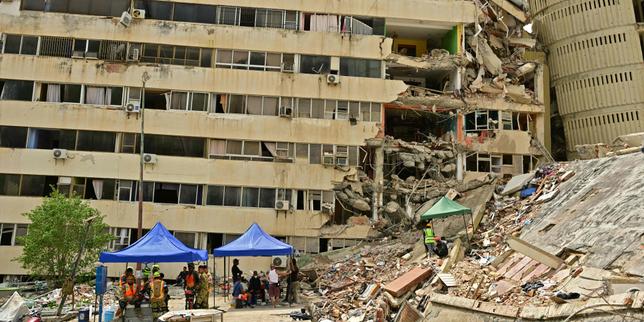
A dual seismic event on June 24, 2026, registering magnitudes of 7.2 and 7.5 within a 39-second window, has resulted in a verified death toll exceeding 4,333 individuals in Caracas and the coastal state of La Guaira. Standard disaster reporting heavily emphasizes the escalating casualty figures. However, an analytical breakdown of this event reveals that the high mortality rate is not merely a function of tectonic magnitude, but rather the compounding effect of structural engineering failures, collapsed public infrastructure, and a deeply compromised rapid-response framework.
Understanding this catastrophe requires isolating the distinct physical, structural, and systemic variables that transformed a major geological anomaly into an acute humanitarian crisis.
The Physics of the Double Pulse
The severity of the destruction stems primarily from the structural behavior of buildings under sequential seismic stress. The 39-second interval between the 7.2 and 7.5 magnitude tremors created a phenomenon known as consecutive structural loading.
The primary shock generated initial kinetic displacement, creating micro-fractures in reinforced concrete and exceeding the elastic limits of older structural designs. Before the internal energy of these structures could dissipate, the secondary 7.5 shock delivered a exponentially larger kinetic payload. This sequence can be explained through two main structural failure mechanisms:
- Progressive Stiffness Degradation: The initial shock degraded the stiffness matrix of local high-rises. When the larger secondary shock struck, the fundamental natural frequency of the damaged buildings had already shifted, rendering them highly susceptible to resonant amplification and immediate structural failure.
- Accumulated Soil Liquefaction: In coastal regions like La Guaira, the first tremor saturated sandy alluvial soils, increasing pore water pressure. The second shock occurred under near-total loss of soil shear strength, causing foundation shear failures that brought down multi-story apartment complexes instantly.
The Infrastructure Deficit and Structural Vulnerability
The high casualty rate is directly linked to structural engineering vulnerabilities across Venezuelan urban centers. Decades of economic volatility reduced enforcement of building codes, creating a highly stratified risk profile in the built environment.
Informal Self-Built Housing (Barrios)
In the dense, hillside settlements of Caracas, structures are predominantly unreinforced masonry built without professional engineering oversight. These buildings lack tensile capacity. When subjected to lateral seismic shear forces, they experienced immediate brittle failure, causing cascading collapses down the steep terrain.
High-Rise Structural Decay
In the formal sectors of Caracas and La Guaira, many high-rise residential properties built during mid-twentieth-century economic booms suffered from deferred maintenance. Corrosion of internal rebar due to moisture penetration, combined with substandard concrete mixing practices common in unmonitored retrofits, meant that columns lacked the ductility needed to survive the 7.5 magnitude secondary shear waves.
Logistic Bottlenecks in the Post-Disaster Framework
An emergency response system's efficiency is determined by its resource throughput and structural adaptability during the first 72 hours. In this instance, the domestic response ran into severe logistical and material constraints.
The destruction of the main highway corridors connecting Caracas to the coast at La Guaira isolated the primary maritime port from the capital's medical hubs. This blockage prevented heavy search-and-rescue machinery from reaching high-density collapse zones during the critical survival window.
Simultaneously, municipal water systems failed due to main-line ruptures, leaving emergency medical units without the basic utility access required to treat crush injuries or manage triage centers effectively.
The institutional response has also been complicated by geopolitics. While international urban search and rescue (USAR) teams arrived within days, the deployment encountered structural frictions. The interim administration under Delcy Rodríguez has faced criticism regarding early-stage domestic coordination.
The state's current strategy relies heavily on international resource mobilization, illustrated by appeals to foreign entities for asset liquidation—such as requesting the release of 30 tonnes of gold reserves held by the United Kingdom—to fund reconstruction logistics.
Short-Term Camp Dynamics and Secondary Risk Vectors
With over 19,000 displaced individuals currently housed in makeshift camps across public squares, stadiums, and thoroughfares, the crisis is transitioning from an acute trauma event to a chronic public health challenge. Managing these displaced populations involves mitigating several distinct systemic risks:
- Epidemiological Risk: The breakdown of wastewater processing infrastructure introduces high risks of waterborne pathogen transmission. Without managed sanitation blocks, high-density tent camps face quick acceleration of diarrheal diseases.
- Supply-Chain Triage: Distributing resources via ad-hoc distribution points introduces major inefficiencies. Without localized, digitally tracked supply registries, resource allocation suffers from geographic mismatching, leaving some temporary shelters undersupplied.
- Ongoing Missing Persons Backlog: With estimates of missing individuals remaining high, the transition from active rescue to recovery creates significant administrative strain on municipal authorities, altering local labor availability and civil management priorities.
Strategic Play for Regional Structural Mitigation
To prevent identical vulnerabilities from causing similar outcomes in future circum-Caribbean seismic events, municipal authorities and regional engineering boards must shift from reactive management to predictive fortification.
The immediate imperative requires the deployment of rapid structural health monitoring (SHM) systems using low-cost telemetry arrays on all standing high-rises to assess residual load-bearing capacity before re-occupancy. Municipalities must also implement an immediate ban on unreinforced masonry construction, replacing it with modular, lightweight timber or light-gauge steel frameworks in informal settlements.
Finally, critical infrastructure lifelines—specifically water networks and medical transport corridors—must be retrofitted with flexible joints and redundant path routing to ensure operational continuity when the next inevitable tectonic displacement occurs.

.webp)