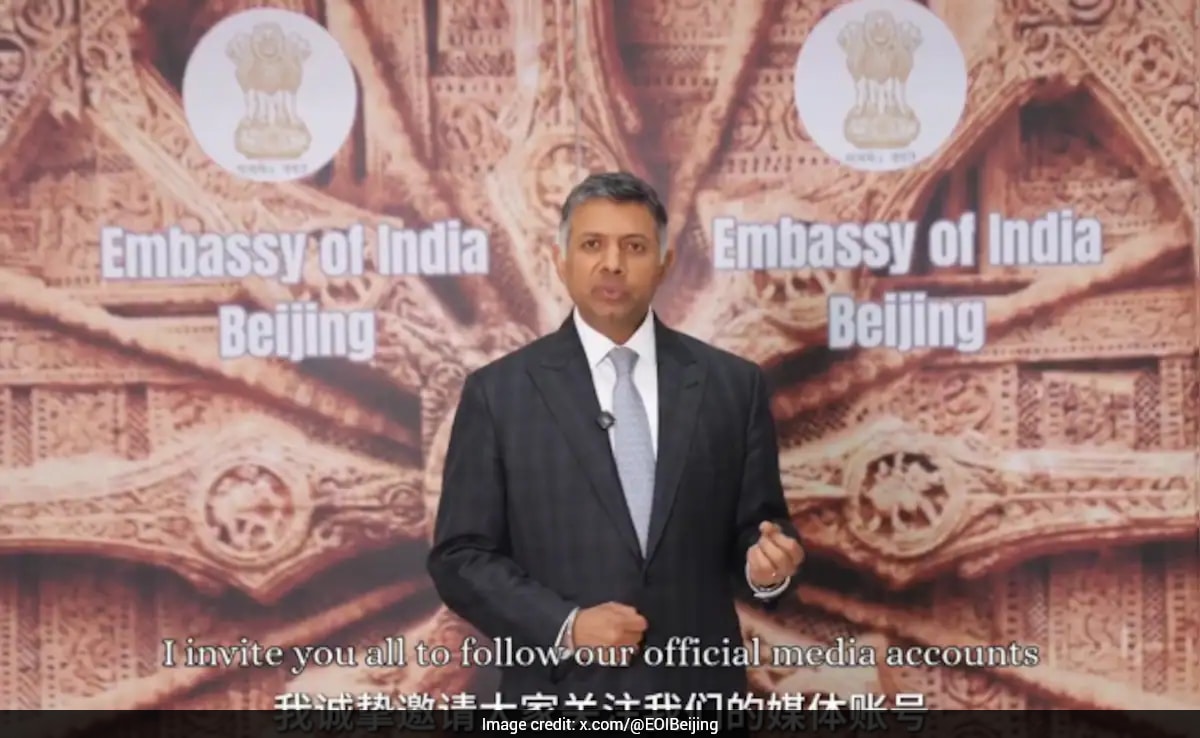
Public diplomacy between adversarial nuclear states operates as a lagging indicator of structural, backroom settlements. When India's newly appointed Ambassador to China, Vikram Doraiswami, released a fluent, Mandarin-language video tour of the Indian Embassy in Beijing, mainstream media characterized the event as a viral internet sensation or a heartwarming cultural overture. This superficial reading misses the operational engineering behind the message. The deployment of a Mandarin-speaking envoy to communicate directly with the Chinese public via domestic social media platforms is a deliberate exercise in tactical asymmetric signaling, executed only after hard security guarantees have been locked down.
The baseline reality of contemporary bilateral relations requires analyzing this event through a cold, strategic framework. Public-facing diplomatic maneuvers do not generate structural breakthroughs; they formalize them. The video represents a calculated pivot from defensive isolation to competitive engagement, occurring precisely because the structural bottleneck of the four-year military standoff in eastern Ladakh was logistically resolved. By examining the underlying mechanisms of this public diplomacy play, we can isolate how soft power is weaponized, where its structural limitations lie, and how linguistic optimization is used to recalibrate state-to-state leverage.
The Three Pillars of Asymmetric Public Diplomacy
To understand why a two-and-a-half-minute video can influence geopolitical perception, the action must be deconstructed into its core operational pillars. State communications in tightly controlled information ecosystems like China's do not go viral by accident. They are permitted to propagate based on an alignment of mutual diplomatic utility.
1. Structural Linguistic Optimization
The choice to conduct an entire embassy tour in Mandarin, rather than relying on English or subtitled Hindi, shifts the communication from an external broadcast to an internal narrative. In diplomatic statecraft, linguistic competence functions as a barrier reduction mechanism. By utilizing the local language, the sender eliminates the friction of translation, which frequently introduces nationalistic bias or misinterpretation when handled by local state-controlled media.
Furthermore, the strategic adoption of a culturally resonant Chinese name—Wei Jiameng, translating roughly to "one who forms an excellent alliance"—serves as an initial anchoring mechanism. This is not a mere pleasantry; it is a structural signaling device targeted at the Chinese Ministry of Foreign Affairs, establishing a baseline of diplomatic intent that allows state censors to justify the unhindered distribution of the content across networks like Weibo and WeChat.
2. High-Context Cultural Anchoring
The tour does not merely highlight the physical real estate of the Beijing mission; it anchors Indian sovereign presence within historical frameworks that the Chinese state validates. The deliberate positioning of the ambassador next to the bust of Rabindranath Tagore is a sophisticated operational choice.
Tagore represents a rare, politically insulated bridge between the two civilizations, recognized in Chinese historical text for advocating Asian cultural renaissance over Western hegemony. By utilizing Tagore as a rhetorical shield, the diplomatic communication bypasses modern geopolitical grievances and grounds the bilateral relationship in a historical continuity that Beijing’s own civilizational state narrative respects.
3. Sub-Sovereign Commercial Display
Beyond history and language, the video explicitly showcases the "One District One Product" (ODOP) exhibition within the embassy walls. This shifts the message from abstract cultural appreciation to tangible economic interaction.
By presenting localized Indian handicrafts directly to Chinese consumers, the embassy functions less like a closed administrative fortress and more like a high-value trade portal. This structural positioning appeals directly to the mercantile class and provincial economic actors who are decoupled from frontline security decisions but essential for trade volume stabilization.
The Cost Function of Diplomatic Access
While a fluent diplomatic presentation establishes a psychological foothold, its real-world efficacy faces a strict cost function governed by structural policy barriers. The viral reception of the video on Chinese social media immediately triggered a counter-demand from Chinese netizens: the restoration of streamlined visa facilities. This juxtaposition highlights the friction between public soft power and hard administrative statecraft.
The operational bottleneck in India-China relations is not a lack of mutual cultural curiosity; it is a calculated regime of reciprocal friction. The suspension of e-visa facilities and the stringent vetting of business visas for Chinese nationals by New Delhi operate as a defensive economic and security policy. The mechanism functions as follows:
[Security & Border Standoff] ──> [Visa Restrictions & Market Access Control] ──> [Suppressed People-to-People Velocity] ──> [Asymmetric Soft Power Deficit]
This creates an direct trade-off for Indian foreign policy architects. To scale the benefits of public diplomacy—such as tourism revenue, academic exchanges, and track-two corporate diplomacy—the state must lower its visa barriers. However, lowering these barriers increases security verification costs and dilutes the leverage New Delhi maintains over Chinese market access. Consequently, the viral nature of the embassy tour serves to expose this policy contradiction rather than solve it. The public demands the velocity of engagement that the underlying security architecture is not yet fully prepared to permit.
Civilizational Parity as a Negotiating Lever
A recurring theme in the strategic rewrite of India's outreach is the explicit framing of both nations as equal, ancient civilizational states. This is a deliberate rhetorical framework designed to counter China’s structural tendency toward hierarchical regional order.
In the classic Chinese geopolitical worldview, international relations are frequently viewed through a tributary or hierarchical lens, where geographic proximity and economic scale dictate deference. By consistently emphasizing that India and China are the world's two most populous nations and its oldest concurrent civilizations, Indian diplomacy uses civilizational parity to demand structural diplomatic parity.
This framing serves a dual purpose:
- Neutralizing Scale Disparities: It shifts the conversation away from current gross domestic product (GDP) differentials and military spending gaps, where China holds a clear material advantage, to a baseline of historical equality where neither side can claim structural superiority.
- Bypassing Western Alliances: It signals to Beijing that New Delhi's foreign policy is driven by independent civilizational agency, rather than acting as a structural proxy for Western containment strategies. This reduces the defensive paranoia of the Chinese security apparatus, creating an opening for localized stabilization.
Tactical De-Escalation Metrics
The deployment of a high-capability, Mandarin-fluent diplomat like Doraiswami—who holds an elective diploma in Chinese from the New Asia Yale-in-Asia Language School and has deep institutional memory within the Beijing and Hong Kong missions—indicates a shift in India's human capital allocation strategy.
Diplomatic postings are highly precise indicators of state intent. During periods of acute crisis, states send aggressive rhetorical enforcers or minimal-maintenance caretakers. Sending a sophisticated communicator capable of direct-to-consumer public diplomacy signals that New Delhi has transitioned from a posture of tactical denial to one of active stabilization.
This transition is quantified not by the volume of digital views or social media likes, but by the sequential normalization of institutional dialogue mechanisms. The true metrics of success for this public diplomacy push are entirely transactional:
- The reactivation of bilateral working mechanisms on border affairs.
- The incremental expansion of commercial flights between the two capitals, which have remained highly restricted since the pandemic and the border crisis.
- The establishment of predictable, depoliticized consular processing times for technical and executive personnel.
Without these structural shifts, a viral video is simply a high-execution PR campaign operating in a vacuum.
The Strategic Playbook
The optimal path forward requires treating this public diplomacy breakthrough not as an end state, but as cheap capital to fund structural concessions. New Delhi must leverage the positive sentiment generated by its diplomatic mission to systematically test Beijing's willingness to grant reciprocal access.
The immediate tactical move is to establish a strict, conditional framework where cultural and public accessibility is tied directly to market access and data security guarantees. India should utilize the current window of positive public sentiment to offer phased, sector-specific visa relaxations—specifically for technical experts required to install and maintain Chinese-manufactured manufacturing equipment in Indian industrial zones—in exchange for a verified reduction in non-tariff trade barriers for Indian pharmaceuticals and IT services in China.
By converting digital soft power into a structured tool for economic reciprocity, New Delhi can exploit the civilizational narrative to secure hard material gains, ensuring that public diplomacy serves as a driver of national interest rather than a substitute for it.
The strategic analysis of this public diplomacy initiative demonstrates that soft power is most effective when used as an advanced guard for structural economic and security realignments. To explore the broader operational context of contemporary international statecraft and how modern digital communications are reshaping sovereign interactions, India's New Ambassador To China Impresses With Fluent Mandarin In Beijing Embassy Tour Video provides an instructive visual case study of how this targeted linguistic signaling is deployed on the ground.