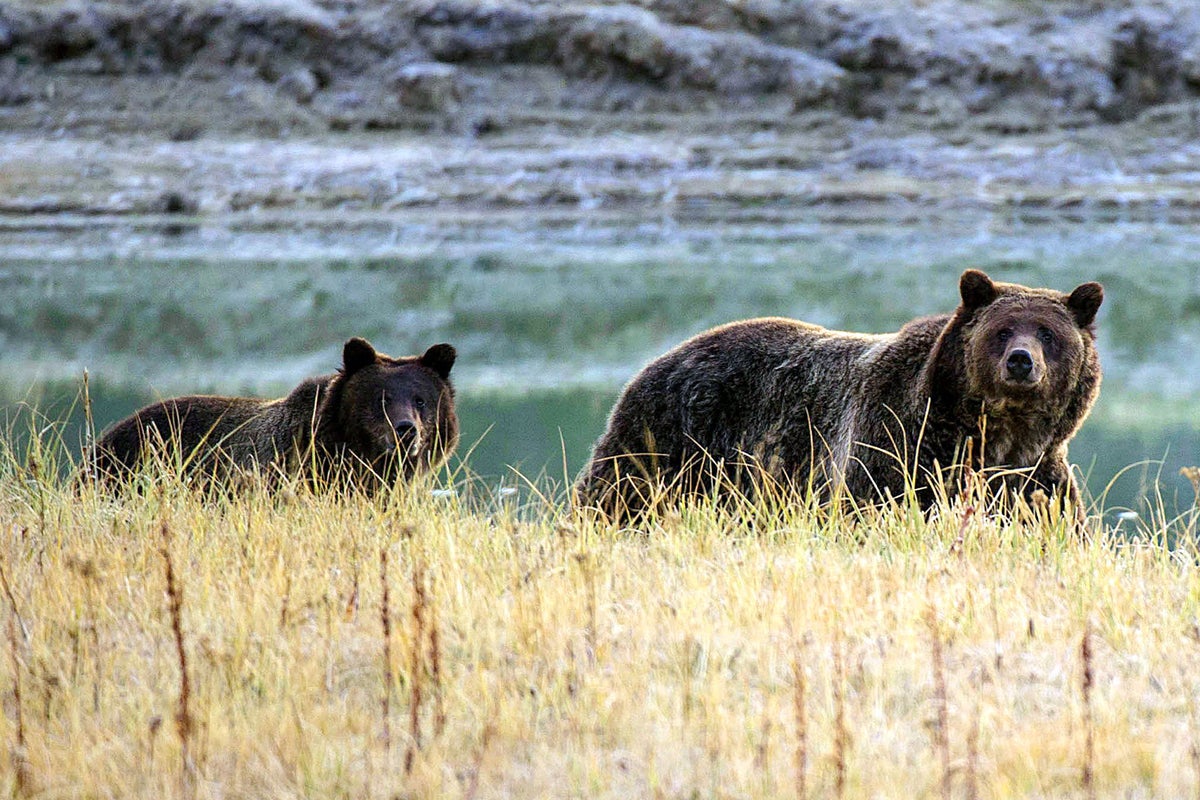
The recent incident involving two hikers and a grizzly bear (Ursus arctos horribilis) in Yellowstone National Park is not an isolated tactical failure but a breakdown in the risk-mitigation framework designed to separate human recreation from apex predator habitat. Traditional reporting treats these encounters as random "attacks." A structural analysis reveals they are the logical output of specific variables: habitat caloric density, human density thresholds, and the failure of individual defensive redundancies.
Understanding the mechanics of a bear encounter requires moving beyond the "unprovoked" narrative. Every interaction is governed by a stimulus-response loop. When humans enter the Yellowstone backcountry, they enter a high-stakes operational environment where the margin for error is dictated by the bear's biological imperatives—specifically hyperphagia (the period of intense calorie loading) and the defense of neonates or food caches.
The Triad of Incident Causality
A grizzly encounter rarely stems from a single mistake. It is the intersection of three distinct risk vectors:
- Environmental Spatial Blindness: The physical geography of the encounter site often dictates the outcome before the bear is even aware of the human presence. Dense brush, topographical blind spots, and "noisy" environments (high wind or rushing water) create a sensory vacuum. When the closing distance between a human and a bear drops below the "reactive threshold"—typically 50 yards—the bear’s sympathetic nervous system triggers a defensive charge.
- The Caloric Defense Mandate: Yellowstone's grizzlies are biologically programmed to protect high-value assets. If hikers inadvertently approach a carcass (winter-kill or wolf-kill) or a concentrated patch of whitebark pine seeds, the bear views the human not as prey, but as a competitor for a finite, survival-critical resource.
- Group Dynamics and Noise Failure: Data from the National Park Service indicates that groups of three or more who maintain consistent vocalizations are significantly less likely to be involved in a physical altercation. The "silent hiker" paradox suggests that the desire for a "pristine" nature experience directly increases the probability of a surprise encounter, which is the primary driver of non-predatory injury.
Mechanics of the Defensive Charge
The anatomy of a bear attack is characterized by rapid escalation. A grizzly can cover ground at speeds exceeding 30 miles per hour, meaning a 50-yard gap is closed in less than four seconds. This timeframe is insufficient for human cognitive processing; it requires a pre-programmed, muscle-memory response.
The "charge" is often misunderstood. It is a bluff-driven or contact-driven deterrent strategy meant to neutralize a perceived threat. In the recent Yellowstone case, the injuries sustained reflect the bear's objective: physical suppression followed by a retreat. Unlike predatory behavior—which is quiet, stalking-oriented, and focused on the neck or head—defensive behavior is explosive, vocal, and aimed at the limbs or torso to "ground" the intruder.
Strategic Failures in Deterrent Deployment
The efficacy of bear spray as a primary defensive tool is well-documented, yet its failure rate in the field is often tied to deployment mechanics rather than chemical composition. Bear spray relies on a concentrated cloud of capsaicinoids to inflame the bear's mucous membranes, causing temporary blindness and respiratory distress.
Two bottlenecks frequently compromise this system:
- Draw Speed vs. Proximity: Many hikers carry spray inside their packs or attached to side pockets where it cannot be accessed within the four-second reaction window. If the spray is not on the chest or hip belt, the tool is functionally non-existent.
- Environmental Interference: Wind direction and velocity can disperse the spray cloud before it reaches the target or, in high-wind scenarios, blow the irritant back onto the user. This creates a secondary hazard where the human is incapacitated while the predator remains active.
The Behavioral Economics of Risk Mitigation
Yellowstone’s management strategy is a balance between public access and species preservation. However, the "Safety Briefing" model often fails because it treats risk as a binary (Safe vs. Unsafe) rather than a spectrum of probability. To optimize safety, hikers must adopt a practitioner's mindset, viewing the backcountry as a series of tactical zones.
Zone 1: High-Frequency Transition Areas
These are trails near water sources or dense berry patches. The operational requirement here is constant vocalization ("hey bear" calls) every 30 to 60 seconds. This is not about scaring the bear; it is about providing the bear with enough lead time to self-evacuate the area.
Zone 2: The Carcass Perimeter
The presence of scavenging birds (ravens, magpies) or the smell of decay indicates a high-probability grizzly presence. The strategic move is not to investigate, but to execute a 180-degree retreat. Entering a carcass perimeter is the highest-risk action a hiker can take, as it triggers the bear’s most aggressive guarding instincts.
Zone 3: The Reactive Space
If a bear is spotted but has not charged, the objective is "de-escalation through passivity." This involves slow, diagonal movement away from the bear while maintaining a visual on the animal without direct eye contact, which can be interpreted as a challenge.
Quantifying the Cost of Non-Compliance
While the probability of an attack remains statistically low—roughly 1 in 2.7 million visits—the severity of the outcome is catastrophic. The "cost" of an encounter extends beyond the physical trauma to the victims. It involves:
- Ecological Impact: If a bear is determined to be a repeat offender or shows "abnormal" aggression, it is often lethally removed from the population. This represents a loss of genetic diversity and a failure of the park's primary mission.
- Resource Diversion: Search and rescue (SAR) operations and subsequent grizzly tracking require significant man-hours and capital, diverting funds from conservation and infrastructure.
- Regulatory Tightening: High-profile incidents lead to trail closures and "Hard-Sided Only" camping restrictions, reducing the total utility of the park for the general public.
Redefining Backcountry Competence
True expertise in bear country is not defined by how one survives an attack, but by the myriad of micro-decisions made to prevent the encounter entirely. The "expert" hiker recognizes that human presence is an intrusion into a high-stakes survival theater.
The immediate tactical play for any individual entering the Yellowstone backcountry is a three-step audit of their current system:
- Access Audit: Can you deploy your bear spray with your eyes closed in under two seconds? If the answer is no, your gear placement is a liability.
- Acoustic Audit: Is your group maintaining a noise floor that exceeds the ambient environment? If you are relying on "bear bells," you are using an ineffective tool; human voices are the only deterrent bears consistently associate with danger.
- Spatial Audit: Are you hiking during crepuscular hours (dawn/dusk) when ursine activity is at its peak? Operating during these windows doubles the risk of surprise encounters.
The survival of both the hiker and the grizzly depends on the human's ability to signal their presence clearly and yield the right-of-way to the biological reality of the apex predator.