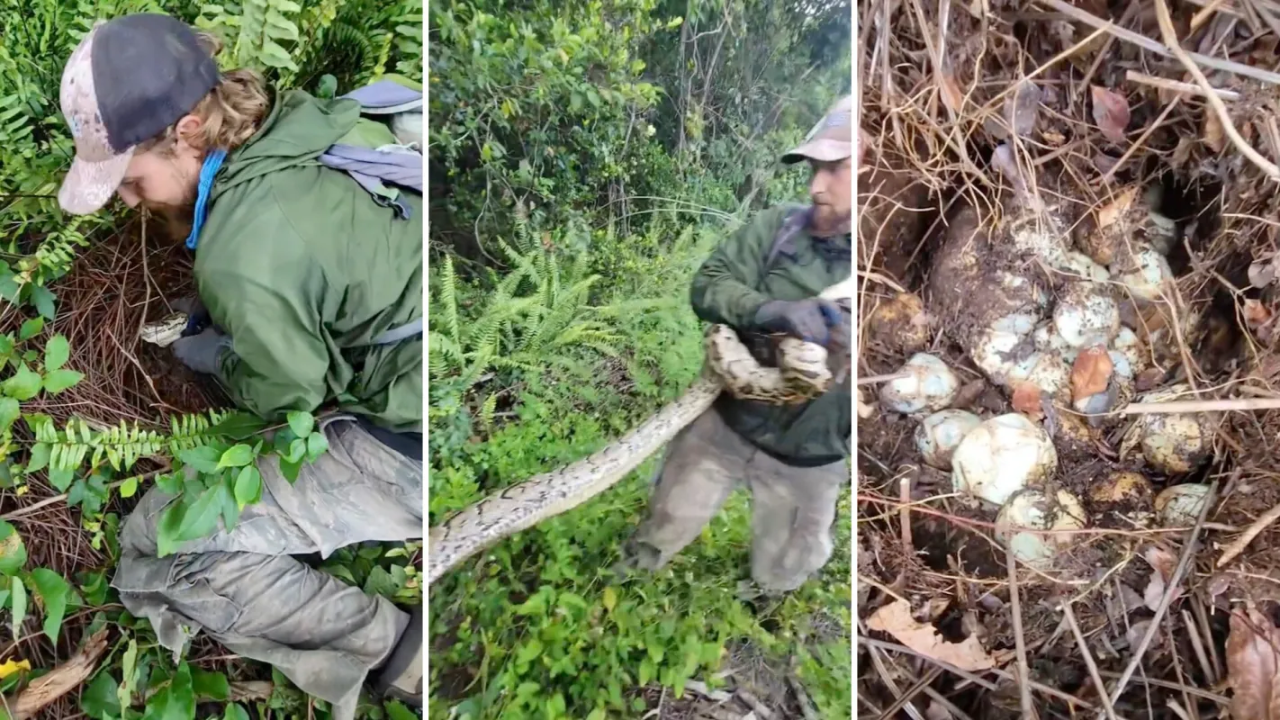
Biologists in the Florida Everglades recently captured a record-sized Burmese python brooding over a massive clutch of eggs, highlighting an ecological crisis that decades of containment efforts have failed to resolve.
The removal of a massive female Burmese python guarding dozens of developing embryos sounds like a routine dispatch for wildlife removal crews in South Florida. It was anything but standard. Finding a brooding female coiled over an enormous nest is a stark reminder of how deeply entrenched these invasive constrictors have become in the subtropical wilderness. They are not merely surviving here. They are dominating the apex predator niche, outcompeting native wildlife, and rewriting the ecological rules of the region.
The Anatomy of an Invasion
Burmese pythons are native to Southeast Asia, thriving in marshes, rain forests, and grasslands. When the pet trade imported thousands of individuals into the United States during the late twentieth century, a combination of accidental escapes and deliberate releases planted a biological time bomb. Hurricane Andrew in 1992 allegedly shattered breeding facilities, washing hundreds of snakes directly into the fragile marshlands of southern Florida.
That environmental disruption provided the catalyst for an unprecedented biological invasion. The Everglades offer an endless buffet of deer, raccoons, bobcats, and wading birds, combined with a climate that mirrors their native habitats. Without native predators to keep populations in check, the snakes grew larger, reproduced faster, and expanded their geographic range northward toward central Florida.
Adult pythons possess a reproductive capacity that staggers field researchers. A single female can lay up to one hundred eggs in a single clutch, though fifty to eighty is more common. Unlike many other reptile species that abandon their nests immediately after laying, female Burmese pythons remain with their eggs for months. They coil tightly around the clutch, shivering their muscles to generate heat and protect the developing embryos from predators until hatching occurs.
Removing a brooding female and her massive egg cluster prevents an entire generation of apex predators from entering the marsh. Yet, wildlife management specialists understand the grim arithmetic of the situation. Every captured snake represents thousands more hidden beneath dense sawgrass and cypress domes.
Measuring the Ecological Toll
The disappearance of medium-sized mammals across Everglades National Park over the last twenty years remains one of the most visible indicators of the python's impact.
Surveys conducted by park biologists show dramatic population declines in raccoons, opossums, bobcats, and marsh rabbits. Sightings of these once-common mammals dropped by more than ninety percent in areas where pythons established high-density populations. When an apex constrictor removes the mesopredators from an ecosystem, the entire food web collapses out of balance. Rodent populations surge, wading birds face increased predation pressure on their nesting grounds, and the fundamental interactions between predator and prey undergo a permanent shift.
The sheer scale of the landscape works entirely in favor of the snakes. The Everglades span millions of acres of flooded sawgrass, impenetrable mangrove forests, and deep sloughs. Traditional hunting and removal methods rely heavily on visual sightings along levees and roadsides, exposing only a tiny fraction of the total population. Telemetry studies using radio-tracked "scout snakes" help researchers locate secretive individuals deep in the brush, but the labor-intensive nature of the technique limits its coverage area.
State-sponsored hunting programs and python removal contractor initiatives yield thousands of captured snakes annually, yet population models suggest these efforts barely scratch the surface of the total biomass. The snakes possess cryptic coloration that renders them virtually invisible against the mud and leaf litter, allowing them to ambush prey with absolute concealment.
Economic and Logistical Realities
Eradication is no longer a realistic objective for environmental agencies operating in the region. State and federal entities have shifted their strategic framework from total elimination to containment and asset protection.
Millions of dollars flow annually into research grants, bounty programs, and specialized removal teams. Training programs teach citizens and professional contractors how to humanely dispatch large constrictors, while academic institutions study thermal imaging, environmental DNA testing, and biological controls to detect pythons before they establish breeding populations in new territories.
Despite these investments, funding remains a perennial battleground. Managing an invasive species across an expansive wilderness area requires sustained financial commitments that span decades, surviving changes in political administrations and shifting public priorities. When a massive python and her egg clutch make headlines, public interest spikes temporarily, bringing fleeting attention to a problem that requires year-round vigilance.
The deeper challenge lies in human behavior and the continued illegal trade of exotic pets. While Florida implemented stricter regulations regarding the ownership and breeding of conditional species like Burmese pythons, enforcement remains difficult in a sprawling state with a massive reptile enthusiast culture. Unscrupulous owners still release unwanted pets into the wild when the animals outgrow their enclosures or become too expensive to feed, inadvertently fueling the very crisis that tax dollars are spent fighting.
The Road Ahead in the Swamp
The removal of this specific python and her clutch stands as a tactical victory for field biologists and conservation officers working on the front lines of the Everglades.
Yet, the victory is undeniably pyrrhic. As long as vast tracts of wilderness remain remote and undisturbed, the pythons will continue to breed, adapt, and expand their territorial boundaries. The future of the Everglades depends on whether modern conservation science can develop scalable, cost-effective suppression technologies before native species are pushed past the brink of local extinction.
The swamp does not forgive ecological imbalances, and the snakes are here to stay.


