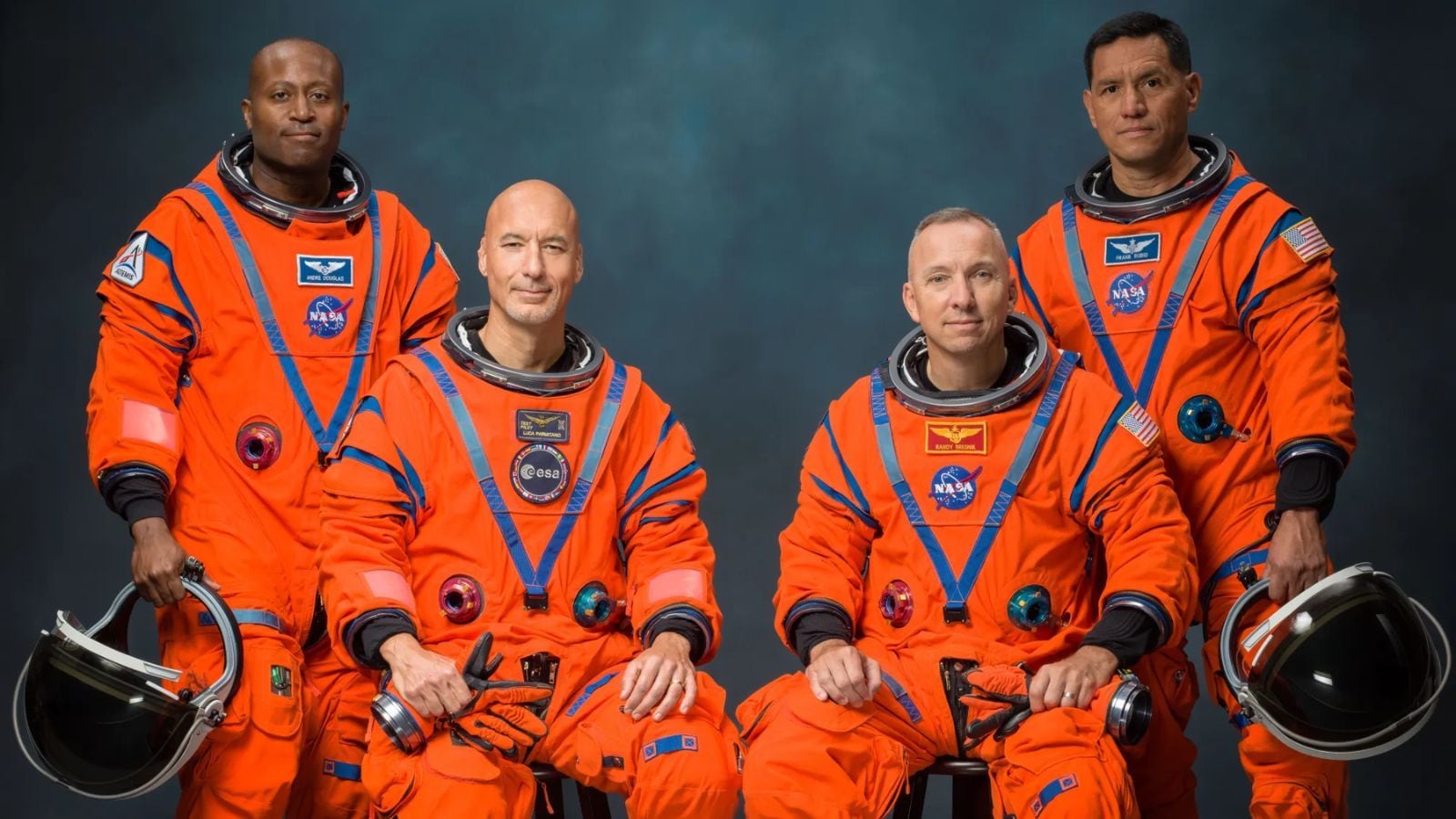
The programmatic restructuring of NASA’s Artemis initiative has altered the execution sequence for returning humans to the lunar surface. By reassessing the technological maturity of critical components, the agency has adapted the Artemis III mission profile from an direct lunar landing into an orbital integration campaign. Scheduled for launch no earlier than mid-2027, the fourteen-day mission will utilize a four-person crew—Commander Randy Bresnik, Pilot Luca Parmitano, and Mission Specialists Frank Rubio and Andre Douglas—not to explore the lunar South Pole, but to execute a high-risk docking and systems integration sequence in Low Earth Orbit (LEO).
This structural shift represents a risk-mitigation framework modeled directly on the Apollo 9 architecture of 1969. Rather than exposing untested commercial human landing systems (HLS) to the unforgiving environment of deep space, NASA is isolating the variables of rendezvous, proximity operations, and docking within the logistical safety net of Earth orbit. This tactical pivot addresses a series of systemic engineering bottlenecks across the commercial aerospace supply chain while transitioning the program from theoretical engineering into human flight readiness.
The Co-Dependency Framework: Managing the Commercial Landers
The core objectives of Artemis III center on resolving the complex integration requirements between NASA’s legacy hardware and new commercial space assets. The mission establishes a dual-vendor validation framework, forcing Elon Musk’s SpaceX and Jeff Bezos’ Blue Origin into parallel operational testing.
The primary engineering bottleneck is the integration of disparate hardware and software ecosystems. The mission profile requires the Orion spacecraft, powered by the Space Launch System (SLS), to achieve rendezvous and structural docking with two radically different HLS test articles: the Starship HLS (SpaceX) and the Blue Moon lander (Blue Origin). The operational metrics of this phase focus on four distinct vectors:
- Mechanical Interface Alignment: Validating the physical capture, latching, and structural rigidity of the docking mechanisms under thermal and orbital variances.
- Propulsion and Attitude Control Coordination: Managing the mass-distribution dynamics when two ultra-heavy spacecraft are mated. The combined center of mass alters the control laws governing the integrated stack's thruster firings.
- Cross-Platform Avionics and Communication: Ensuring telemetry, voice, and data streams remain unbroken across proprietary commercial software architectures and NASA’s encrypted military-grade communication systems.
- Environmental Control and Life Support System (ECLSS) Integration: Testing atmospheric pressure equalizations and hatch-open procedures, allowing astronauts to transition between the Orion capsule and the test landers.
The necessity of an Earth-orbit baseline was highlighted by a significant industrial setback on May 28, when Blue Origin’s 321-foot New Glenn rocket suffered a catastrophic engine failure during a hotfire test at Cape Canaveral Space Force Station. The resulting detonation damaged the launch pad infrastructure and injected substantial variance into Blue Origin’s development timeline. By decoupling the HLS testing from a trans-lunar injection trajectory, NASA isolates these commercial hardware failures from the primary mission survival metrics.
Crew Optimization and Operational Archetypes
The composition of the Artemis III crew reflects a deliberate allocation of human capital designed to counter the extreme mechanical uncertainties of the mission. Each seat corresponds to a specific risk vector within the flight profile.
+------------------+-----------------------+----------------------------------+
| Crew Position    | Name (Agency)         | Operational Utility              |
+------------------+-----------------------+----------------------------------+
| Commander        | Randy Bresnik (NASA)  | Test pilot background; extreme   |
|                  |                       | environment specialization       |
+------------------+-----------------------+----------------------------------+
| Pilot            | Luca Parmitano (ESA)  | High-pressure ISS command exp;   |
|                  |                       | complex international logistics  |
+------------------+-----------------------+----------------------------------+
| Mission Specialist| Frank Rubio (NASA)    | Medical doctorate; microgravity  |
|                  |                       | endurance baseline (371 days)    |
+------------------+-----------------------+----------------------------------+
| Mission Specialist| Andre Douglas (NASA)  | Systems engineering focus;       |
|                  |                       | cross-platform technical testing |
+------------------+-----------------------+----------------------------------+
Commander Randy Bresnik brings extensive experience as an F/A-18 test pilot and space shuttle veteran. His background in extreme environments—including underwater aquanaut deployments—is critical for managing unmodeled aerodynamic or mechanical feedback loops during manual docking overrides. Pilot Luca Parmitano, representing the European Space Agency (ESA), provides deep operational knowledge derived from commanding the International Space Station (ISS) and executing manual European cargo vehicle dockings. His presence satisfies international diplomatic frameworks while filling the cockpit with proven high-pressure piloting capabilities.
The mission specialists target physiological and systemic variables. Dr. Frank Rubio holds the American record for continuous spaceflight at 371 days. His medical background and deep understanding of microgravity adaptation will guide the assessment of crew fatigue during intense, around-the-clock docking operations. Andre Douglas, transitioning from his role as the backup specialist on Artemis II, provides systems engineering expertise required to analyze the real-time performance data of the experimental commercial lander interfaces.
The Multi-Launch Supply Chain Bottleneck
The strategic logic of Artemis III must be viewed through the lens of orbital mechanics and launch infrastructure constraints. Executing a dual-lander docking demonstration requires an unprecedented cadence of heavy-lift rocket launches.
The launch sequence dictates that the commercial lander pathfinders must be deployed into a stable low Earth orbit before the crew launches. Blue Origin's lander architecture is engineered for long-duration orbital storage, meaning it must successfully launch, self-circularize its orbit, and enter a quiescent state for multiple weeks while awaiting the crew. This introduces a major dependency: the commercial launch vehicles—SpaceX's Starship and Blue Origin's New Glenn—must achieve flight certification from the Federal Aviation Administration (FAA) following their respective launch anomalies.
Once the landers are verified in orbit, the SLS rocket will deliver the crew inside the Orion capsule. The immediate engineering priority upon orbital insertion is the empirical assessment of Orion's redesigned thermal protection system. Following thermal degradation anomalies observed on early uncrewed re-entries, the updated heat shield must perform flawlessly during the high-velocity atmospheric insertion that concludes the mission.
The second limitation is the cryogenic propellant transfer bottleneck. To sustain the landers in orbit, the program relies on unproven in-space cryogenic refueling techniques. Liquid oxygen and liquid hydrogen boil off rapidly when exposed to solar radiation in LEO. The margin of error for launch synchronization is razor-thin: a delay in the SLS launch window directly correlates to a degradation of the fuel margins within the pre-deployed commercial landers.
Tactical Pathfinding for the Lunar South Pole
The data harvested during Artemis III will directly dictate the software baselines, operational rules, and hardware modifications for Artemis IV—the true lunar landing attempt scheduled for 2028. By focusing the scope of Artemis III onto the Earth-orbital phase, NASA is mapping the exact human-machine interfaces required for deep-space survival.
The final strategic phase of the mission shifts from mechanical docking to planetary telemetry. While in orbit, the crew will pivot their sensor arrays back toward Earth, evaluating the atmosphere and validating high-resolution imaging systems. This phase serves as an operational test for the scientific workflows that will be deployed on the lunar surface, ensuring that the software pipelines transferring multi-spectral data from the spacecraft to ground-based scientific teams function under realistic operational stress.
The immediate pathway forward requires the immediate integration of the newly announced crew into the engineering simulators at the Johnson Space Center. Over the next twelve months, Bresnik, Parmitano, Rubio, and Douglas will undergo high-fidelity simulations that model sensor failures, docking mechanism jams, and software desynchronizations across the Orion-SpaceX-Blue Origin interfaces. The strategic play is no longer about flags and footprints; it is an industrial optimization campaign designed to stabilize a fractured commercial aerospace supply chain before committing human lives to the lunar environment.