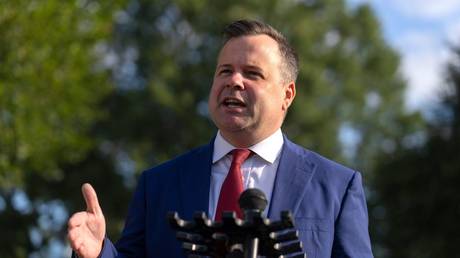
The appointment of Federal Housing Finance Agency (FHFA) Director Bill Pulte as the acting Director of National Intelligence (DNI) represents a fundamental structural shift in the executive branch’s optimization function. By installing a real estate executive with zero national security experience to oversee the 18 agencies of the intelligence community, the administration has signaled a structural pivot: the prioritization of absolute executive alignment over traditional institutional domain expertise.
To analyze the strategic fallout of this transition from outgoing DNI Tulsi Gabbard to Pulte, observers must look past conventional partisan critiques and instead evaluate the operational levers of the Office of the Director of National Intelligence (ODNI). This change operates along three distinct axes: the statutory constraints of the Vacancies Act, the structural transformation of intelligence data pipelines, and the institutional friction between macroeconomic policy and national security.
The 210-Day Statutory Runway and Institutional Constraints
The operational architecture of this appointment is strictly bounded by the Federal Vacancies Reform Act of 1998. Because Pulte is entering the role in an acting capacity following Gabbard's resignation, his tenure is governed by a precise cost function of time.
- The Temporal Limit: Under statutory rules, an acting official can serve for a maximum of 210 days from the date the vacancy occurred. Given the formal transition timeline, Pulte’s legal authority as acting DNI is projected to expire on January 26, 2027.
- The Senate Confirmation Bypass: The structural advantage of an acting designation is the immediate deployment of personnel without the friction of a Senate confirmation vote. This bypass is highly critical given that key legislative figures—including members of the Senate Select Committee on Intelligence—have already cited 50 U.S.C. § 3026, which states the DNI should possess "extensive national security experience".
- The Dual-Hat Efficiency Constraint: Pulte will simultaneously retain his positions as Director of the FHFA and Chairman of Fannie Mae and Freddie Mac. Managing a $10 trillion housing finance portfolio while directing the National Intelligence Program introduces a profound cognitive and operational bottleneck. Time allocation becomes a zero-sum game, naturally forcing the delegation of day-to-day intelligence operations to career deputies while the acting DNI focuses on high-level administrative directives.
Structural Overhaul and Information Filtering
The core function of the ODNI is to synthesize disparate raw data streams from human, signals, and geospatial intelligence into the President’s Daily Brief (PDB). Under Gabbard's tenure, the agency initiated an "ODNI 2.0" restructuring strategy, which reduced or reassigned approximately 40% of the staff and consolidated several analytic functions. Pulte inherits an agency already optimized for centralized command rather than expansive, decentralized analysis.
The primary mechanism of concern for the intelligence bureaucracy is the shift in the information filtering matrix. Traditional intelligence synthesis relies on a probability-weighted, adversarial consensus model, where agencies challenge each other's assumptions to avoid confirmation bias.
By contrast, Pulte’s operational history at the FHFA reflects a strict top-down, punitive accountability framework. His deployment of administrative authority to issue criminal referrals against political figures—such as Federal Reserve Governor Lisa Cook and New York Attorney General Letitia James—demonstrates a preference for using institutional tools to drive specific, targeted outcomes.
When applied to the intelligence apparatus, this operational style alters the bureaucratic incentive structure. Career analysts face a modified payoff matrix:
[Analyst Incentive Matrix]
┌───────────────────────────┬─────────────────────────────┐
│    Deliver Consensual     │    Deliver Non-Consensual   │
│   Intelligence Narrative  │    Intelligence Narrative   │
├───────────────────────────┼─────────────────────────────┤
│   Low Career Risk /       │   High Bureaucratic Friction│
│   High Executive Favor    │   / Target of Retribution   │
└───────────────────────────┴─────────────────────────────┘
The systemic risk of this matrix is the degradation of data integrity. If analysts perceive that non-consensual intelligence—such as assessments regarding the execution of the war with Iran or geopolitical alignment in Venezuela—results in career stagnation or administrative investigations, the output of the 18 intelligence agencies will artificially converge on the executive's pre-existing hypotheses.
The Convergence of Intelligence Assets and Capital Markets
The official justification for Pulte's appointment relies on an unconventional premise: that managing systemic risk within the $10 trillion mortgage market equips an executive with the analytical tools required to manage global kinetic and asymmetric threats. This premise requires a rigorous evaluation of where macroeconomic risk and national security intersect.
The ongoing war with Iran has directly disrupted global energy supply chains, causing a corresponding upward pressure on domestic mortgage rates and capital costs. In a highly inflationary, high-interest-rate environment, the administration's domestic economic objectives are structurally bound by geopolitical outcomes.
Pulte’s previous policy proposals, including a highly debated 50-year mortgage framework to ease consumer affordability, were ultimately shelved due to capital market resistance and rising macro yields. By placing the head of the FHFA at the apex of the intelligence community, the executive branch is attempting to unify its macroeconomic defense mechanisms with its foreign intelligence apparatus.
The immediate operational test of this convergence will be the handling of highly sensitive, pending intelligence products. For instance, the ODNI is slated to release a comprehensive assessment regarding Anomalous Health Incidents, widely known as Havana Syndrome. A traditional intelligence leader views the release of such a report through the lens of state-actor attribution and diplomatic fallout. A markets-focused DNI will inevitably calculate how the presentation of threat vectors influences sovereign risk, defense allocations, and broader market stability.
The clear limitation of this unified approach is the fundamental difference in data velocity and validation. Financial markets operate on transparency, rapid price discovery, and quantifiable liquidity metrics. National security operates on highly classified, often fragmented indicators where over-indexing on short-term market stability can result in a catastrophic failure to identify low-probability, high-impact kinetic threats.
Institutional Friction Points and the Path Forward
The dual-hatting of Pulte creates immediate, intense institutional friction across the executive branch. To project the short-term trajectory of this appointment, analysts must monitor two primary operational fault lines.
First, internal administrative conflict within the cabinet will likely intensify. Pulte’s documented friction with Treasury Secretary Scott Bessent over interest rate policies and economic messaging indicates a fractured economic command structure. With Pulte now gaining access to the nation's most sensitive intelligence assets, the leverage dynamic between the FHFA/ODNI axis and the Treasury Department shifts significantly. Intelligence regarding global illicit finance, sanctions evasion, and foreign sovereign wealth movements can be operationalized to influence domestic economic policies, potentially escalating disputes over interest rates and debt management.
Second, the structural balance of power within the national security apparatus will tilt toward established institutional actors. Because Pulte lacks foundational experience in operational tradecraft, defense intelligence, or clandestine collection protocols, the actual execution of strategic operations will naturally concentrate in nodes with deeply entrenched expertise. Specifically, Central Intelligence Agency (CIA) Director John Ratcliffe, who has maintained a highly prominent role in planning and coordinating active campaigns regarding Iran and Venezuela, will see his relative bureaucratic authority expand. The ODNI under Pulte may increasingly function as a political and administrative clearinghouse, while the actual levers of covert action and raw collection remain anchored within the CIA and the Department of Defense.
Rather than looking for a return to traditional institutional norms, strategic planners must adjust to an environment where intelligence assessments are openly treated as extensions of executive policy and domestic economic stabilization. The core task for external analysts over the next 210 days is to separate objective reality from the highly curated, centralized intelligence narratives likely to emerge from a structurally altered ODNI.
For a deeper dive into the organizational origins and statutory role of the Office of the Director of National Intelligence, the video Intelligence Reform and Terrorism Prevention Act Overview provides historical context on why the position was originally created to coordinate America's 18 intelligence agencies.