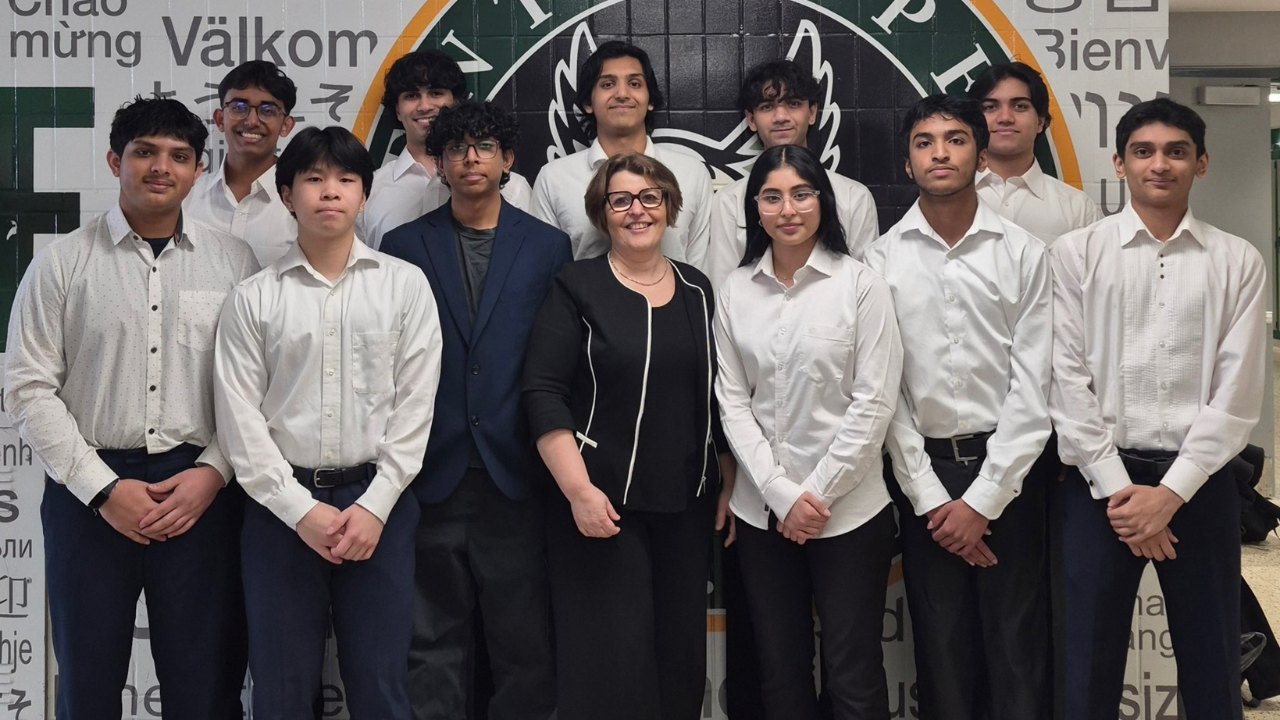
The air in a typical high school physics lab smells of floor wax and ozone. It is a place of predictable outcomes—inclined planes, rolling marbles, and equations that always balance if you ignore friction. But for a small group of teenagers at North Park Secondary School in Brampton, the equations stopped balancing. They were looking at the vacuum of space, a place where the friction of everyday life—the expectations of immigrant parents, the pressure of university applications, the sheer noise of being a teenager in 2026—simply falls away.
They weren't just doing homework. They were designing a city for 10,000 people.
It started with a prompt from the NASA Ames Space Settlement Design Contest. The challenge is deceptively simple: create a viable, self-sustaining colony in orbit. It is the kind of task that usually draws the brightest minds from elite private academies and specialized technical institutes across the globe. This year, 23,000 students from dozens of countries entered. They submitted blueprints for oxygen scrubbers, centrifugal gravity rings, and radiation shielding. They argued over the caloric density of space-grown algae and the psychological impact of living in a world without a horizon.
Then came the results. A group of Indian-origin teens from a public school in suburban Ontario didn't just place. They won.
The Weight of 1G
To understand why this matters, you have to look past the trophy. You have to look at the engineering of hope. When you are 16 years old, the world feels incredibly heavy. You are told that the future is a narrow corridor. You study, you get the grades, you find a career. But these students decided to build their own corridor, one that stretches past the stratosphere.
Consider the technical audacity required to win. A space settlement isn't a building; it is an organism. If the circulatory system—the life support—fails for five minutes, everyone dies. If the skeletal structure—the hull—vibrates at the wrong frequency, the centrifugal force required to simulate Earth’s gravity will tear the station apart.
The team spent months obsessing over "L5," a Lagrange point where the gravitational pull of the Earth and Moon cancel each other out. It is a stable parking spot in the void. Imagine trying to balance a needle on its tip while a gale-force wind blows. That is the mathematical reality of orbital mechanics. They lived in that math. They spent their weekends debating the structural integrity of carbon nanotubes versus aluminum-lithium alloys. While their peers were scrolling through feeds, these kids were calculating the precise thickness of lunar regolith needed to stop a solar flare from frying a human nervous system.
Beyond the Blueprints
The judges didn't just see a collection of CAD drawings. They saw a narrative of survival. The Brampton team understood something many of the 23,000 other competitors missed: a city isn't just pipes and wires. It is a community.
They designed schools. They planned for parks where the "trees" would grow toward the center of the spinning cylinder. They mapped out the social governance of a colony where every breath of air is a shared resource. This is where the human element shines through. For many of these students, the children of families who moved halfway across the world to build a new life in Canada, the concept of a "pioneer" wasn't abstract. It was their dinner table conversation.
The migration from Punjab or Gujarat to Brampton is a feat of logistics and bravery. It requires leaving behind everything familiar to build a foundation in a place that feels alien. In a way, designing a space station was just the next logical step in a multi-generational journey. They were applying the resilience they witnessed in their parents to a frontier that is 400,000 kilometers away.
The Invisible Stakes
Why do we care about a high school contest when the world below is so messy?
Because we are running out of "new" ideas. Much of our current technology is iterative—a slightly faster phone, a slightly more efficient battery. We have become experts at polishing the status quo. These students are doing something different. They are engaging in radical imagination.
When you solve for space, you solve for Earth.
The water filtration system they designed for their orbital colony could provide clean drinking water to drought-stricken regions in East Africa. The high-efficiency solar arrays they mapped out could power a village in the Himalayas. The psychological research they conducted on isolation and confined spaces has immediate applications for a generation struggling with the mental health fallout of a hyper-digital world.
The stakes aren't just a plaque on a wall. The stakes are the survival of the species. We are a one-planet civilization, and history shows that one-planet civilizations have a shelf life. By beating 23,000 other students, this team proved that the solutions to our most complex problems aren't locked away in secret government labs. They are sitting in the minds of teenagers who are willing to stay up until 3:00 AM arguing about the thermal conductivity of a heat sink.
The Sound of a Shift
There is a specific kind of silence that happens when a group of people realizes they have won something life-changing. It isn't a cheer. It’s a sharp intake of breath.
For the North Park team, that moment was the culmination of thousands of hours of invisible labor. It was the result of the "Brampton hustle"—that particular brand of suburban grit where you have to work twice as hard to get half the recognition of the downtown schools.
They weren't supposed to win. The odds were 23,000 to one. On paper, they were just another group of kids from a diverse neighborhood. But on the screen, in the eyes of NASA’s experts, they were the architects of tomorrow.
Think about the sheer scale of the competition. Students from India, China, Europe, and the United States—many from schools with budgets larger than some small towns. The Brampton team didn't have a massive endowment. They had laptops, a shared Google Drive, and an uncompromising belief that they belonged among the stars.
The Reality of the Void
The most difficult part of space travel isn't the launch. It’s the maintenance. It’s the boring, daily grind of making sure the sensors are calibrated and the seals are tight.
This team excelled because they embraced the boring. They didn't just draw pretty pictures of spaceships. They wrote the manuals. They accounted for the waste management systems. They thought about what happens to trash in a closed loop. They looked at the reality of the void and didn't blink.
In a world that often treats teenagers as consumers to be marketed to, these students chose to be creators. They chose to be the people who provide answers instead of just asking questions. They showed that "Indian-origin" isn't just a demographic marker; it’s a lineage of scholars, engineers, and dreamers who have been looking at the sky for five thousand years.
The Horizon is a Choice
We often talk about the "future" as if it is something that happens to us, like the weather. We wait for it to arrive. We hope it will be kind.
The North Park Secondary team reminds us that the future is something you build. It is a choice made of steel, glass, and mathematics. It is a series of decisions made in a classroom in Brampton that ripple outward until they touch the edge of the moon.
As the sun sets over the strip malls and subdivisions of the GTA, a group of teens is likely still staring at their screens. They aren't looking at the road outside. They are looking at a coordinate in deep space, a place where they have already built a home.
The next time you look up at the night sky, don't just see stars. See a construction site.