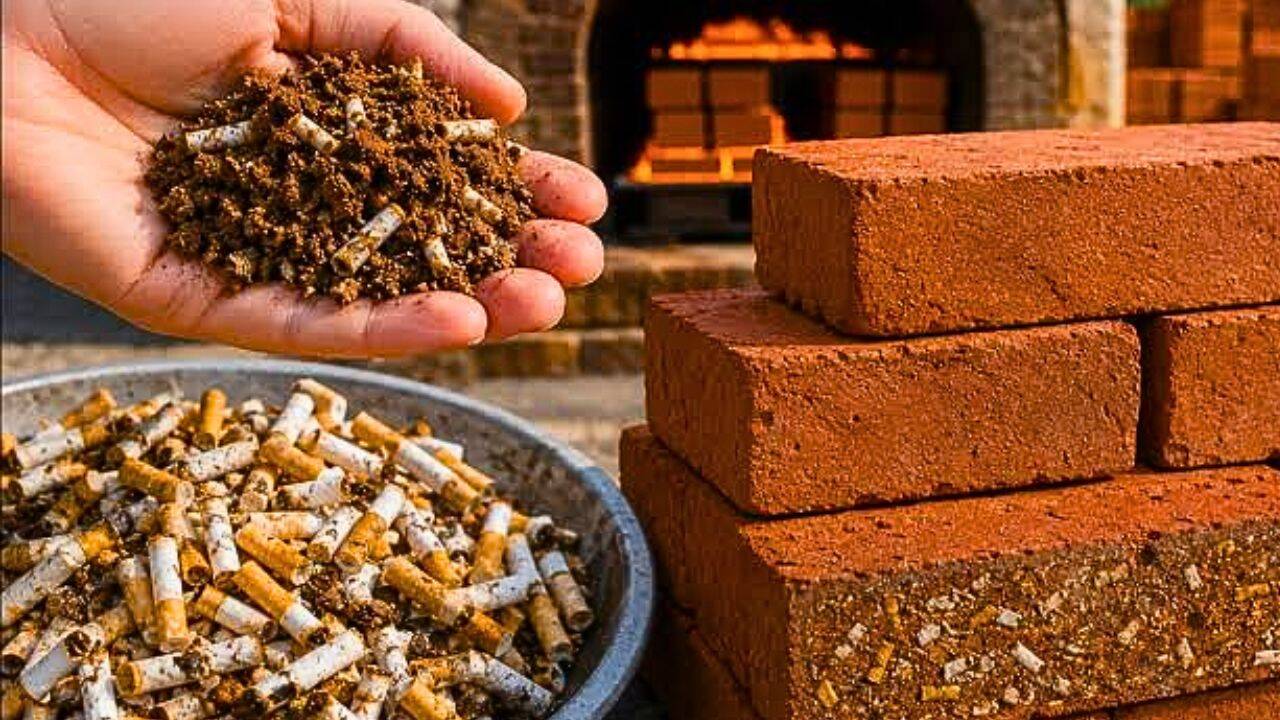
Every year, human beings discard roughly 4.5 trillion cigarette filters. These synthetic cellulose acetate butts do not rot. They sit in soil, choking waterways and leaching heavy metals into the biosphere. At RMIT University, researchers under the direction of material scientists found a radical workaround: mixing these toxic remnants directly into standard clay bricks. By embedding cigarette butts into the clay matrix, manufacturing plants can slash firing energy consumption by up to ten percent while permanently trapping hazardous pollutants inside a vitrified structure. Yet, beneath the neat scientific triumph lies an industrial bottleneck that exposes why systemic waste solutions struggle to cross the threshold from university laboratories into mass commercial production.
The Anatomy of a Global Pollutant
Most people assume cigarette filters are made of biodegradable cotton or paper. They are not. They are manufactured from cellulose acetate, a tough thermoplastic polymer derived from wood pulp that has been treated with acetic anhydride. Nature cannot break this material down easily. Sunlight causes photo-oxidation, shattering the long polymer chains into brittle fragments, but the underlying plastic residues persist for over a decade in urban soils and marine environments.
The filter acts as a trap. When a cigarette burns, the porous cellulose acetate network snags tars, nicotine, and particulate combustion byproducts, along with heavy metals like arsenic, lead, chromium, and cadmium drawn from the soil during tobacco cultivation. When a smoker tosses a butt onto the pavement, they are discarding a micro-sponge soaked in systemic agricultural chemicals and carcinogenic tar.
Municipal cleanup efforts treat these filters as street debris rather than hazardous chemical waste. Sweepers collect them, landfills bury them, and stormwater systems wash them straight into the ocean. Traditional recycling methods fail because separating the chemical load from the degraded plastic matrix is economically unviable. The material is chemically stubborn, volumetrically massive, and socially normalized as acceptable litter.
Inside the Ceramic Matrix
The RMIT team realized that trying to clean the filters was a losing battle. Instead, they inverted the problem. What if the contamination could be sealed inside a permanent architectural medium?
Bricks are ancient technology. Mud, clay, water, and heat. For millennia, the process remained fundamentally unchanged. You dig up raw clay, shape it into blocks, dry it, and bake it in an industrial kiln at temperatures soaring past one thousand degrees Celsius. That baking process requires immense thermal energy, typically generated by burning natural gas or coal. Energy represents one of the largest operational expenses for structural brick manufacturers, driving production costs and carbon emissions skyward.
When researchers incorporated untreated cigarette butts directly into the wet clay mix before extrusion, a distinct thermodynamic advantage emerged. Cellulose acetate has high calorific value. As the raw brick dries and enters the kiln's heating zones, the trapped filter material begins to decompose and eventually combust within the clay core. This internal oxidation generates supplementary heat directly inside the brick structure.
The kiln burners do not have to work as hard. The internal thermal contribution cuts the external energy required for firing by roughly ten percent.
Furthermore, the physical properties of the brick change for the better in certain applications. As the cigarette filters burn away during firing, they leave behind tiny microscopic pores throughout the clay body. These air pockets reduce the overall density of the brick without sacrificing structural integrity, provided the volume fraction of the waste remains controlled within strict parameters. Lower density means a lighter product, reducing transportation fuel costs. More importantly, those tiny air voids dramatically lower the thermal conductivity of the finished masonry unit. A building constructed with these modified bricks requires less energy for heating and cooling because the walls themselves act as superior thermal insulators.
The Logistics Nightmare of Collection
If the chemistry works and the energy savings are documented, why are brickyards not overflowing with discarded cigarette butts right now? The answer has nothing to do with physics and everything to do with logistics.
To produce structural bricks at an industrial scale, a manufacturing plant needs raw materials delivered in massive, predictable, homogenous quantities. A standard brick plant turns out hundreds of thousands of units daily. Each brick requires a specific ratio of filler material to maintain uniform compression strength and dimensional stability during the drying and firing stages.
Consider the raw material supply chain. Cigarette butts are scattered across every street corner, park bench, highway median, and bar patio on the planet. They are not neatly packaged in industrial super-sacks waiting for forklift pickup. They are contaminated with moisture, saliva, chewing gum, food waste, soil, and broken glass.
Collecting four point five trillion filters requires an aggressive municipal infrastructure overhaul. Cities would need dedicated public receptacles that separate cigarette waste from general refuse, preventing the organic decay of food wrappers from spoiling the polymer load. Sanitation departments would then need sorting facilities to strip away foreign debris, ash, and paper wrapping before the pure cellulose acetate filters could be shipped to a brickworks.
Who pays for this sorting? Local governments operate under tight budgets. Tobacco companies have historically resisted funding post-consumer waste recovery programs unless forced by stringent statutory mandates. Without a subsidized collection pipeline, brick manufacturers cannot secure a stable, low-cost input stream. Buying raw clay is cheap and logistically frictionless. Sourcing post-consumer cigarette butts is a messy, expensive municipal nightmare.
Regulatory Walls and Safety Realities
Another invisible barrier blocks the path from laboratory bench to commercial construction site: building codes and public perception.
Construction is an inherently conservative industry. Structural engineers and municipal regulators do not gamble on novel materials without decades of stress-testing, freeze-thaw cycle analysis, and seismic resilience data. Even if laboratory compression tests prove that bricks containing one percent cigarette waste meet standard load-bearing thresholds, getting those units approved for multi-story commercial buildings requires navigating an expensive gauntlet of certification hurdles.
Public perception introduces a separate friction point. Human beings are psychological creatures. Tell a prospective homeowner that their exterior walls contain millions of incinerated cigarette butts, and their immediate reaction is visceral revulsion. They imagine the smell of stale ashtrays or toxic fumes leaching into their living room during a hot summer afternoon.
The science refutes this fear. During the kiln firing process, temperatures exceed one thousand degrees Celsius. Organic compounds undergo complete thermal destruction, while heavy metals and complex molecules become permanently trapped and vitrified within the melted silicate glass structure of the fired clay. The resulting brick is chemically inert. The toxins cannot leach out because they are locked inside a ceramic matrix.
Yet overcoming the "yuck factor" requires immense marketing and transparent educational campaigns. Builders prefer to use standard, proven materials rather than explain to skeptical buyers why their load-bearing walls are built out of recycled municipal waste.
Economics of Low Margin Manufacturing
The brick industry operates on razor-thin profit margins. Clay is a low-value commodity, and finished standard bricks are heavy, cheap to buy, and expensive to haul over long distances. Freight costs usually limit a brick plant's market radius to a narrow geographic zone around the quarry and kiln.
When a manufacturer evaluates a process modification, the return on investment must be immediate and unambiguous. Saving ten percent on firing energy sounds impressive on paper, but capital expenditure tells a different story. Modifying existing clay extrusion machinery to blend shredded filters uniformly without creating structural weak points requires re-engineering the production line. Installing specialized shredders, air filtration systems to capture volatile organic compounds during the initial drying phase, and automated feeding mechanisms demands significant upfront capital.
If the supply of cigarette filters fluctuates—meaning the factory runs out of raw waste for three weeks because municipal collection stalled—the plant has to re-tune its machinery back to standard clay-only processing. This operational volatility destroys profit margins. For a plant manager staring at quarterly balance sheets, the risk of downtime outweighs the marginal savings on natural gas bills.
Scaling Past the Laboratory Bench
The RMIT research succeeded because it proved a fundamental thermodynamic and material science principle: waste streams can serve as internal fuel sources while improving the thermal performance of traditional ceramics. That is a genuine breakthrough in environmental engineering.
However, academic studies operate in controlled environments with hand-sorted samples and idealized laboratory ratios. Industry operates in a chaotic world governed by supply chain friction, municipal budgets, consumer psychology, and capital expenditure limits.
For cigarette butt bricks to move out of university journals and into actual housing developments, the systemic architecture surrounding waste management must evolve first. Cities must treat cigarette litter not as a minor cosmetic nuisance for street sweepers, but as a hazardous industrial feedstock. Extended producer responsibility laws must compel tobacco manufacturers to finance the collection, sorting, and transport of their spent products directly to industrial processors.
Until the logistics of waste collection match the ingenuity of laboratory chemistry, the four point five trillion filters discarded each year will continue to choke our landscapes and oceans, while the kilns burn native gas alone, ignoring the smoldering fuel waiting right outside the factory gates


