The server rack does not care about your political party. It hums at a steady sixty cycles per second, drawing thousands of watts of power to execute matrix multiplications in the dark. Millions of them, stacked row upon row in windowless warehouses across the American desert, chewing through water and electricity to mint an invisible future.
Outside those concrete walls, the language is entirely different. It is loud. It is theatrical. It is electoral.
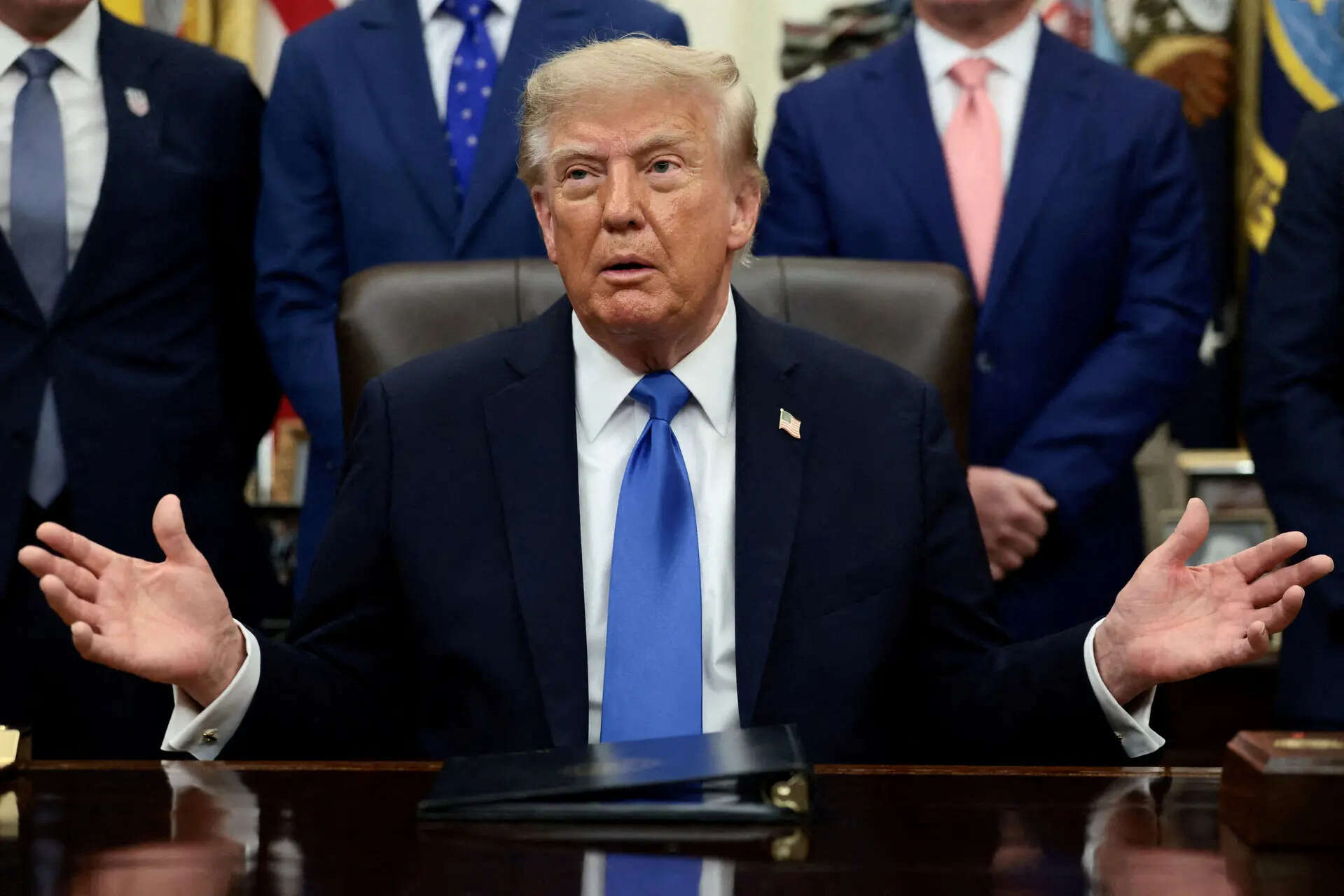
When Donald Trump took aim at artificial intelligence guardrails, dismissing them not merely as bad policy but as a "sick conspiracy," he tapped into a very specific American anxiety. The fear of being left behind. The terror of the bureaucratic hand reaching into the garage of the lone inventor to clip his wings. To the rally crowd, safety standards look like handcuffs. They look like red tape spun by coastal technocrats who want to slow down the American engine.
But behind the podium rhetoric lies a much sharper, quieter tension. This is not just a fight over rules. It is a battle over who gets to define what is dangerous before the danger has even learned how to speak.
Consider what happens inside a laboratory when the training run begins. Billions of parameters adjust themselves in a silent digital dance, finding patterns in human text, human art, and human malice. The engineers watch the loss function drop on a glowing monitor. They do not know what the model is learning. They only know how fast it is learning. And somewhere in that loop, the question of containment arises. Do we build the walls now, while the beast is still small, or do we wait until it fills the room?
For years, a loose coalition of researchers, ethicists, and corporate leaders tried to answer that question with frameworks. Voluntary commitments. Red teaming. Watermarking. Safety buffers designed to keep models from spewing hate speech, fabricating biochemical weapons blueprints, or destabilizing financial markets with automated panic.
To the critics, these guardrails were never about safety. They were about capture. They were incumbents pulling up the drawbridge, writing regulations that only a multi-trillion-dollar balance sheet could afford to comply with. There is truth in that cynicism. Silicon Valley has long practiced regulatory engineering—advocating for rules that choke off scrappy startups while cementing the dominance of the giants who helped write them. When a politician calls safety protocols a conspiracy, they are giving voice to that suspicion. They are telling the mechanic that the government is outlawing wrenches.
Yet the alternative to a flawed brake is not a faster engine. It is a cliff.
We have lived through this movie before. Every major technological revolution arrives with a utopian promise and an unacknowledged bill. The industrial age brought soot-choked skies and child labor before it brought the weekend. The social media era brought global connection before it brought algorithmic radicalization and the erosion of shared reality. Each time, society reacted with the same naive optimism: let it run free, innovation will fix the messes it creates.
Innovation did not fix the messes. It monetized them.
Now, we are applying the exact same libertarian gamble to an intelligence that operates at a scale incomprehensible to human cognition. When a model generates text, it is not thinking; it is synthesizing the collective digital footprint of humanity, warts and all. It knows our prejudices because we taught them. It knows our vulnerabilities because we published them. To strip away the guardrails in the name of speed is not freedom. It is an invitation to chaos disguised as deregulation.
Let us be honest about what safety frameworks actually achieve. They do not stop bad actors. A rogue state or a criminal syndicate operating outside the jurisdiction of Washington or Brussels will not pause because an executive order mentions red-teaming guidelines. They will train their weights on raw data in unmonitored server farms. The guardrails were never meant to stop the outlaws.
They were meant to hold the legitimate institutions to a standard. They were meant to ensure that the companies building the infrastructure of the twenty-first century paused long enough to ask if their product would break the social contract.
When that pause is reframed as a conspiracy, something profound shifts in the national conversation. Caution becomes treason. Doubt becomes weakness. The race takes precedence over the destination. We are told that if America does not build the most powerful model first, someone else will—and that second place means obsolescence, subjugation, loss of empire.
It is a powerful argument. It is an argument built on urgency and fear.
Picture a boardroom in Silicon Valley or Austin. Executives sit around a walnut table, watching the quarterly projections. The compute budget is astronomical. The energy bill rivals a small city. Every month, the models get denser, the reasoning capabilities sharper, the economic stakes higher. Someone in the corner raises a hand. They point out a vulnerability—a tendency for the model to hallucinate false accusations or assist in social engineering attacks. They suggest delaying the rollout by three months to patch the vulnerability.
The room goes cold. Three months means losing market share. Three months means a competitor captures the enterprise contracts. Three months means the stock price stumbles.
In that moment, the political rhetoric outside—the shouting about conspiracies and red tape—becomes the justification they were waiting for. If the highest levels of political power are telling you that safety is just a trick by your enemies, why listen to the safety officer in the corner? Why slow down when the culture itself is cheering for speed?
This is how normalization happens. Not through a sudden, catastrophic collapse, but through a thousand tiny concessions where convenience beats conscience.
The irony is that absolute deregulation does not create a free market. It creates a vacuum, and vacuums are invariably filled by the most ruthless actors with the deepest pockets. Without agreed-upon standards of verification, liability, and safety, the ecosystem devolves into a digital wild west where trust evaporates. If you cannot trust that an AI system’s medical advice is safe, or that its financial transactions are secure, or that its generated media is authentic, the entire edifice collapses under its own weight.
Guardrails are not the enemy of innovation. They are the guardrails on a mountain road. They do not exist to prevent you from reaching the summit; they exist to ensure you survive the hairpin turns long enough to see the view.
When political figures reduce this intricate, high-stakes engineering challenge to a political grievance, they are playing a dangerous game with tools they only partially understand. They are trading long-term civilizational stability for short-term applause lines. They are telling the pilot to disable the collision warning system because it makes too much noise.
The servers in the desert do not care about the applause. They continue to draw their power. They continue to multiply their matrices. The code compiles whether we watch it or not. And as the rhetoric grows louder and the rules grow weaker, the most important question remains entirely unanswered, echoing quietly in the space between the data centers and the ballot boxes:
When the machine finally makes a decision we cannot reverse, whose name will be on the manual?



