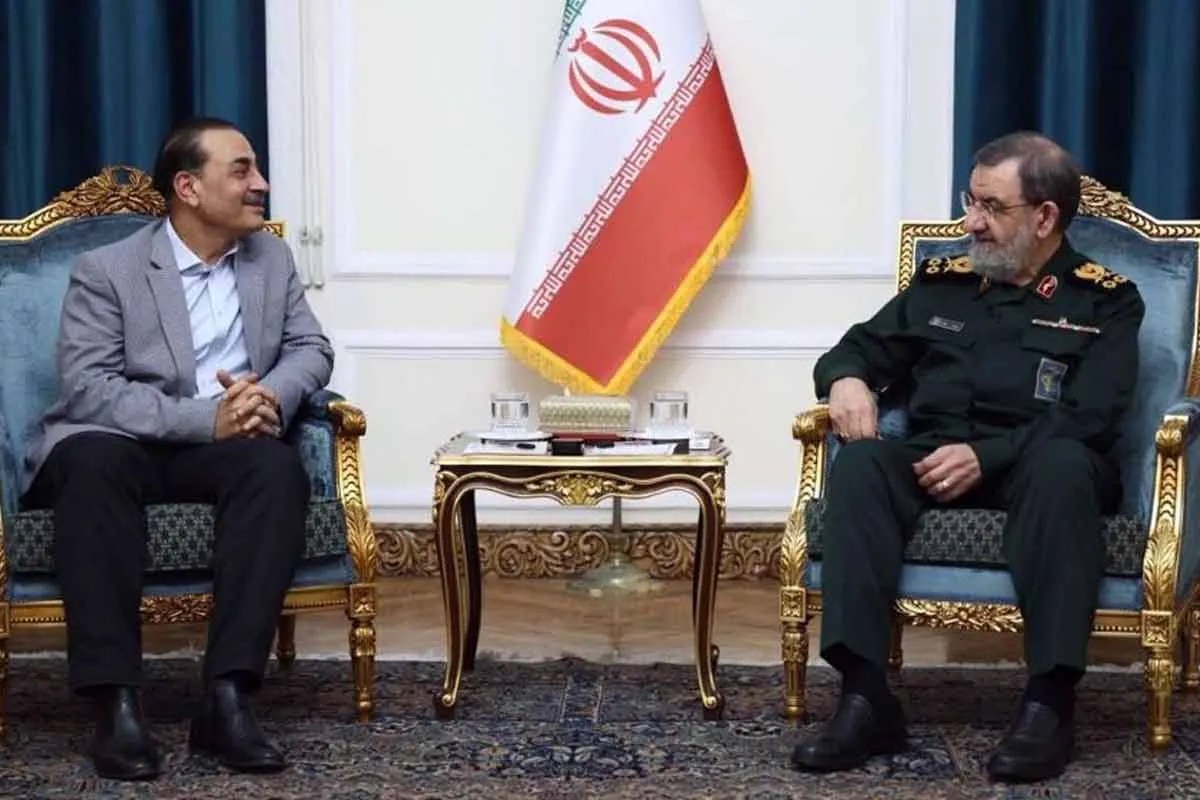
Read the headline again. "We won't give uranium, we won't bow." Dramatic. Defiant. Made for prime-time tickers and furious comment sections.
Now step back from the theater.
Whenever a Pakistani army chief visits Tehran, the lazy consensus writes the exact same script. Two nervous neighbors. One nuclear-armed, cash-strapped, and perpetually balancing between Washington, Beijing, and Gulf capitals. The other sanctioned, isolated, and cornered over enrichment and regional proxies. A high-stakes meeting happens, dramatic red lines get quoted, and pundits ask whether a grand breakthrough or a sudden flare-up will emerge from the room.
That framing misses the point.
Neither side walks into a bilateral meeting expecting a sudden ideological conversion. When Field Marshal Asim Munir meets Iranian counterparts in Tehran, the real game isn't about dramatic surrender or overnight nuclear capitulation. It's about managing friction along a volatile border without letting tactical miscalculations spiral into a strategic mess neither state can afford.
Headline diplomacy loves absolutes. Realpolitik runs on limits.
The Lazy Consensus Around Uranium and Defiance
The standard coverage treats a visit like this as a showdown over nuclear red lines and ideological posture. One camp claims Tehran is drawing an unbreakable line on uranium enrichment while Islamabad tries to mediate or signal strength. Another assumes every high-level military trip must produce either a historic pact or a public rupture.
Both readings mistake noise for signal.
First, Pakistan's core security calculus has never centered on forcing Iran to abandon its nuclear program at the negotiating table. Islamabad's primary obsession is its own security environment: militant sanctuaries along porous borderlands, sectarian spillover inside Pakistan, economic vulnerability, and maintaining credible deterrence on its eastern front while avoiding unnecessary fronts in the west.
Second, Iran's public rhetoric on uranium is domestic and regional armor, not a surprise twist invented for a visiting general. Tehran has spent decades treating enrichment leverage as its primary bargaining chip against Western pressure. Repeating "we won't give uranium, we won't bow" in front of cameras is standard messaging discipline, not a sudden shift in Bilateral talks with a neighboring military chief.
Treat a routine high-level security engagement like a Hollywood standoff and you miss the boring, decisive mechanics underneath. Border intelligence sharing. Cross-border militant containment. Trade bottlenecks. Maritime and energy corridors. That is where real friction lives.
You Are Asking the Wrong Question
Most readers scrolling past this story ask: Will this visit break the deadlock or lead to a clash?
Wrong question.
A single visit rarely breaks structural deadlocks rooted in sanctions regimes, competing external patrons, and deep-seated mistrust. Nor does a formal military visit usually trigger a clash—clashes happen when communication breaks down, not when generals sit across a table.
The sharper question is this: How do two states with conflicting external alignments and overlapping border headaches keep mutual irritation below the threshold of open crisis?
Think about how foreign policy actually works when neither side holds all the cards. Diplomats and military leaders don't always meet to solve a problem completely. Often, they meet to put guardrails on a problem so it doesn't explode during someone else's crisis.
When regional tensions spike—whether in the Gulf, along shipping lanes, or across South and Central Asia—a porous Pakistan-Iran border becomes a force multiplier for trouble. Smuggling networks expand. Armed groups exploit rugged terrain. Rumors travel faster than official statements. A direct channel between Rawalpindi and Tehran isn't a magic wand. It's a shock absorber.
What People Also Ask—And Why the Premise Usually Slips
Why would Asim Munir visit Iran if tensions and suspicions remain high?
Because high suspicion is precisely when backchannels matter most.
People who view international relations like a schoolyard rivalry assume you only talk to friends. In reality, states talk most urgently when incentives collide. Even when Islamabad and Tehran view certain regional moves or outside partnerships with skepticism, both share an immediate interest in preventing cross-border militant attacks from dragging them into escalating retaliatory cycles.
If you wait for trust before holding talks, you never hold talks. Channels exist to manage risk under distrust.
Does Iran's stance on uranium directly derail Pakistan-Iran relations?
Not directly—though it shapes the broader geopolitical environment around both capitals.
Pakistan is a nuclear-armed state itself, operating under its own non-proliferation sensitivities, strategic partnerships, and economic constraints. Iran's nuclear file is primarily a standoff between Tehran, Washington, Brussels, and international inspectors. While regional proliferation dynamics concern everyone in the neighborhood, Pakistan's day-to-day bilateral friction with Iran has historically revolved around border security, militant groups operating in restive frontier regions, energy and trade hurdles, and competing regional influence—not Islamabad acting as a Western enforcer over enrichment centrifuges.
Conflating every headline about Iranian uranium with Pakistan-Iran bilateral ties makes for catchy copy. It makes for sloppy analysis.
Can Pakistan and Iran ever become seamless strategic partners?
No. And pretending otherwise sets readers up for perpetual disappointment.
Seamless alignment requires compatible threat perceptions, aligned external alliances, and complementary economic capacity. Pakistan and Iran have too many competing pulls—different strategic partners, different economic realities, and recurring security anxieties along their shared frontier—to ever move in lockstep.
Expecting a grand alliance is just the flip side of expecting total collapse. Both are lazy binaries.
A Thought Experiment: Two Versions of the Same Meeting
Imagine a scenario where two observers watch the exact same delegation arrive in Tehran.
Observer A watches cable news and reads sensational headlines. Every tough quote about sovereignty and uranium looks like proof of impending rupture or dramatic failure if no sweeping treaty is signed by dusk. By tomorrow, Observer A declares the trip pointless or explosive.
Observer B looks at the structural pressures on both capitals. Pakistan needs border stability, economic breathing room, and predictable neighbors while juggling domestic and regional pressures. Iran faces intense external squeeze and cannot afford an uncontrolled, messy front along its southeastern border. Observer B judges the visit not by dramatic slogans, but by whether practical communication channels stay open and cross-border flare-ups stay contained.
Observer A gets entertained. Observer B gets a realistic read on risk.
Inside the Mechanics of High-Stakes Neighborhood Diplomacy
Having watched coverage of South Asian and Middle Eastern security affairs for years, I've seen plenty of analysts blow their credibility by treating every diplomatic handshake or stern press line as a turning point of history. They chase drama because drama gets clicks. Then, six months later, the underlying structural constraints reassert themselves and the pundits quietly move on without ever admitting their forecast was built on hype.
Let's be precise about terms so we don't muddy the waters. Bilateral crisis management is not the same thing as strategic alignment. Crisis management means keeping disputes contained, sharing basic operational red lines, and preventing accidental escalation. Strategic alignment means sharing long-term security goals and acting in concert against common threats. Pakistan and Iran have practiced periodic crisis management and practical neighborhood coordination; they do not have seamless strategic alignment.
The heavy hitters in serious strategic studies—scholars and practitioners who examine deterrence, security dilemmas, and regional balancing—consistently point out that states in tight neighborhoods often balance competing pressures simultaneously. A government can maintain close ties with one major power while still talking pragmatically with a sanctioned neighbor. That isn't hypocrisy; it's statecraft under constraint.
Now for the part most contrarian writers conveniently skip: the downside of my own argument.
If you treat every high-level visit as routine risk management, you risk underestimating genuine escalation when real red lines are crossed. Sometimes tensions really do spill over. Sometimes miscalculations happen despite open lines of communication. Over-correcting against hype can make an analyst complacent when a genuine shift in posture—such as a sharp change in military deployments, rhetoric, or regional proxies—actually deserves alarm.
A contrarian lens sharpens your judgment only if you still watch the facts on the ground.
How to Read This Story Like an Insider
If you want to cut through the noise the next time a top commander or senior envoy makes a high-profile regional stop, skip the theatrical quotes first and check four practical indicators:
- Watch the composition of the delegation. Who actually travels matters more than the loudest soundbite. Security, intelligence, and border officials point toward operational coordination; trade and technical teams point toward economic friction points.
- Look at border and security headlines over the following weeks. Real signals show up in reduced cross-border incidents, quieter rhetoric around frontier security, or joint statements on counter-terrorism and border management—not in recycled slogans about sovereignty.
- Track external pressures on both capitals. Neither Islamabad nor Tehran operates in a vacuum. Sanctions, economic strain, energy needs, and great-power rivalries shape what each side can realistically offer or concede.
- Ignore binary verdicts. A visit doesn't have to be a historic triumph or a total failure to serve a concrete purpose. Incremental risk reduction is often the highest realistic ceiling in tough neighborhoods.
Don't fall for the loudest line in the room. Watch what changes—or stays quiet—after the cameras pack up.


