The concrete of Bucharest is a cold thing by November. It holds the exhaust of a million rushing cars, the frantic pulse of a capital city that has spent the last three decades trying to outrun its own history, trading old shadows for the bright, synthetic hum of neon storefronts. To walk these streets on a normal night is to be a spectator to modern velocity. Everyone is going somewhere. Everyone is late.
Then the traffic stops.
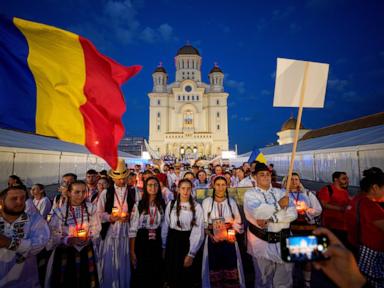
Not because of an accident or a VIP motorcade, but because a river of wax and wool has spilled out from the stone steps of the Patriarchal Cathedral.
Young Orthodox Christians take part in a lights procession in Romania’s capital, but calling it a "procession" is like calling an ocean a puddle. It is an intrusion of another time into our own. Thousands of young people—students with earbuds dangling from their coat pockets, young nurses still smelling faintly of antiseptic, software developers who spent the last eight hours staring at glowing monitors—are standing shoulder to shoulder in the damp autumn air, shielding tiny, flickering points of fire with cupped palms.
Silence is a heavy commodity in a city of two million. Yet, as the procession begins to wind its way down the hill toward the nocturnal arteries of Bucharest, a hush settles over the crowd that no police megaphone could ever command.
Listen closely. You can hear the rhythmic scraping of boot leather on asphalt. You can hear the low, rolling murmur of ancient liturgical chants, passed down through generations like a family heirloom carried in the palm of a hand.
To understand why a twenty-two-year-old marketing coordinator would spend her Thursday night walking three miles in the cold holding a melting pillar of beeswax, you have to look past the religious tourism brochures. You have to look at the hunger.
Modernity promised an absolute liberation. We were told that by untethering ourselves from tradition, from ritual, from the heavy anchors of community and creed, we would finally become the authors of our own complete, uninhibited happiness. The digital age delivered on that promise with terrifying efficiency. We are untethered. We are free. We are also profoundly, paralyzingly lonely.
The psychological landscape of contemporary Eastern Europe is a complex mosaic. On one side stands the glittering allure of Western individualism, consumerism, and the relentless pressure to optimize every waking second. On the other stands the immense, often traumatic generational weight of a communist past that tried systematically to bulldoze the spiritual soul of the nation. For decades, faith in Romania was driven underground, treated as a quiet act of rebellion or whispered behind closed doors.
Now, the grandchildren of those who hid their icons in floorboards are stepping out into the open air. But they are not doing it out of mere habit. They are doing it because they are suffocating in the vacuum of a culture that measures human worth in productivity metrics and Instagram engagement.
The candle flame is fragile. A sharp gust of wind off the Dâmbovița river can snuff it out in a microsecond. This is why the participants instinctively lean toward one another. If your neighbor's flame dies, you offer yours to relight it. In that simple, ancient gesture—the passing of fire from one wick to another—lies an entire philosophy of human interdependence that the algorithm cannot replicate.
Look at the faces in the amber glow. There is Ionuț, a twenty-four-year-old architecture student who spent his afternoon rendering concrete parking garages on his laptop. Tonight, his face is illuminated by a golden warmth that has nothing to do with electricity. He doesn't look at his phone once during the two-hour march. When asked why he’s here, his answer is remarkably unpretentious.
"In the office, everything is temporary," he says, adjusting the collar of his wool coat against the chill. "Projects end. Jobs change. Relationships dissolve over text messages. But this? This wall of people, walking the same way, singing the same words our grandparents sang when everything was forbidden—it stays. It makes me feel like I actually exist."
There is a profound sociological truth buried in that raw confession. We live in an era obsessed with permanence, yet we build our lives out of digital sand. We collect followers, bookmarks, and cloud storage, terrified that if we stop moving, we will vanish. Ritual is the antidote to that terror. It provides a container for time. It tells the human animal that we belong to something larger than our individual anxieties, something that was here before we arrived and will remain long after our screens go dark.
The procession reaches its climax outside the damp stone walls of a neighborhood church, where the thousands of tiny lights converge into a single, blazing bonfire of wax and prayers. The heat hits the cold air, creating a swirling pillar of mist and smoke that rises toward the indifferent night sky.
For a few moments, the city forgets its deadlines. The streetlights overhead look anemic, washed out by the ancient brilliance of human hands holding fire against the dark.
Tomorrow, the emails will pile up. The traffic jams will choke the boulevards. The cold mechanics of the twenty-first century will resume their relentless grinding. But for tonight, the asphalt belongs to the pilgrims. And somewhere in the flickering shadows, the invisible architecture of the human soul has been quietly rebuilt, one wax-stained finger at a time.