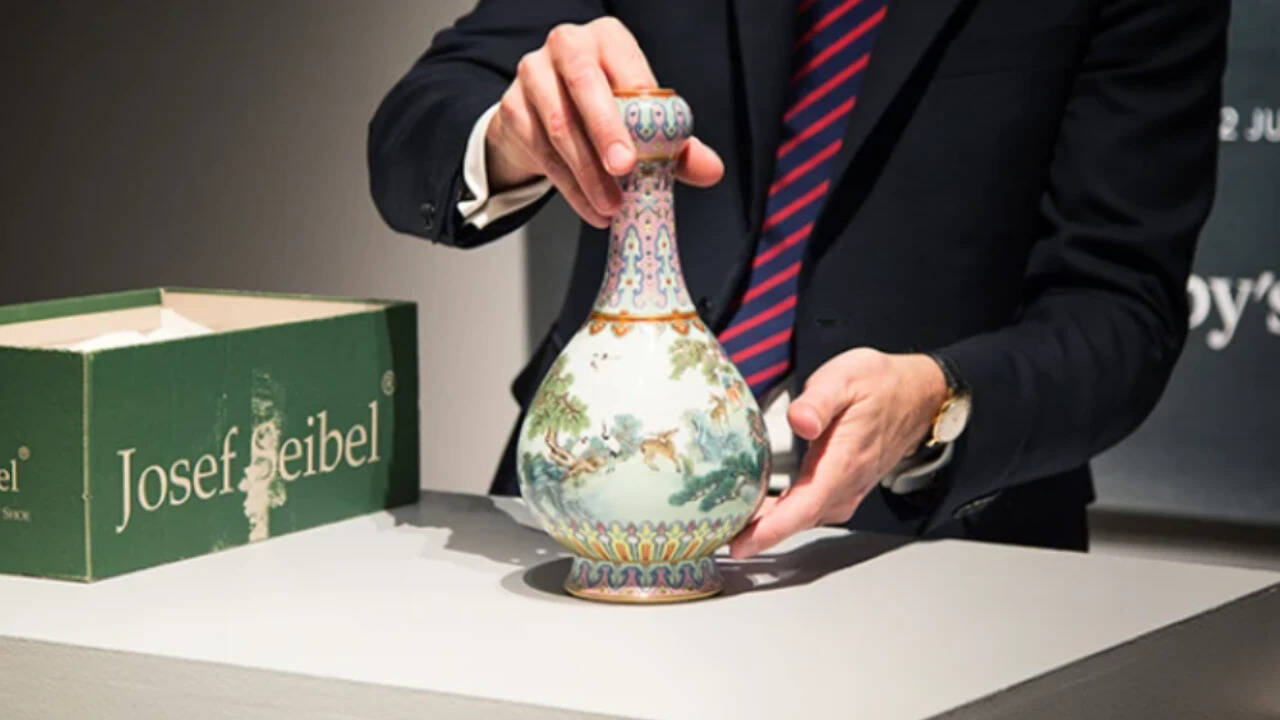
The discovery of a Qing Dynasty porcelain vase in a French attic, subsequently auctioned for 16.18 million euros against an initial reserve or estimate fraction, serves as a masterclass in market inefficiencies, information asymmetry, and asset valuation anomalies. While mainstream media frames such anomalies as whimsical lottery outcomes, a rigorous economic dissection reveals a predictable convergence of provenance verification, liquidity shocks, and positional arbitrage within the secondary luxury antiquities market.
To deconstruct how an object stored in a shoe box transforms into a multi-million-dollar liquidity event, one must evaluate the cost functions of provenance authentication, the information asymmetry between uninitiated owners and institutional auction houses, and the mechanics of competitive bidder signaling in high-value private collections.
The Information Asymmetry Gap in Unverified Provenance
Value in the fine art and antiquities market does not reside exclusively in physical composition, age, or aesthetic execution. It rests entirely on institutional trust, historical documentation, and provenance chain integrity.
When a family discovers an artifact in a residential attic, they operate under severe information asymmetry. The asset owner lacks the diagnostic capabilities, historical cataloging databases, and comparative pricing matrices held by elite auction houses like Sotheby’s or Christie’s. This creates a massive valuation spread.
To the untrained eye, the object is an inherited artifact of indeterminate worth, bounded by zero marginal cost of storage but accompanied by infinite uncertainty regarding liquidation value. Institutional auction houses, conversely, possess the proprietary comparative data required to attribute the piece accurately—in this case, establishing that the 18th-century imperial porcelain piece was crafted for the Qianlong Emperor.
The economic friction here is authentication cost. For an individual holder, verifying an imperial artifact requires specialized expert consultation, metallurgical or material spectroscopy, and archival cross-referencing, which carry high upfront transaction costs and expert fee barriers. The auction house internalizes these verification costs as a standard operational overhead, absorbing the risk in exchange for a percentage of the eventual hammer price through buyer and seller premiums.
The Supply Chain and Custody Risk Dynamics
The physical journey from an attic shoebox to a Paris auction podium highlights the fragility and critical importance of asset custody management during pre-liquidation phases.
Uncatalogued high-value assets face two primary risk vectors prior to formal market introduction: physical degradation and provenance contamination. Residential attics present uncontrolled thermal fluctuations, high humidity gradients, and physical vulnerabilities that threaten fragile ceramic matrices. In economic terms, unoptimized storage subjects high-value capital assets to accelerated depreciation and catastrophic loss risks without any hedging mechanism.
Furthermore, the custody transfer mechanism requires strict chain-of-custody documentation. If the provenance chain—mapping ownership from the 19th-century diplomatic or colonial acquisition to the current heirs—is fractured or poorly documented, the asset suffers from a severe liquidity discount. Bidders at the highest tiers of the art market require absolute certainty regarding legal title to mitigate repatriation claims or restitution challenges from sovereign states or institutional claimants.
The successful monetization of the French attic vase hinged on establishing clean legal title and verifiable historical custody before public exposure, insulating the auction house and prospective buyers from title risk.
Auction Mechanics and the Winner's Curse Mitigation
The mechanism design of an elite fine art auction is explicitly engineered to extract maximum economic rent from high-net-worth individuals through strategic information revelation and competitive tension.
When an item of exceptional rarity enters the market with a conservative pre-sale estimate—a common strategy to stimulate broad initial interest—it creates a psychological and financial anomaly for bidders. The divergence between the conservative low estimate and the final hammer price of 16.18 million euros illustrates the mechanics of the winner's curse mitigation and scarcity-driven bidding wars.
Bidders operate under incomplete information regarding the subjective valuations of their competitors. When an institutional auction house signals that a piece is an unrecorded, highly pristine imperial artifact, sophisticated collectors recognize that market clearing prices will be dictated by positional scarcity rather than fundamental utility.
- Scarcity Premium: Imperial Qing porcelain commissioned specifically for the imperial court represents a finite, non-reproducible supply asset. As global wealth concentration increases, the marginal utility of holding status-conferring positional goods scales disproportionately.
- Signaling Value: Acquiring a museum-grade piece directly from an attic discovery narrative adds a compelling provenance footnote, enhancing the asset's future liquidity and resale optionality.
- Competitive Friction: Sealed-bid or open-cry auction formats force bidders to reveal their private valuations rapidly. As multiple institutional buyers and high-net-worth collectors compete, the price escalates until it reflects the valuation of the single most optimistic marginal buyer, completely decoupling from the initial auction house estimate.
The Cost Function of Unclaimed Heritage
The discovery incident also exposes the macro-level economic inefficiencies inherent in generational asset inheritance. Families frequently hold dormant capital assets across residential properties without recognizing their yield potential or risk exposure.
When capital is locked in physical antiquities, it incurs an opportunity cost equivalent to the risk-free rate of return, adjusted for insurance, preservation, and security overheads. However, unlike traditional equities or fixed-income securities, fine art and antiquities exhibit extreme illiquidity. Converting a porcelain vase into liquid capital requires a multi-month operational pipeline involving cataloging, marketing campaigns, international preview exhibitions, and auction scheduling.
The 16.18 million euro transaction is not an isolated windfall; it represents the sudden realization of deferred capital gains accumulated across decades of unrecognized asset appreciation. The friction lies in the lack of continuous asset auditing by private individuals. Most households possess zero visibility into the changing market dynamics of niche luxury sectors, meaning generational wealth often remains misallocated in cluttered domestic spaces until external diagnostic triggers—such as an estate liquidation or an accidental inventory review—force market exposure.
Strategic Portfolio Implications for Alternative Asset Holders
Analyzing the dynamics of this high-profile auction yields direct tactical takeaways for collectors, estate planners, and asset managers navigating physical luxury assets:
- Dynamic Asset Auditing: Periodic professional appraisals of residential and estate holdings prevent catastrophic undervaluation and mitigate the risk of accidental damage to high-value uncatalogued assets.
- Custody Risk Mitigation: High-value physical assets must be transitioned from unconditioned domestic storage to climate-controlled, insured institutional vaults immediately upon identification of potential historical significance.
- Intermediary Selection: Leveraging tier-one auction houses is mandatory for maximizing price discovery. The global reach and curated collector databases of premier institutions are required to eliminate the liquidity discounts associated with private or regional secondary markets.
- Provenance Documentation: Securing clear family histories, bills of lading, or historical correspondence prior to auction submission directly reduces buyer apprehension and enhances final valuation multiples.
Capitalize on latent physical asset portfolios by integrating rigorous inventory audits into standard estate management frameworks before relying on stochastic discovery events to unlock hidden value.