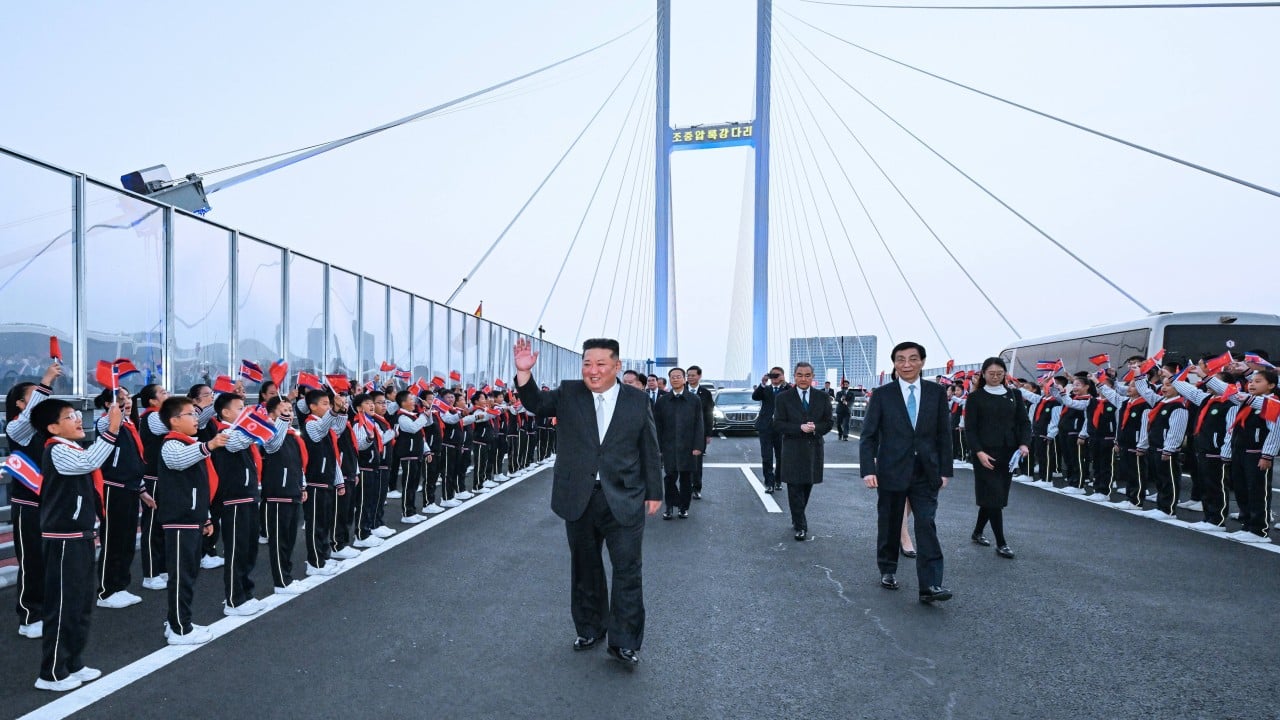
Kim Jong-un’s recent border transit into China diverges from historical pre-summit protocols because Pyongyang is no longer seeking Beijing’s diplomatic mediation; instead, the regime is executing a transactional alignment designed to insulate its economy against Western sanctions while maximizing bargaining leverage over Washington and Seoul. In previous diplomatic cycles—most notably prior to the 2018–2019 Singapore and Hanoi summits—North Korean leadership treated Beijing as an essential guarantor and strategic backstop before engaging external adversaries. Today, the underlying mechanics of Northeast Asian geopolitics have inverted. Pyongyang enters these border engagements from a position of heightened military self-sufficiency, backed by deepening defense-industrial ties with Moscow, which fundamentally alters the bilateral cost function between North Korea and China.
To understand this shift, analysts must separate historical precedent from current operational reality. Standard geopolitical commentary often reduces North Korean border diplomacy to repetitive choreography—armored trains, opaque communiqués, and ritualized demonstrations of socialist solidarity. That framework obscures the structural variables driving the current posture. By decomposing Pyongyang’s pre-summit playbook into its core strategic inputs—security guarantees, economic lifelines, and triangular leverage—we can isolate why this specific border transit signals a hardening of North Korean autonomy rather than a prelude to denuclearization concessions.
The Historical Pre-Summit Playbook
Between March 2018 and January 2019, Kim Jong-un conducted four separate visits to China, utilizing Beijing as a mandatory staging ground before and after high-stakes engagements with South Korean President Moon Jae-in and U.S. President Donald Trump. That sequence followed a rigid, predictable logic rooted in vulnerability and information asymmetry.
During the 2018–2019 cycle, Pyongyang operated under the acute pressure of United Nations Security Council (UNSC) Resolutions 2371, 2375, and 2397. Those sanctions severed roughly 90 percent of North Korea’s legitimate export revenue, targeting coal, iron ore, textiles, and seafood while capping refined petroleum imports. Facing a severe foreign currency bottleneck, Kim Jong-un required two immediate deliverables from Xi Jinping before sitting across from Washington:
- Sanctions Relief Advocacy: Pyongyang needed China to use its veto power and diplomatic weight at the UN Security Council to advocate for phased sanctions relaxation in exchange for reversible nuclear freezes.
- Security Umbrella Verification: Before discussing nuclear dismantlement—even rhetorically—North Korea needed assurance that Beijing would enforce the 1961 Sino-North Korean Mutual Aid and Cooperation Friendship Treaty if negotiations collapsed into kinetic conflict.
In that era, the border transit was an act of strategic deference. Kim traveled deep into Chinese territory—visiting Beijing and Dalian—to align talking points with Xi Jinping, ensuring that Washington could not drive a wedge between Pyongyang and its primary economic patron. China held the structural advantage, dictating the pace of border trade enforcement to keep North Korea compliant with Beijing’s broader stability goals on the Korean Peninsula.
The Structural Inversion of Leverage
The current border engagement operates under an entirely different set of boundary conditions. Three structural changes have degraded Beijing’s unilateral leverage over Pyongyang, transforming a patron-client relationship into a contested, multi-vector negotiation.
The Moscow Factor and Defense-Industrial Substitution
The primary variable disrupting the traditional Sino-North Korean equilibrium is the formalized strategic partnership between Pyongyang and Moscow. By supplying Russia with ballistic missiles, artillery shells, and tactical munitions for the war in Ukraine, North Korea unlocked an alternative revenue and resource stream entirely outside Chinese customs control.
In economic terms, Russia broke China’s monopsony over North Korean labor and exports. Previously, Beijing accounted for over 90 percent of North Korea’s total trade volume, giving Chinese border authorities near-total control over Pyongyang’s macroeconomic survival. Today, Russian transfers of refined petroleum, hard currency, dual-use aerospace components, and food aid have reduced North Korea’s existential dependence on Chinese border crossings. When Kim Jong-un approaches the Yalu River now, he does not arrive as a supplicant seeking permission to negotiate; he arrives as an actor with diversified supply lines who can afford to reject Chinese behavioral conditions.
Nuclear Irreversibility as a Baseline Condition
In 2018, the diplomatic premise of pre-summit diplomacy was the theoretical negotiability of North Korea’s nuclear arsenal. Pyongyang maintained strategic ambiguity, allowing Beijing and Washington to operate under the assumption that sufficient economic incentives might yield denuclearization.
That premise is dead. Following the 2022 codification of North Korea’s nuclear force policy—which lowered the threshold for preemptive nuclear use and declared nuclear status irreversible—Pyongyang no longer engages in pre-summit coordination to discuss disarmament. Any upcoming bilateral or multilateral diplomacy is aimed at arms control, sanctions normalization, and recognition as a de facto nuclear weapons state. This removes China’s primary diplomatic utility. Beijing has historically opposed North Korean nuclearization because it justifies expanded U.S. missile defense deployments (such as THAAD) and strengthens trilateral military integration among the United States, South Korea, and Japan. Because Pyongyang refuses to put its warheads on the table, Beijing can no longer act as an honest broker between Washington and Pyongyang.
Geographic and Operational Compression
The physical parameters of a border trip—as opposed to a multi-day rail journey to Beijing—reflect operational efficiency and calculated signaling. A localized border engagement minimizes security exposure, compresses diplomatic timelines, and signals equality rather than hierarchy.
Historically, traveling to Beijing required Kim to enter the seat of Chinese imperial and Party power, visually reinforcing China’s status as the senior partner. Meeting at or near the border region shifts the optics to mutual frontier management. It centers the agenda on immediate physical infrastructure—customs throughput, cross-border rail modernization, hydroelectric grid integration along the Yalu and Tumen rivers, and special economic zone (SEZ) protocols—rather than grand ideological alignment.
Deconstructing the Three Pillars of Current Border Diplomacy
To evaluate what is actually being transacted during this border engagement, we must look past public statements on "traditional friendship" and examine the three operational mechanisms governing Sino-North Korean border policy.
Pillar 1: Informal Trade Normalization and Sanctions Evasion
Official customs data released by China’s General Administration of Customs captures only a fraction of cross-border economic activity. The true metric of Sino-North Korean alignment lies in informal, gray-zone trade mechanisms that bypass UNSC monitoring panels—particularly following Russia’s March 2024 veto of the UN Panel of Experts mandate.
Border engagements serve to calibrate the enforcement intensity of Chinese provincial authorities in Liaoning and Jilin provinces. Key friction points include:
- Labor Quota Repatriation: Under UNSC Resolution 2397, all North Korean overseas laborers were supposed to be repatriated by December 2019. Tens of thousands remain in Chinese manufacturing, seafood processing, and construction sectors, generating hundreds of millions of dollars in remitted wages for Pyongyang. Border summits establish the tacit tolerance thresholds for visa renewals and rotational replacements.
- Maritime and Rail Transshipment: Pyongyang relies on Chinese territorial waters and border rail hubs (such as Dandong-Sinuiju and Hunchun-Wonjong) to import luxury goods, industrial machinery, and precursor chemicals while exporting sanctioned coal and textiles via ship-to-ship transfers.
- Financial Clearing Houses: Because North Korean banks are severed from the SWIFT network, Pyongyang depends on informal Chinese underground banking networks and front companies operating in border cities to settle cross-border balances in renminbi.
A border meeting indicates that high-level political clearance is required to unblock administrative bottlenecks in these three channels—bottlenecks often created when Chinese state-owned banks fear secondary U.S. Treasury sanctions.
Pillar 2: Containment of the Russia-North Korea Axis
From Beijing’s perspective, the primary strategic driver for engaging Kim Jong-un at the border is risk mitigation. China faces a classic alliance security dilemma: supporting North Korea too openly invites secondary Western sanctions and accelerates U.S.-led containment in the Indo-Pacific, yet ignoring Pyongyang allows Moscow to capture dominant strategic influence on China’s northeastern flank.
Beijing views the deepening Russia-North Korea military relationship with acute suspicion. Russian transfers of advanced satellite, submarine, or ICBM re-entry vehicle technology to Pyongyang directly undermine regional stability and risk triggering nuclear proliferation debates in Seoul and Tokyo. If South Korea or Japan pursues indigenous nuclear weapons in response to a Russian-backed North Korea, China’s regional security environment deteriorates catastrophically.
Therefore, Beijing uses border diplomacy to reassert its economic gravity. By offering targeted infrastructure upgrades—such as operationalizing the New Yalu River Bridge, which has sat largely idle on the North Korean side for a decade due to missing connecting roads and customs facilities—China seeks to remind Pyongyang that while Russia provides wartime artillery contracts, only China can provide long-term industrial modernization and consumer goods at scale.
Pillar 3: Pre-Emptive Triangular Signaling
Whenever geopolitical conditions suggest a potential shift in Washington’s foreign policy posture or a diplomatic opening on the Korean Peninsula, Pyongyang moves to secure its rear flank. By meeting Chinese officials near the border prior to any prospective engagement with external powers, Kim Jong-un executes a dual-track signaling strategy:
- To Washington and Seoul: The meeting demonstrates that North Korea is not diplomatically isolated and cannot be coerced through maximum pressure campaigns. It signals that any U.S. strategy relying on Beijing to enforce economic strangulation on Pyongyang will fail.
- To Moscow: Engaging China reminds the Kremlin that Pyongyang retains strategic optionality. North Korea is historically adept at playing Moscow and Beijing against each other to extract maximum concessions from both—a tactic Kim Il-sung perfected during the Sino-Soviet split of the 1960s.
Differentiating Verified Facts from Analytical Hypotheses
In analyzing closed authoritarian systems, rigorous intelligence assessment requires strict separation between observable empirical data and inferential modeling. Misinterpreting signaling noise as structural policy shifts leads to flawed forecasting.
Verified Operational Facts
- Asymmetric Trade Dependency: Despite increased Russian trade, China remains North Korea’s dominant commercial partner, accounting for the vast majority of imported basic foodstuffs, fertilizers, plastics, and industrial inputs required to prevent domestic economic collapse.
- Infrastructure Stagnation: Major cross-border infrastructure projects—including the New Yalu River Bridge linking Dandong and Sinuiju and the modernization of the Tumen River border crossings—have experienced prolonged delays due to disputes over financing, customs jurisdiction, and Pyongyang’s reluctance to allow unfettered Chinese commercial penetration.
- Divergent Threat Perceptions: Beijing prioritizes regime stability and conflict prevention on its border, whereas Pyongyang prioritizes regime survival through asymmetric nuclear deterrence and offensive military modernization.
Educated Analytical Hypotheses
- The Sanctions-Evasion Calibration Hypothesis: The timing and localized nature of the border trip strongly suggest that mid-level Chinese bureaucratic caution—driven by fear of U.S. secondary sanctions on Chinese financial institutions—has slowed the flow of renminbi liquidity and dual-use goods to North Korea. Kim’s physical presence at the border is likely designed to secure a direct political override from Beijing’s central leadership to loosen provincial customs enforcement.
- The Trilateral Hedging Hypothesis: Pyongyang likely anticipates a finite lifespan for its current economic windfall from Russia. Once the Ukraine conflict stabilizes or Russian munitions stockpiles replenish, Moscow’s demand for North Korean artillery will contract sharply. Kim Jong-un is preemptively locking in Chinese economic commitments now, while his leverage is at its peak, to avoid facing a sudden fiscal cliff when Russian wartime procurement slows down.
- The Command-and-Control Buffer Hypothesis: Border discussions almost certainly include private assurances from Pyongyang regarding its nuclear command-and-control doctrine. Beijing requires verification that North Korea’s tactical nuclear deployments near the inter-Korean border will not result in accidental escalation that draws the People’s Liberation Army into an unwanted regional war.
Limitations of the Current Analytical Framework
Every strategic model contains blind spots. Relying purely on rational-actor economic models to forecast Sino-North Korean border dynamics introduces three specific analytical vulnerabilities:
First, opacity of Russian transfers. Because military-industrial trade between North Korea and Russia occurs via clandestine rail routes across the Tumen River and dark-fleet maritime shipments between Rajin and Russian Far East ports, external analysts cannot precisely quantify the hard currency reserves currently held by Pyongyang’s Room 39. If Russian payments exceed current intelligence estimates, North Korea’s threshold for resisting Chinese economic pressure is substantially higher than historical trade ratios suggest.
Second, domestic Chinese economic constraints. Analysts often assume Beijing can effortlessly subsidize North Korea whenever geopolitics demand it. In reality, China’s northeastern rust-belt provinces—Liaoning, Jilin, and Heilongjiang—face severe local government debt, demographic contraction, and sluggish industrial growth. Beijing’s willingness to fund massive cross-border infrastructure in North Korea is constrained by domestic fiscal realities and the reluctance of Chinese state enterprises to invest in a jurisdiction with zero rule-of-law protections and a history of asset seizure.
Third, personalized decision-making volatility. Both Beijing and Pyongyang operate under hyper-centralized leadership structures where personal rapport or friction between Xi Jinping and Kim Jong-un can override institutional bureaucracy. A sudden shift in personal trust or an unscripted provocation—such as a North Korean satellite launch or nuclear test conducted without prior notification to Beijing—can instantaneously freeze border throughput regardless of underlying economic logic.
Strategic Forecast and Policy Execution
The divergence of Kim Jong-un’s border diplomacy from past pre-summit playbooks confirms that the era of Chinese-mediated denuclearization is permanently closed. Pyongyang is no longer using Beijing as a bridge to Washington; it is using Beijing and Moscow as parallel pillars to sustain a permanent nuclear state immune to Western economic coercion.
For policymakers, intelligence analysts, and regional risk strategists, attempting to revive the 2018 diplomatic model—by pressuring China to rein in North Korea in exchange for bilateral trade concessions—is a guaranteed strategic failure. Beijing neither possesses the unilateral leverage it held in 2018 nor shares Washington’s objective of complete North Korean disarmament.
Strategic execution must pivot immediately to three concrete actions:
- Shift Monitoring from Beijing to Border Customs Nodes: Stop treating high-level diplomatic communiqués as leading indicators of Sino-North Korean alignment. Instead, track physical throughput at specific frontier choke points—specifically rail car volume across the Dandong-Sinuiju bridge, vessel traffic at Nampo and Rajin ports, and night-time illumination patterns in border special economic zones. Physical logistics will reveal whether Beijing has actually loosened sanctions enforcement long before diplomatic rhetoric shifts.
- Target Secondary Financial Clearing Networks: Because Pyongyang’s border diplomacy aims to unlock renminbi liquidity, economic containment must focus on small, regional Chinese banks and front companies operating in Liaoning and Jilin provinces that lack exposure to the U.S. dollar system. Disrupting these localized clearing houses imposes immediate friction on North Korean procurement without requiring futile diplomatic appeals to Beijing’s central government.
- Exploit the Sino-Russian Friction Seam: Recognize that China’s fear of Russian technological proliferation into North Korea is genuine and acute. Diplomatic engagement with Beijing should bypass denuclearization talking points entirely and focus strictly on shared non-proliferation boundaries—specifically pressuring China to interdict aerospace, submarine, and missile guidance components transiting Chinese territory or airspace toward North Korean defense facilities.