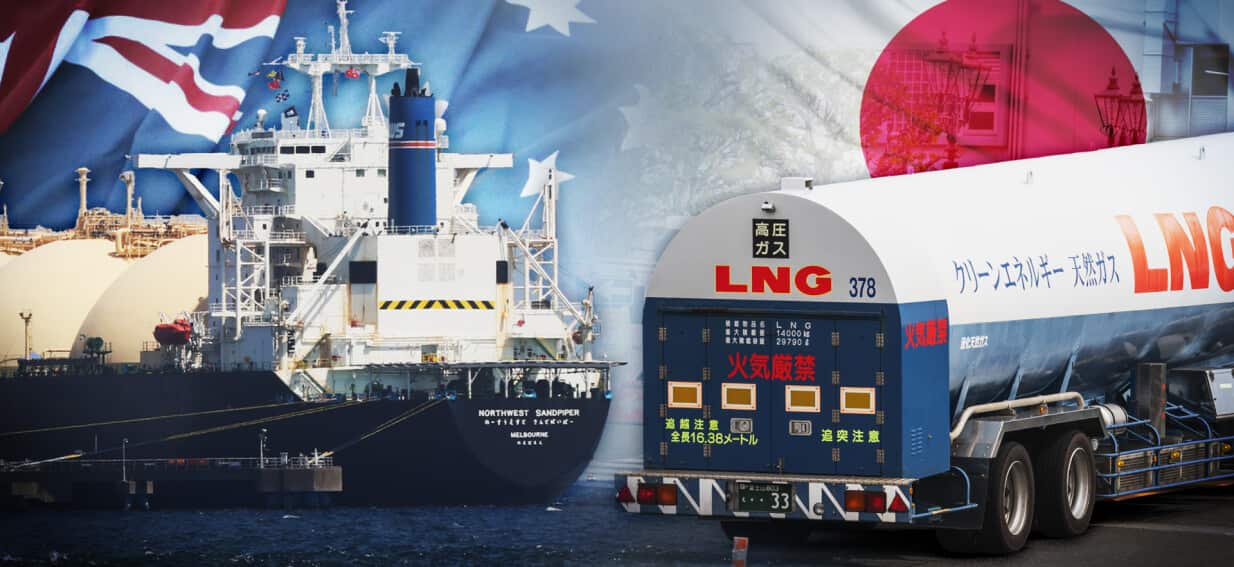
The national outcry over Australian gas exports to Japan is a masterclass in economic illiteracy. We are currently drowning in headlines suggesting that Australia is being "played" or that Japanese utilities are getting our resources for free while we pay record-high prices at home. It makes for a great populist chant, but it ignores the brutal reality of how global energy markets actually function.
The narrative is simple: Australia is a "mug" for exporting vast quantities of Liquefied Natural Gas (LNG) to Tokyo while local industry starves. The reality is far more uncomfortable. Australia didn't get cheated; Australia got exactly what it signed up for. If we feel like we're losing, it’s because we lack the long-term vision and diplomatic discipline that Japan has perfected over the last five decades.
The Myth of the Free Lunch
Let’s dismantle the "getting it for free" argument first. This claim usually stems from a misunderstanding of how the Petroleum Resource Rent Tax (PRRT) and corporate tax structures interact with massive capital expenditures.
When Mitsui, Mitsubishi, or INPEX invest billions of dollars into a project like Ichthys or the North West Shelf, they aren't just buying gas. They are financing infrastructure that Australia was too risk-averse to build on its own. These companies took the "exploration risk" and the "construction risk" when oil prices were volatile and the technical challenges seemed insurmountable.
To say they are getting gas for "free" because the tax revenue hasn't hit a certain arbitrary threshold yet is like saying a homeowner is living for "free" because they haven't finished paying off their mortgage. The capital recovery phase of these projects is a legal and necessary part of the contract. If you change the rules of the game mid-stream, you don't just "fix" the budget; you destroy your reputation as a safe place to invest for the next half-century.
The Domestic Price Trap
Critics love to compare the price of gas in Sydney to the price of Australian gas in Osaka. They point to the "divergence" as proof of a conspiracy. This is the wrong metric.
The price of gas in Australia is high because of a catastrophic failure in domestic policy, not because we are too generous to our neighbors. We have a supply problem on the East Coast caused by drilling bans and regulatory gridlock in states like New South Wales and Victoria. Meanwhile, the gas being exported to Japan comes primarily from the West Coast or the Northern Territory—vastly different basins with entirely separate pipeline infrastructures.
You cannot simply "pipe" gas from the Browse Basin to a factory in Melbourne. The geography doesn't allow it, and the economics of building a transcontinental pipeline are laughably bad. Blaming Japan for East Coast price hikes is like blaming a baker in Paris because the bread is expensive in New York.
Japan’s Secret Weapon: Long-Termism
Japan is not a "mug." Japan is a strategist. They understand something the Australian political class refuses to acknowledge: Energy security is national security.
While Australian politicians treat gas like a political football to be kicked around during every election cycle, the Japanese Ministry of Economy, Trade and Industry (METI) views it as the lifeblood of their civilization. They don't just buy gas; they buy into the entire supply chain. They take equity stakes. They provide low-interest financing through state-backed banks. They sign twenty-year contracts that provide the "bankability" required to get these projects off the drawing board.
Without Japanese demand and Japanese capital, most of Australia’s LNG industry wouldn't exist. We would have the gas, sure, but it would be sitting thousands of meters underground, doing nothing for our GDP.
The Sovereignty Delusion
There is a growing movement calling for "gas reservation" or even nationalization. The argument is that "it’s our gas, so we should keep it."
Imagine a scenario where Australia decides to unilaterally tear up its export contracts to divert gas to domestic manufacturers. On day one, the local price drops. On day two, our credit rating is downgraded. On day three, foreign investment in every other sector—from critical minerals to green hydrogen—evaporates.
Capital is cowardly. It goes where it is treated well and where contracts are honored. If Australia proves it cannot be trusted to uphold a twenty-year energy agreement, why would anyone invest in our "Net Zero" transition? We are currently asking the world to help us build a massive renewable energy export industry. We are asking for billions to develop "Green Iron" and "Green Ammonia."
Who do we think is going to buy those products? The same Japanese customers we are currently threatening to gouge.
The Real Beneficiary of the Status Quo
The irony is that the loudest voices complaining about Japan are often the same ones standing in the way of new supply. By blocking new gas developments on the East Coast, activists and NIMBYs have created a permanent shortage. This shortage keeps prices high, which gives them more ammunition to attack the "greedy" exporters.
It is a self-fulfilling prophecy of failure.
Instead of looking for a scapegoat in Tokyo, we should be looking at the mirror. We should be asking why we haven't built the import terminals necessary to bring West Coast gas to the East Coast. We should be asking why we make it so difficult to develop the Narrabri gas project.
The Cost of Betrayal
Japan is Australia's most reliable partner in the Indo-Pacific. Our relationship is built on the "Japan-Australia Joint Declaration on Security Cooperation." A huge pillar of that security is the guarantee that Australia will provide the energy Japan needs to keep its lights on.
If we break that promise for a short-term political win at home, we aren't just losing money; we are losing a strategic anchor. In a world where geopolitical tensions are rising, turning your back on your most loyal customer—who also happens to be your second-most important security ally—is worse than bad economics. It is a strategic blunder of historic proportions.
Hard Truths for the "Mug" Narrative
- Taxation follows profit, not revenue. You cannot tax a company into prosperity if they are still recouping the $50 billion it cost to build the plant.
- Infrastructure is geography. West Coast gas cannot solve East Coast politics without a pipeline that doesn't exist.
- Contracts are sacrosanct. A nation that breaks energy contracts becomes a pariah in the global capital markets.
- Japan is an investor, not just a customer. They own parts of the projects. You can't "charge" them more for something they already own without it being a direct seizure of assets.
The "We're the mugs" headline is an insult to the intelligence of the Australian public. It suggests that we are victims of a sophisticated Japanese heist. We aren't. We are victims of our own inability to plan beyond a three-year election cycle.
If we want lower gas prices, we need to dig more holes and lay more pipes. If we want more tax revenue, we need to encourage more investment, not threaten the people who already put their money on the table.
Japan isn't the problem. Our lack of a coherent national energy strategy is.
Stop looking at the ships leaving the harbor and start looking at the red tape clogging our own backyard.
Build the supply. Honor the deals. Grow up.