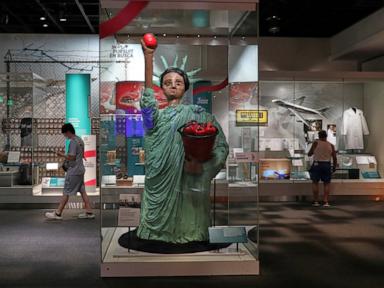
The marble step on the National Mall feels cool through thin soles on a humid July morning. Dust settles on the limestone facades where millions of visitors gather each year, holding paper maps, pushing strollers, and whispering in hushed tones as if inside a church. Museums are built to feel like sanctuaries. They give us a sense that history has been collected, cleaned, sorted, and fixed in place once and for all.
Then comes a piece of metal outside the entrance.
When executive orders target museum displays, commanding that physical plaques be placed outside public institutions to label certain exhibits as inaccurate, the conflict isn't really about brass or ink. It is about who owns the narrative of the past.
Consider a hypothetical museum guard—let’s call him Marcus—standing near the threshold at nine in the morning. For fifteen years, Marcus has watched school groups file past, wide-eyed kids craning their necks up at aircraft, fossilized bone, and hand-woven garments. To him, the building is solid. It represents a shared agreement: here are the things that happened, presented by people who spent their lives studying the remnants.
Now, imagine Marcus watching a new marker being installed near the doors. It tells the family entering with their tickets that what lies inside is disputed territory. Before they even step through the turnstile, the framework shifts. Trust gives way to skepticism.
That single physical addition changes the air in the room.
The Weight of a Frame
Every display case is an act of curation. A museum cannot contain everything, so scholars make choices. They decide which letter to display, which photograph to blow up, and which sentence to put on the wall card. That process is rarely quiet behind closed doors; historians debate fiercely over single adjectives.
When political authority steps over the threshold to mandate overarching disclaimers, it alters the fundamental contract between the institution and the public.
History is rarely a neat line of undisputed facts. It is messy, full of contradictory eyewitness accounts and evolving interpretations. But there is a grand difference between revising history based on newly uncovered evidence and slapping a mandatory label on an institution because its narrative collides with a political agenda.
The plaque at the entrance doesn't merely critique a specific display. It casts a shadow over the entire floor plan.
The Echo in the Grand Hall
Walk down the hallway of any national museum. Listen to the murmur of tourists.
A visitor from Ohio stands before an artifact. A visitor from Tokyo stands beside them. They read the text on the wall. Up until now, that shared experience operated on a baseline of institutional authority. The museum said, "This occurred," and the public accepted the premise enough to reflect on its meaning.
Once a label outside declares the contents suspect, the internal dialogue changes completely.
Is this part true?
Who wrote this panel?
What was left out?
Doubt can be a healthy tool for critical thinking. But when doubt is imposed from above via administrative command, it creates a fog. Visitors no longer focus on the artifact itself—the faded tunic, the handwritten journal, the charred wreckage of an early engine—they focus on the battle taking place over the artifact. The object loses its voice, drowned out by the noise of the dispute outside the front door.
Where Narrative Meets Power
Every era sees a struggle over memory. Governments have long understood that controlling how a nation remembers its past is key to defining its present.
Placing warning labels on historical exhibits is a direct tactic in that ongoing struggle. It signals to the public that the state claims authority over the scholars, that political mandates override archival research.
It creates a strange precedent. If a political administration can order warning signs placed outside cultural institutions today, the next administration can order them rewritten tomorrow. The brass plaques could accumulate like layers of paint on an old doorframe, each layer attempting to cover the one beneath it, until no one remembers what the bare wood looked like.
The real danger isn't that people will read a single controversial label and change their minds. The real danger is fatigue. When history becomes a battleground of mandated disclaimers, citizens grow exhausted. They begin to view all historical records as mere spin, retreating into cynical disbelief where no shared truth can survive.
The bronze doors swing open. The crowds keep coming. But as they pass the marker by the entrance, they enter a space where the past is no longer a anchor, but a rope being pulled from both sides.