Western analysts love a lazy narrative. Feed them a headline about China and the People Liberation Army, and they immediately default to the tired Cold War script. They paint Beijing as a monolithic war machine itching to flex muscle across the Taiwan Strait, driven by an ideological hunger for global domination. This is the comfort food of foreign policy journalism. It is simple, it fits nicely into a Sunday morning talk show segment, and it is fundamentally, dangerously wrong.
The lazy consensus argues that the Chinese Communist Party is obsessively tightening its grip on the military because it wants to build an offensive empire. I have spent decades watching foreign observers misread the room in Beijing. The truth is much more uncomfortable for the West to swallow. The Party does not control the gun to conquer neighbors. It controls the gun because it is terrified of its own shadow.
The Pretorian Paranoia That Dictates Every Move
Let us strip away the propaganda and look at the structural mechanics of authoritarian survival. In a democracy, political power is divorced from the barracks. Ballots drop, governments change, and the generals stay in their quarters eating breakfast. The military serves the state, not the party in temporary possession of the legislature.
In a Leninist system, that separation is fatal.
The Chinese Communist Party remembers history with terrifying clarity. Every major fracture in modern Chinese history involved military defection or warlordism. Chiang Kai-shek carved his power out of military patronage. The warlords of the Republican era tore the country apart because troops answered to commanders, not an abstract political ideal. When you build a regime on absolute monopoly, you cannot afford the luxury of a professionalized, apolitical military.
If the PLA ever truly became a Western-style national defense force belonging to the state rather than the Party, the Party would cease to exist within a week.
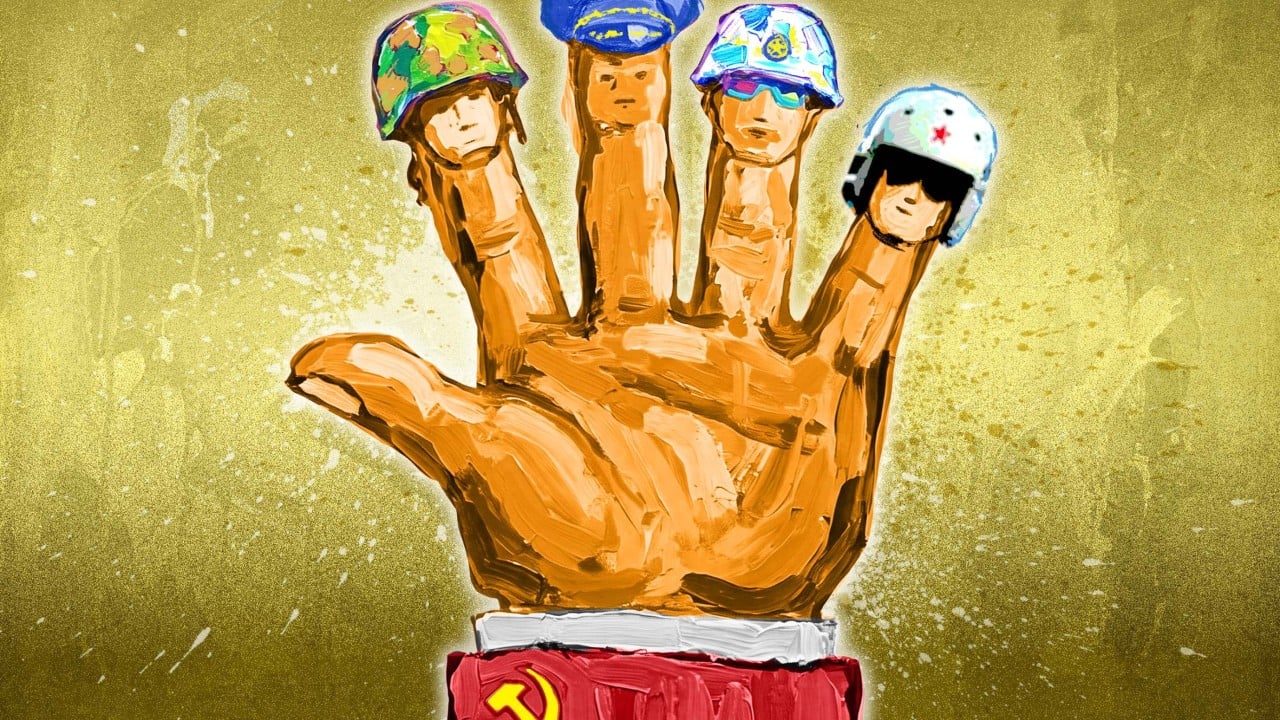
Therefore, civilian control in Beijing is not about preparing for an amphibious invasion of Taipei. It is about domestic insurance. The Central Military Commission is an internal security firewall. Every promotion, every political commissar embedded in a brigade, and every anti-corruption purge executed by Xi Jinping serves a single purpose: ensuring the bayonets point outward to protect the regime from internal rot, economic shock, and popular unrest.
Dismantling the Modernization Myth
When the Pentagon releases its annual report on Chinese military power, western media hyperventilates over hypersonic missiles, aircraft carrier groups, and stealth fighters. Analysts look at the hardware and assume an aggressive doctrine. This is like looking at a Ferrari in a driveway and assuming the owner plans to drive it through your living room.
Capabilities do not equal intentions.
China has modernized its military at a staggering pace, yes. But modernization is not synonymous with offensive readiness. For decades, the PLA was a bloated, corrupt, mercantile conglomerate that ran golf courses, hotels, and smuggling rings. Xi Jinping did not purge thousands of generals because they were too hawkish. He purged them because the military had become a corporate mafia incapable of fighting a modern war, let alone policing the domestic population.
Imagine a scenario where a massive economic slowdown triggers widespread labor strikes across the industrial belt. Who do you think the Party relies on to keep the lid on the boiler? Not the local police force. They rely on garrison divisions whose loyalty has been tested through grueling political indoctrination. The hardware upgrade is designed to deter foreign intervention while the regime secures its home turf.
Look at the structural design of the Theater Commands. They are organized to control domestic peripheries just as much as external flashpoints. The Western Theater Command exists to sit on top of restless border regions. The Southern Theater Command guards trade chokepoints that keep energy flowing into an economy that cannot survive a naval blockade for thirty days.
The Dangerous Flaw in Western Deterrence Strategies
Because Washington insists on viewing the Chinese military through the lens of a classic peer competitor like the old Soviet Union, American strategy keeps missing the target.
For years, defense intellectuals have argued that economic interdependence would pacify Beijing. When that failed, they shifted to the opposite extreme: containment through military hardware build-ups in the Indo-Pacific. Both approaches suffer from the same fundamental blindness. They treat the Chinese leadership as rational actors maximizing national power on a global chessboard, rather than insecure political survivors managing a deeply fragile domestic transition.
When you corner an insecure actor by threatening their vital supply lines and surrounding them with hostile alliances, they do not back down because they are rational. They lash out because domestic survival demands strength.
The irony is thick enough to cut with a knife. By assuming Beijing wants regional hegemony, Western containment policies force the Party to accelerate military control and build projection capabilities that they might not have otherwise prioritized. You create the very monster you fear by misdiagnosing its DNA.
What Real Expertise Looks Like
Let us address the elephant in the room: corruption. The Western press treats recent anti-corruption sweeps in the Chinese military as evidence of instability. They write breathless pieces about generals disappearing and missile silos filled with water instead of fuel.
They are looking at the symptom and missing the mechanism.
In a system built on patronage, corruption is the operating system, not a bug. When a leader wants to consolidate power, purging corrupt generals is the ultimate political tool because every single officer is guilty of something. Xi Jinping is not cleaning the military to make it pure; he is cleaning it to make it obedient.
The downside of this approach is devastating for military effectiveness. Hyper-centralization breeds sycophancy. When officers spend more time studying political theory packets and reciting loyalty oaths than running realistic joint-operations exercises, battlefield competence drops off a cliff. An army designed primarily to prevent coups is rarely an army optimized to win amphibious wars across complex oceanic geography.
We see this tension play out in real time. The technological sheen of the PLA hides a deep institutional anxiety about initiative, independent command, and logistical resilience.
Stop Asking the Wrong Questions
If you are still asking whether China will invade Taiwan next Tuesday, you are playing checkers while the game is three-dimensional chess.
The right question is: How long can an authoritarian party sustain the economic cost of maintaining absolute military control while navigating a demographic cliff and a slowing growth model?
The answer is not found in Jane's Defence Weekly. It is found in labor statistics, property markets, and internal security budgets. The Party's biggest threat is not the United States Seventh Fleet. It is the structural contradiction of trying to run a twenty-first-century digital economy with a twentieth-century political straitjacket.
Control of the military is the ultimate anchor holding that contradiction together. As long as the guns are pointed inward to protect the regime, peace is maintained through deterrence, not because war is impossible, but because war is a luxury the Party cannot afford to lose—and cannot survive winning at too high a cost.
The next time you read an expert warning of imminent global conflict driven by an all-powerful military machine, remember the simple, brutal truth of authoritarian politics. The bigger the army, the greater the fear of the people inside the barracks.
Never mistake the armor for ambition. It is just heavy metal worn by a government that knows how close it is to the edge.