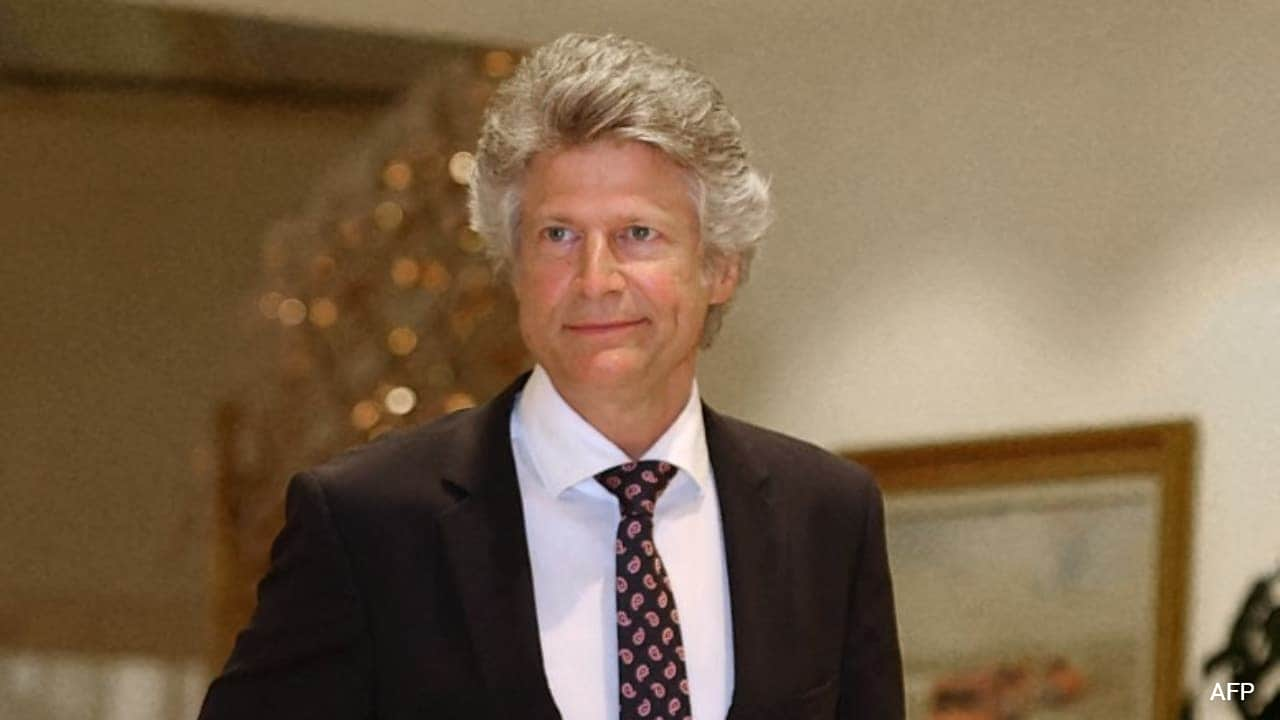
When Jasper Wieck took his seat at the NDTV World Summit 2026 as Germany's ambassador to India, he did not arrive as a career trade bureaucrat or a gentle cultural envoy. He arrived straight from four years as Political Director at the German Federal Ministry of Defence. That single appointment tells you almost everything you need to know about where Berlin's priorities sit in 2026.
For decades, German foreign policy in Asia operated on a simple division of labor. Commerce came first, security came second, and hard military power rarely entered the conversation unless a crisis forced the issue. Sending a seasoned defense strategist to New Delhi signals that those polite boundaries are gone.
Having covered European security desks and Indo-Pacific diplomacy for over twenty years, I have watched plenty of ambassadors arrive in South Asia bearing glossy brochures about green hydrogen and clean mobility. Wieck's dossier looks very different. Before stepping into the New Delhi embassy in the summer of 2026, he ran defense and security policy in Berlin, served at Germany's permanent delegation to NATO in Brussels, and worked on South Asia and the Indo-Pacific at the Federal Foreign Office. He knows how alliances strain under pressure. He also knows how slowly defense procurement moves when politicians talk big and factories lag behind.
The Real Shift Behind the Envoy Pick
A polite summit appearance makes for tidy headlines. It rarely explains the underlying power math.
Berlin is no longer treating India merely as a vast consumer market or a counterweight to Beijing on paper. With bilateral trade in goods and services pushing past $52 billion in 2025 and Chancellor Friedrich Merz leading a heavy business delegation to India in January 2026, the economic foundation is already sizable. Yet trade numbers alone do not protect shipping lanes, stabilize semiconductor supply chains, or deter maritime coercion in the Indian Ocean.
That is where Jasper Wieck comes in. Putting a defense veteran at the helm of the embassy aligns diplomatic messaging with hard hardware. Consider what has moved onto the bilateral agenda between 2025 and 2026:
- Submarine and naval cooperation, including Indian approval of a massive ₹70,000-crore program for six locally built submarines involving German industrial participation.
- Munitions and defense manufacturing, with German firms such as Rheinmetall and Diehl Defence expanding industrial ties in India.
- Critical technologies and space, spanning semiconductors, critical minerals, and deeper coordination between ISRO and the German Space Agency.
- Skilled migration and labor mobility, built on Germany's Skilled Labour Strategy for India, aimed at easing severe domestic workforce shortages in engineering, healthcare, and tech.
None of those tracks are easy. Each carries friction that summit panels tend to gloss over.
Where Defense Ambition Meets Industrial Reality
Let us look closely at the defense track, because that is where the gap between grand rhetoric and real execution is widest.
Berlin has spent the past few years retooling its own security posture after years of underinvestment. German defense companies face heavy domestic order books, strict export-control scrutiny, and supply bottlenecks of their own. Meanwhile, New Delhi insists on indigenous manufacturing, technology transfer, and domestic value addition rather than off-the-shelf imports.
Those two instincts collide regularly. A German defense executive wants predictable export clearances and clear intellectual property protection. An Indian defense official wants local assembly, domestic supply chain depth, and competitive pricing. Neither side is acting irrationally. Both are protecting national interests.
To see how this plays out in practice, consider a hypothetical example: a German naval electronics supplier bids on a joint Indian shipyard program. On paper, both capitals cheer the partnership as a triumph of democratic security cooperation. Behind closed doors, engineers argue over source-code access, compliance officers review dual-use rules, and procurement timelines stretch across fiscal years.
That is the unglamorous reality Jasper Wieck has to manage every week. Big joint statements get signed in conference halls. Real capability gets built—or stalled—in contract clauses, licensing approvals, and factory audits.
Why New Delhi Still Guards Its Strategic Autonomy
Anyone watching India's foreign policy from afar sometimes mistakes closer ties with Berlin for alignment with Western bloc politics. That is a mistake.
New Delhi has spent decades building strategic autonomy, and it is not handing that leverage to any capital, Washington or Berlin included. India maintains deep historical defense ties with Russia, manages complex border tensions with China, and courts partnerships across the Middle East, Africa, and Europe simultaneously.
Germany's own record adds nuance to the conversation. For years, Berlin's energy and industrial model leaned heavily on cheap Russian gas and deep Chinese market integration. When those assumptions fractured, Germany had to rethink its entire economic and security playbook. Indian policymakers noticed. They respect German engineering and rule-of-law institutions, yet they read Berlin's newfound urgency with clear-eyed pragmatism.
In New Delhi, partnership is transactional as well as strategic. If Germany wants deeper security cooperation and greater market access for its firms, it has to offer tangible industrial value, faster visa and mobility pathways for skilled Indian workers, and a consistent voice on global supply chains.
The Talent and Trade Equation
Security dominates headlines at a summit like NDTV World Summit 2026, especially when an envoy with a military-policy background is on stage. Yet people and capital move on a quieter clock.
Germany faces a demographic squeeze that no single policy decree can fix overnight. Factories, hospitals, and software teams need engineers, nurses, and technicians. India has millions of young workers entering the labor force every year, alongside growing domestic ambitions to keep high-value manufacturing and research at home.
Even bilateral investment shows how selective capital can be. While cumulative German foreign direct investment in India has reached roughly $15.5 billion since 2000, annual inflows in recent fiscal years have hovered in the hundreds of millions rather than exploding overnight. Indian companies, meanwhile, have expanded their footprint in Germany across IT, automotive, pharmaceuticals, and manufacturing, though asymmetric trade balances and regulatory hurdles still require constant attention.
A hypothetical example helps illustrate the human side of that ledger. Imagine a mid-sized mechanical engineering firm in Baden-Württemberg struggling to fill open automation roles. It partners with a training institute in Pune and sponsors engineers under Germany's skilled labor framework. The firm gets needed talent; the engineers gain European experience and higher pay. Yet language training, credential recognition, and housing costs in German cities still slow the process down.
Diplomacy without operational follow-through leaves good intentions stranded on paper.
What to Watch Beyond Summit Soundbites
Summits reward polish. Ambassadors get judged on friction.
Over the coming year, the real test of Jasper Wieck's tenure in New Delhi will not be how smoothly he speaks on a panel at the NDTV World Summit 2026. It will be whether major defense industrial programs move past negotiation into actual production, whether German export and technology-transfer rules adapt fast enough to match Indian manufacturing goals, and whether mobility channels for students and skilled professionals clear administrative bottlenecks without creating backlash at home.
Watch the contract milestones, not the press releases. Watch how quickly licensing approvals move when industrial stakes get real. That is where German-Indian relations stop being a talking point and start becoming a durable power equation.