The sun is a physical assault. It hammers against the shutters of a small taverna in Athens, or perhaps a lokanta in Istanbul—at this hour, with a head full of last night’s anise-scented regrets, the geography feels secondary to the biological crisis. Your pulse is a drum. Your mouth is a desert. You need a miracle, and in this corner of the Mediterranean, that miracle usually arrives in a bowl of gray, steaming broth that smells aggressively of the barnyard.
This is tripe soup. To the uninitiated, it is a challenge. To the desperate, it is salvation. But to the Greeks and the Turks, it is a frontline in a cultural war that has simmered for centuries.
The Geography of a Hangover
History is often written in blood and ink, but it is felt in the stomach. For decades, a quiet but fierce feud has bubbled over who truly owns the recipe for this funky, fatty restorative. The Greeks call it patsas. The Turks call it işkembe çorbası. Both sides claim the title of inventor. Both sides treat their version as the definitive cure for a night spent dancing under the stars or arguing in a dimly lit bar.
Consider a hypothetical traveler named Elias. Elias spends his Friday night in Thessaloniki, moving from one tsipouro house to another. By 4:00 AM, his equilibrium is a memory. He stumbles into a 24-hour patsatzidiko. The air is thick with steam and the scent of boiling vinegar and garlic. He orders a bowl. The cook, a man whose family has likely chopped tripe since the fall of the Ottomans, ladles out a mixture of cow stomach and trotters.
Across the Aegean, in a bustling district of Istanbul, a woman named Selin is having the exact same experience. Her broth is seasoned with a lemon-egg emulsion called terbiye. She adds a heavy splash of garlic water. Both Elias and Selin are seeking the same thing: a way to coat the stomach, replenish salts, and survive the coming day. They are united by their misery, yet their nations remain divided by the bowl.
The Chemistry of the Cauldron
Why does this work? Why would anyone, in their most fragile state, reach for the lining of a cow’s stomach?
The logic is brutal and effective. Tripe is incredibly rich in collagen and minerals. When simmered for hours, those proteins break down into a gelatinous broth that sits heavy and protective against a stomach lining ravaged by ethanol. It isn't a delicate meal. It is a structural repair.
The conflict isn't just about ingredients; it is about identity. Food is the last thing people surrender when borders shift. When the population exchanges of the 1920s forced millions of people to move between Greece and Turkey, they carried their copper pots with them. They brought the smell of boiling tripe into new neighborhoods, claiming the scent as the aroma of "home."
When a Greek chef insists that patsas is an ancient Hellenic remedy, they are reaching back to the medicinal broths of antiquity. When a Turkish usta argues that işkembe is a jewel of the Ottoman court, they are citing centuries of imperial culinary refinement. The facts are often buried under layers of shared history. The Byzantine Empire and the Ottoman Empire occupied the same dirt, breathed the same air, and suffered the same hangovers. To pick a "winner" is to try and unweave a rug that has been knotted together for a millennium.
A Ritual of Vinegar and Fire
The experience of eating this soup is a theater of the senses. You don't just eat it; you negotiate with it.
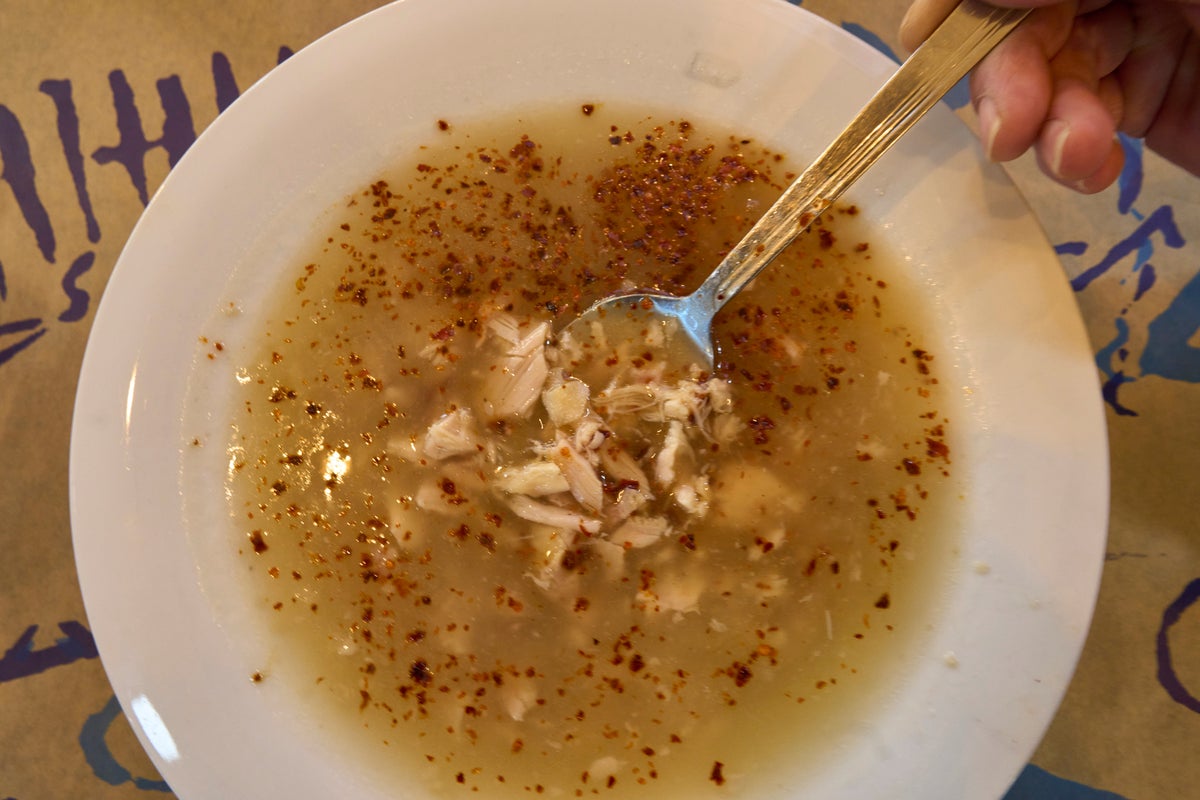
First comes the bowl, white and unassuming. Then comes the ritual of seasoning. In Greece, the skordostoubi—a potent infusion of crushed garlic in vinegar—is non-negotiable. You pour it in until your eyes water. You add dried red pepper flakes until the surface of the broth looks like a map of Mars.
The first spoonful is a shock. The texture of the tripe is soft, almost creamy, but with a distinct chew that reminds you of its origin. It is earthy. It is primal. It tastes like survival.
As you eat, the heat of the soup begins to work. The sweating starts. This is the "exorcism" phase. The alcohol is being chased out by the sheer force of the garlic and the fat. By the time you reach the bottom of the bowl, the world feels slightly less tilted. The sun outside the door is still bright, but it no longer feels like a personal insult.
The Stakes of a Shared Table
We live in an era where we want to categorize everything. We want clear origins. We want "authentic" labels. But the feud over tripe soup reveals a deeper truth about the human condition: we are more alike in our vices and our recoveries than we are different in our politics.
The invisible stakes of this culinary battle aren't about patents or restaurant revenue. They are about the fear of being forgotten. If a Greek admits the soup has Turkish roots, or vice versa, they feel a piece of their cultural armor falling away. Yet, the irony remains that a Turk and a Greek could sit at the same table in a neutral city, share a bowl of stomach broth, and find themselves in complete, silent agreement about the remedy.
The tension persists because food is the most intimate form of nationalism. You take it inside your body. It becomes your cells. To say a "rival" invented your comfort food is to admit that you are made of them.
The Morning After the War
There is no resolution in sight for the great tripe debate. The menus will continue to use different names. The grandmothers on both sides of the sea will continue to claim their secret method is the only "true" one.
But tonight, somewhere in a dark alley in Athens or a bright square in Istanbul, a pot is already beginning to simmer. The water is turning cloudy. The tripe is softening. The cook is sharpening his knife, preparing for the wave of broken souls who will come seeking a cure as the clubs close.
They will come for the salt. They will come for the fat. They will come because, despite the centuries of bickering, the human body knows what it needs when the lights go up. It needs the warmth of a shared past, served in a chipped ceramic bowl, seasoned with enough garlic to keep the rest of the world at bay.
The steam rises. The spoon clinks against the side of the dish. The feud continues, but for a moment, the pain stops.