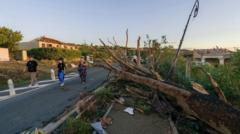
Every time a funnel cloud drops out of a European sky and rips the roof off a cluster of centuries-old stone houses, the media machine spins up the exact same tired narrative. The headlines scream about freak weather, wrathful skies, and unprecedented acts of atmospheric violence. Dozens are left injured, shock blankets the local café, and commentators nod sagely while talking about how unpredictable the planet has become. It is a comforting narrative for people who prefer their disasters neat, random, and completely absolved of human agency.
It is also absolute garbage.
I have spent two decades walking the wreckage of industrial and municipal planning failures across three continents. I have stood in the muddy craters where insurance adjusters cry wolf and municipal engineers quietly shred their own zoning permits. When a tornado tears through a French village, the meteorology is merely the executioner. The architect of the disaster is human stupidity, compounded by systemic denial, ancient infrastructure wrapped in romantic nostalgia, and building codes written by people who think a stiff breeze is a national emergency.
Let us dismantle the lazy consensus right now.
The Myth of the Unprecedented Freak Event
The standard news cycle relies on amnesia. The moment a tornado touches down in Western Europe, anchors act as though the continent has never seen swirling wind before. They treat atmospheric physics like an uninvited guest crashing a quiet dinner party.
The truth is much more inconvenient. Tornadoes in France are not statistical anomalies. They happen with regular, documented frequency. Météo-France records dozens of them every single year. The difference between a harmless swirl in an empty wheat field and a catastrophe that levels a village is not the wind speed. It is the structural integrity of what sits in the path of that wind.
When a twister hits a Midwestern town in the United States, we critique the lack of basements and the reliance on cheap timber framing. Yet when the exact same meteorological phenomenon hits a rural French commune with medieval mortar and unsupported masonry walls, we blame the heavens. We romanticize stone and mortar as eternal, ignoring the fact that lime mortar degrades into powder over centuries, and unreinforced rubble walls turn into lethal shrapnel at the slightest lateral load.
If you build out of brittle materials without structural steel ties or proper anchor bolts, you are not living in historic charm. You are living in a trap.
The Zoning Illusion and the Bureaucracy of Blindness
Let us talk about why those villages look the way they do. Local French mayors and regional planning commissions love to hide behind heritage protection laws. Every tile on the roof must match the 18th-century aesthetic. Every shutter must be painted the authorized shade of faded blue.
Yet, when it comes to structural wind resistance, modern engineering standards are treated like optional suggestions for fear of ruining the view.
I have seen municipal budgets where millions are funneled into cobblestone beautification projects while the local school roof is held together by hope and structural neglect. When disaster strikes, the immediate cry is for state emergency funds and national sympathy. Nobody asks why the local government spent the last decade fighting wind-bracing mandates because they compromised the aesthetic purity of the town square.
Insurance markets have started noticing this willful blindness, even if the journalists haven't. Reinsurance firms are quietly rewriting risk models for European windstorms, realizing that high-density historical settlements are sitting ducks. The risk is not growing because the atmosphere is turning into an action movie. The risk is growing because populations are clinging to antique building typologies while density creeps outward into vulnerable agricultural corridors.
The Physics They Do Not Want to Print
Let us get technical for a moment, because precision matters when lives are on the line.
A tornado generates destructive force primarily through extreme pressure differentials and high-velocity shear stress. When wind hits an unanchored roof, it creates an aerodynamic lift identical to an airplane wing. If the roof trusses are merely resting on top of a stone wall by gravity rather than being securely bolted down with steel hurricane ties, the roof lifts off, destabilizing the entire structural envelope. Once the roof goes, the lateral pressure from the wind pushes the unsupported exterior walls outward, causing a catastrophic pancake collapse.
This is basic physics. It has nothing to do with bad luck.
Yet, try telling a local preservation board that you need to run steel anchor rods through a two-hundred-year-old stone facade. They will look at you as if you proposed paving the Louvre. They prefer the aesthetic of tragedy over the intrusion of modern safety engineering.
We need to stop treating these events as acts of God. An act of God is an earthquake in an unpopulated desert. A village destroyed by a moderate-intensity wind vortex is an act of human negligence masked as tragedy.
What Real Preparedness Looks Like
If you want to stop counting injuries after every storm, the solution requires tearing up the playbook of sentimentality.
First, stop rebuilding destroyed structures to their exact original specifications just to satisfy regional architecture boards. If a house falls down because the wind blew hard, rebuilding it the exact same way is an open invitation for the next storm to finish the job. Retrofitting historic masonry with hidden interior steel frames is entirely possible, but it costs money, requires political courage, and ruins the illusion that we can live in the past without paying the piper.
Second, overhaul early warning dissemination. Too many European rural zones rely on sirens that sound like air raid relics from 1945, operated by volunteers who have to physically drive to the town hall to flip a switch. In an era of pocket supercomputers, local emergency alerts should target mobile devices with pinpoint radar trajectories minutes before touchdown, not five minutes after the roof is already in the next county.
Finally, we need to retire the phrase "freak storm" from the journalistic vocabulary entirely. It is a cognitive crutch used by lazy observers who refuse to study the intersection of meteorology, structural engineering, and poor municipal planning.
The wind does not care about your heritage zoning laws. It does not care about your historical aesthetics. And until local authorities stop treating structural physics as an optional elective, every village with a medieval church steeple is just waiting for its turn in the wind tunnel.