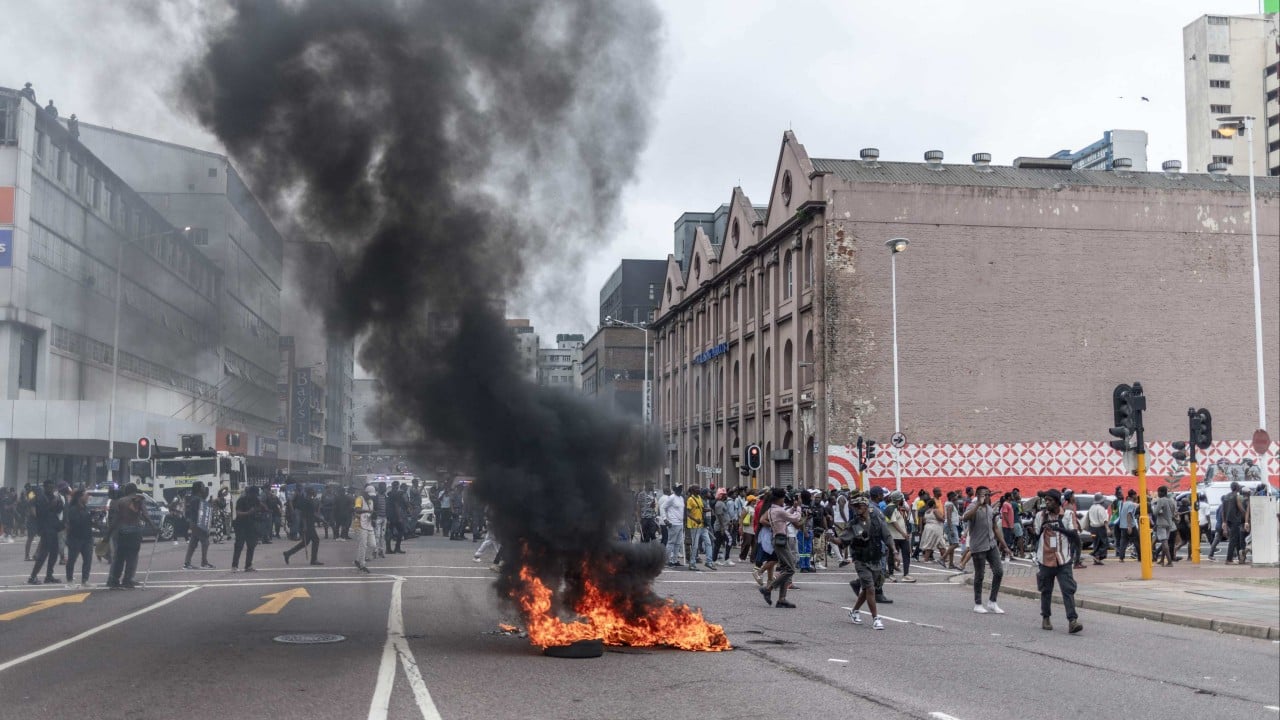
Every time a mob erupts in South Africa and takes a human life under the banner of border protection, international journalism rolls out a tired script. Xenophobia. Hatred of the stranger. The poor, misguided native population lashing out at economic outsiders because of ancient tribal animosities or simple ignorance.
It is a clean narrative. It fits neatly into a Western cable news segment. It requires zero cognitive effort.
It is also completely, catastrophically wrong.
When fifty people beat a man to death in a township street, calling it mere xenophobia is an intellectual cop-out. It hides the machinery of state failure behind a moralizing fog. It treats a symptom of institutional collapse as a root cause of personal wickedness. If you want to understand why South African townships boil over into lethal vigilante justice, you have to stop listening to pundits who have never walked a dirt road in Diepsloot and start looking at the mechanics of abandoned sovereignty.
I have spent years watching institutions decay from the inside, tracking how civic order dissolves the moment the monopoly on violence shifts from the police badge to the street corner. When governance dies, people invent their own security. And when you invent your own security without courts, without evidence, and without rules, murder becomes municipal administration.
The Myth of the Bigoted Mob
The lazy consensus says that local South Africans wake up every morning consumed by hatred for Zimbabweans, Nigerians, or Somalis. The data—and the reality on the ground—tells a far more uncomfortable story.
Look at the demographics of the attackers and the victims. They often live on the same dusty streets. They shop at the same spaza shops. They share the same power outages, the same contaminated water sources, and the same complete absence of municipal services. The tension is rarely cultural; it is structural.
Imagine a scenario where a municipality has completely stopped functioning. The police response time is measured in hours—if they show up at all. Extortion rings run by local gangs control the electricity grid, shaking down residents just to keep the lights on. In this vacuum of authority, crime surges. Break-ins happen nightly. Hijackings are a morning commute routine.
When citizens realize the state has abandoned them, they form neighborhood patrols. Initially, these patrols serve a noble purpose: keeping the block safe. But without legal boundaries, due process, or judicial oversight, a patrol quickly mutates. It becomes a kangaroo court. And a kangaroo court always demands a sacrificial lamb to prove its effectiveness.
Foreign nationals—particularly undocumented ones—make convenient targets not because of their passports, but because they lack political constituency, family networks to protect them, or recourse to the legal system. They are the path of least resistance for a community desperate to exert control over something, anything, in a world spinning entirely out of control.
Blaming xenophobia lets corrupt politicians off the hook. It allows municipal leaders who have looted infrastructure budgets for decades to point a finger at the populace and cry prejudice. As long as the ruling class can frame the violence as a cultural defect of the poor, they do not have to answer for the fact that they built a country where the social contract has completely expired.
Sovereignty Vacuum and the Rise of Lethal Self-Help
To grasp why these modern lynchings happen with terrifying regularity, we have to define what actually happens when a state fails.
Max Weber famously defined the state as a human community that successfully claims the monopoly of the legitimate use of physical force within a given territory. In vast swathes of South Africa's urban peripheries, that monopoly does not exist. The state has surrendered the streets.
When the state abdicates its core function, a power vacuum opens. Nature abhors a vacuum, and civic order abhors lawlessness. Into that gap steps the mob.
Political scientists often talk about weak states, but they rarely describe the terrifying efficiency of localized vigilante justice. When there is no detective to investigate a burglary, no prosecutor to try the thief, and no prison to hold the convict, the community becomes all three.
The transition from a community meeting to a public execution follows a predictable, cold-blooded sequence:
- The Trigger Event: A high-profile crime—a robbery, a murder, or a rape—shatters the fragile peace of a neighborhood.
- The Information Breakdown: Rumors spread unchecked through WhatsApp groups and word-of-mouth. In the absence of official police updates, conspiracy theories harden into absolute truths within minutes.
- The Scapegoating: A suspect is identified, often based on circumstantial markers, foreign accent, or outsider status.
- The Collective Absolution: Responsibility is diffused across the crowd. When fifty people strike a single target, individual accountability vanishes. No single hand delivered the fatal blow; the collective body politic did.
This is not random chaos. It is a grotesque, distorted parody of law and order. The mob believes—erroneously, brutally, but sincerely—that they are doing the job the government refuses to do. They are cleaning up the neighborhood.
Pretending this is just about bigotry prevents us from fixing the machinery that drives it. You can run all the tolerance campaigns you want, plaster billboards across Johannesburg about unity, and hold UN-sponsored conferences on human rights. None of it will save a single life as long as police stations are understaffed, courts are dysfunctional, and communities are left to fend for themselves against armed syndicates.
Dismantling the Rescue Fantasy
The international community loves a simple rescue fantasy. Bring in foreign aid, fund an NGO, launch a public awareness campaign against hate speech, and watch the problem evaporate.
It is a comforting delusion. It costs money, makes donors feel virtuous, and changes nothing.
The brutal truth is that social cohesion cannot be manufactured by marketing firms. It is the byproduct of competent governance. Where the state provides reliable security, functional courts, and equitable economic opportunity, xenophobic violence plummets. Where the state collapses, neighbor turns on neighbor, fighting over the scraps of a dying economy.
If we want to stop these tragedies, we have to abandon the comforting lie of pure xenophobia. We have to look at the unvarnished reality of policing deficits, municipal corruption, and the total breakdown of the rule of law in marginalized settlements.
Stop asking how we can teach tolerance to a starving, terrorized population abandoned by its government. Start demanding accountability from the leaders who turned the promise of the rainbow nation into a survivalist free-for-all.
Until the state reclaims its monopoly on violence and restores basic security to every neighborhood, the mob will remain the ultimate judge, jury, and executioner. And no amount of moral posturing from afar will stop the next beating from starting in the dark.