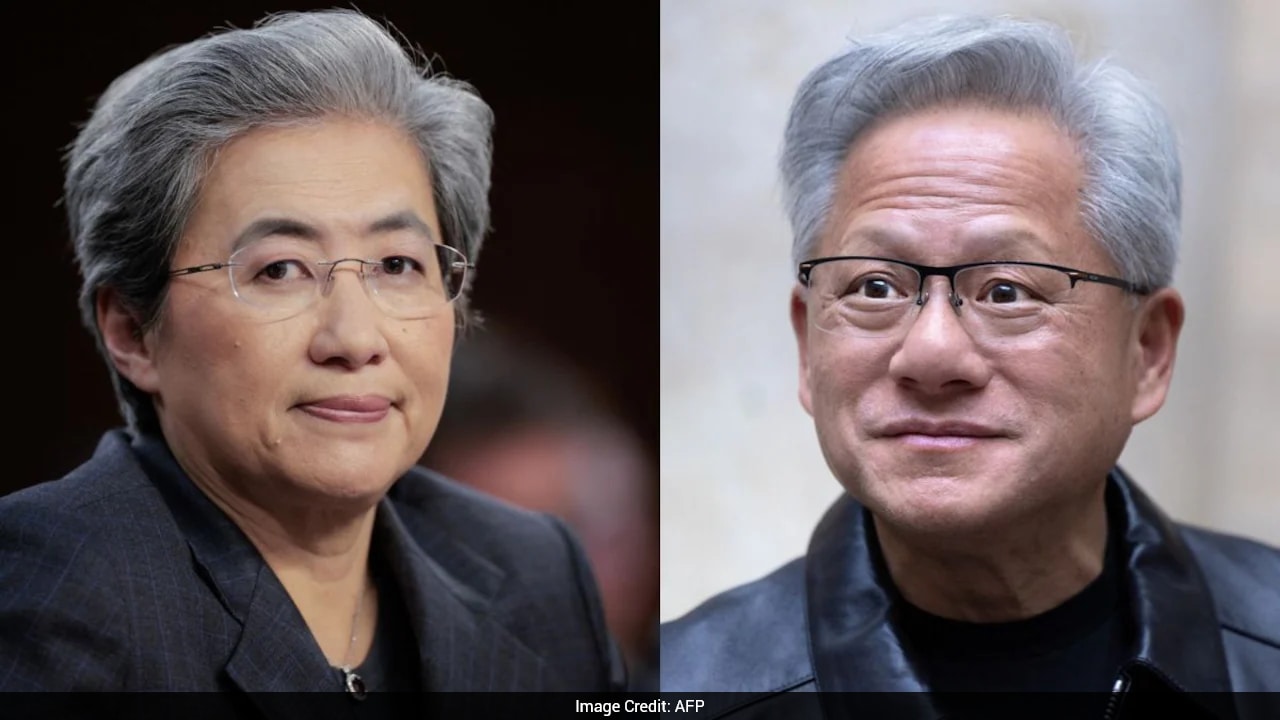
Two children sit at opposite ends of a crowded family banquet table in Tainan, Taiwan, decades ago, passing dishes of braised pork and bamboo shoots under the warm hum of ceiling fans. Neither of them knows that the air between them will one day carry the weight of a three-trillion-dollar industrial revolution.
One is a boy with restless eyes who will soon be shipped off to a boarding school in rural Kentucky, where he will scrub toilets and dodge switchblades before founding Nvidia. The other is a quiet, intensely focused girl who will move to Queens, New York, disassemble her brother's remote-controlled cars just to see how the gears mesh, and eventually rescue Advanced Micro Devices from the brink of bankruptcy.
Jensen Huang and Lisa Su are first cousins once removed. In the cold, fluorescent-lit server farms of northern Virginia and the boardrooms of Silicon Valley, their shared DNA is the ultimate tech industry trivia. Yet behind that genealogical quirk lies a ruthless, high-stakes struggle over who controls the foundational machinery of modern artificial intelligence. For years, Huang looked untouchable, wrapped in his signature black leather jacket while Nvidia captured upwards of eighty percent of the AI accelerator market. Every major tech giant, from Microsoft to Meta, lined up with blank checks, begging for allocations of Nvidia's Hopper and Blackwell chips.
Then gravity remembered where Silicon Valley lives.
Stumbles at the summit of the semiconductor industry rarely look like sudden explosions. They look like thermal throttling in a flagship server rack, a delayed shipment schedule whispered across supply chain channels, or a sudden realization among hyperscale buyers that paying a seventy-five percent gross margin to a single vendor is an existential vulnerability. When Nvidia hits friction—whether through engineering delays, regulatory scrutiny, or the sheer hubris of monopolistic pricing—the tremor does not stay contained in Santa Clara. It rolls straight down the road to Lisa Su's front door.
The Anatomy of a Single-Vendor Trap
To understand why a crack in Jensen Huang's armor sends shockwaves through the global economy, step inside a modern data center. Imagine a hypothetical infrastructure architect named Marcus, standing on a raised perforated floor in Ashburn, Virginia, wearing industrial ear protection against the deafening roar of liquid-cooling pumps. Marcus manages a cluster of forty thousand graphics processing units. Every single one of those chips was designed by Nvidia.
For three years, Marcus had no choice. Nvidia did not merely build fast silicon; Huang spent nearly twenty years constructing a walled garden called CUDA, the proprietary software layer that lets engineers talk to Nvidia hardware. Think of CUDA as the native language of modern machine learning. If an engineer writes an AI model, they write it in dialects optimized for CUDA. Switching to another chipmaker was like asking a lifelong concert pianist to suddenly perform on a keyboard where all the black and white keys had been rearranged.
Marcus loved the performance, right up until he saw the renewal invoice.
When a single company controls the hardware, the networking cables, and the software compiler, the buyer loses all pricing power. Marcus watched his capital expenditure budget balloon past ten billion dollars while lead times stretched past forty weeks. Worse still, when Nvidia's next-generation architectures encountered packaging bottlenecks at Taiwan Semiconductor Manufacturing Company or thermal dissipation headaches in densely packed liquid-cooled racks, Marcus had no fallback plan. His company's entire AI roadmap was held hostage by one cousin's supply chain.
This is the invisible vulnerability beneath the AI boom. Wall Street celebrates trillion-dollar market caps, yet the engineers actually wiring the clusters together feel a creeping dread. Monopolies breed fragility. When Nvidia falters—even slightly, even temporarily—chief technology officers across the Fortune 500 suddenly remember the cardinal rule of enterprise hardware: never allow a sole-source supplier to dictate your survival.
The Engineer Who Refused to Blink
While Huang played the charismatic visionary on stadium stages, Lisa Su operated with the methodical precision of a surgeon. When she took the helm of AMD in October 2014, the company was bleeding cash, drowning in debt, and trading under two dollars a share. Analysts openly speculated about liquidation. Su, who holds a doctorate in electrical engineering from MIT, did not hire a PR firm to spin a turnaround narrative. She locked herself in conference rooms with chip architects and made a brutal bet on modular design.
Instead of trying to build massive, monolithic slabs of silicon that were expensive to manufacture and prone to defects, Su pushed AMD toward chiplet architectures. As an analogy, imagine trying to bake a single wedding cake the size of a dining table in one giant pan; one burnt corner ruins the entire batch. Chiplets allow engineers to bake dozens of smaller, flawless cupcakes and assemble them together at high speed. That architectural discipline allowed AMD to eat Intel's lunch in the traditional server CPU market over the course of seven grueling years.
Now, Su is running the exact same playbook against her cousin.
Look closely at AMD's Instinct MI300X and its successors. Su understood she could not beat Nvidia by copying Nvidia's playbook line for line. Instead, she looked at where AI workloads were actually choking. Training massive frontier models grabs the headlines, yet the real day-to-day cost of AI lies in inference—the split-second calculation that happens every time you ask a chatbot a question or generate an image. Inference requires massive amounts of high-bandwidth memory sitting right next to the compute cores. Su packed the MI300X with 192 gigabytes of HBM3 memory, eclipsing Nvidia's flagship H100 at the time and allowing large models to fit onto fewer chips.
She did not stop at hardware. Knowing that CUDA was Huang's deepest moat, Su poured resources into ROCm, AMD's open-source software stack, while quietly forging alliances with PyTorch developers and cloud providers so engineers could run existing code on AMD silicon with minimal friction.
When Giants Slip on Their Own Ambition
No empire falls solely because a challenger works hard; the incumbent has to open the door.
In the semiconductor business, physics is an unforgiving landlord. As Nvidia pushed transistor densities and power consumption to the absolute edge of what modern packaging and data center grids can handle, the margin for error vanished. Pushing a single server rack past one hundred kilowatts of thermal output turns minor design imperfections into major deployment headaches. When rumors of design respins, substrate shortages, or interconnect glitches surface around Nvidia's bleeding-edge rollouts, the financial press treats them as temporary blips. Inside hyperscale procurement offices, however, those blips trigger emergency board meetings.
Consider what happens next when a cloud giant like Microsoft Azure, Meta, or Oracle faces a three-month delay on an Nvidia shipment. Every week a data center sits half-empty costs millions in lost cloud compute revenue and depreciated real estate. If Lisa Su's team walks into that room with verified silicon, transparent delivery schedules, and a willingness to co-engineer custom configurations without demanding dictatorial control over the networking stack, the door swings wide open.
It is easy to confuse Nvidia's stock price with invincibility, yet history is littered with hardware kings who mistook temporary dominance for permanent law. In the late nineties, Sun Microsystems owned the backbone of the early internet. In the two-thousands, Intel commanded nearly ninety-nine percent of the server market. Both companies fell victim to the same psychological trap: believing their software ecosystems and manufacturing leads made them immune to architectural disruption and customer resentment.
I remember watching veteran hardware engineers during the Intel stagnation of the late twenty-tens. For years, they complained quietly about stagnant core counts and rising prices, convinced they had no viable alternative for mission-critical workloads. The moment AMD proved its EPYC processors could match or beat Intel's performance per watt without the security vulnerabilities plaguing legacy architectures, the dam broke. Enterprise buyers did not switch out of charity; they switched out of relief.
The Quiet Rebellion in the Server Racks
Spend time talking to infrastructure leads today, and you hear that exact same tone of exhausted relief. Nobody wants to rip out every Nvidia GPU overnight—doing so would be operational suicide. What they want is leverage.
When Meta deployed massive clusters of AMD Instinct accelerators to power Llama inference, or when Microsoft integrated AMD silicon into Azure's core AI offerings, they were sending a calculated signal to Santa Clara. By validating AMD's hardware in production at scale, the tech giants proved that the CUDA moat is crossable. Once a software engineering team successfully ports an inference pipeline to ROCm, the psychological barrier evaporates. The second vendor stops being a risky experiment and becomes a permanent fixture of the budget.
This dynamic changes the math of the entire AI race. For AMD to win, Lisa Su does not need to dethrone Jensen Huang or capture eighty percent of the market. If Nvidia stumbles—whether through supply chain arrogance, engineering overreach, or regulatory antitrust pressure in Washington and Brussels—and AMD captures just twenty to twenty-five percent of a five-hundred-billion-dollar annual accelerator market, AMD's revenue transforms overnight.
There is an undeniable vulnerability in watching this unfold, because the stakes extend far beyond executive bragging rights or quarterly earnings beats. Every hospital using AI to scan mammograms, every grid operator balancing renewable energy loads, and every startup training protein-folding models pays the hidden tax of a single-vendor monopoly. High compute costs slow down scientific discovery. Hardware bottlenecks determine which researchers get access to clusters and which ideas die on a whiteboard. Competition is not an abstract economic virtue here; it is oxygen.
Two Jackets, One Bloodline
The media loves a tidy family feud, painting Huang and Su as estranged gladiators locked in a personal vendetta. The reality is far more nuanced and infinitely more fascinating. Both executives grew up shaped by the immigrant grit of Taiwanese engineering families, where excellence was expected and excuses were ignored. Huang famously wears his black leather jacket to project rock-star inevitability, turning semiconductor keynotes into cultural events. Su wears tailored blazers and speaks with the calm, unhurried cadence of a professor who has already checked the math three times before walking into the lecture hall.
Yet beneath the contrasting theatrics, both cousins are fighting the exact same war against the physical limits of silicon. Both know that Moore's Law—the decades-old cadence of doubling transistor density every two years—has fractured into an expensive, brutal slog of advanced packaging, optical interconnects, and extreme ultraviolet lithography.
The difference lies in posture. Nvidia is defending a kingdom built on proprietary lock-in and astronomical margins. AMD is leading an insurgency built on open standards, modular engineering, and aggressive pricing. When an empire grows too vast, its supply lines stretch thin, its bureaucracy slows down, and its customers begin quietly funding the rebels.
Back in Tainan, the family ties remain an unspoken footnote whenever the two cross paths at industry galas in Taipei or Silicon Valley. They nod, exchange brief pleasantries, and return to their respective corners of the arena. Outside, across thousands of miles of fiber-optic cable and rows of humming server blades, the real verdict is being written in megawatts and teraflops—one swapped accelerator card at a time.