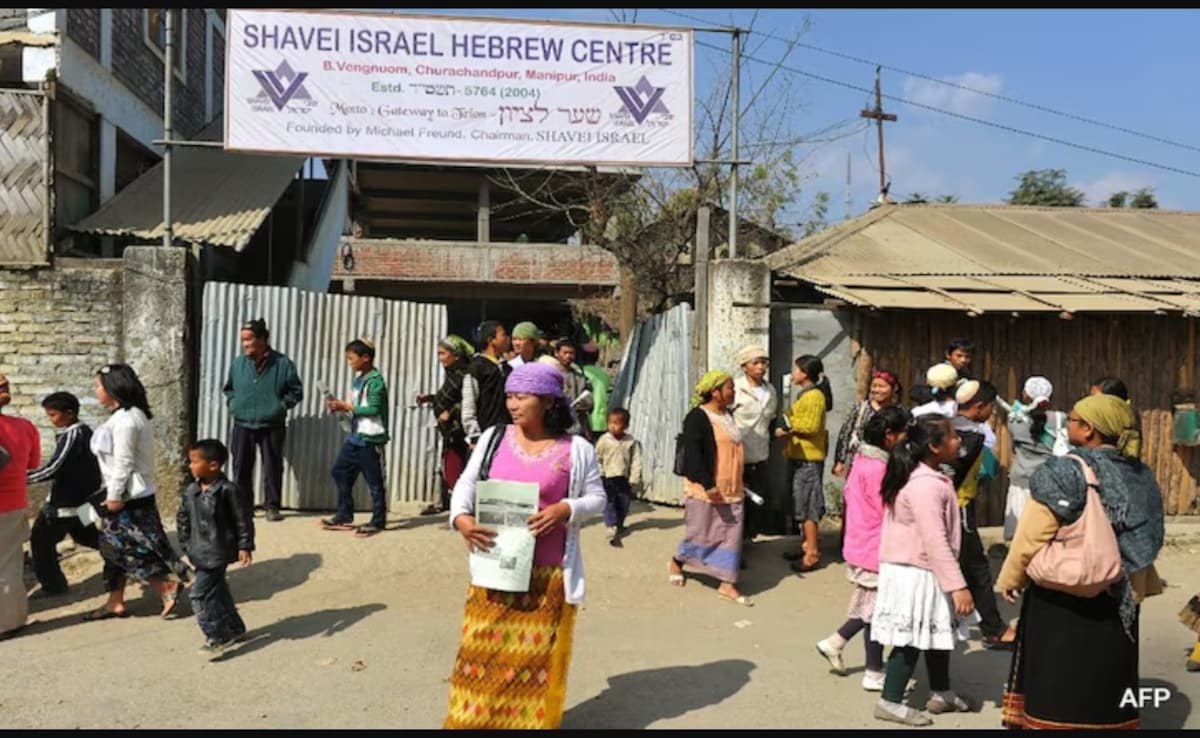
Deep in the hills of Northeast India, specifically in Manipur and Mizoram, thousands of people don’t see themselves as just another ethnic group in a diverse country. They call themselves the Bnei Menashe. They claim to be descendants of the Tribe of Manasseh, one of the ten lost tribes of Israel.
This isn't just some local legend or a passing cultural trend. It's a conviction that has driven thousands to leave their ancestral villages for a desert landscape thousands of miles away. You might think this sounds like a plot for a historical thriller, but for the Bnei Menashe, it's a matter of biological and spiritual survival.
They believe their ancestors were driven out of the Land of Israel by the Assyrian Empire around 722 BCE. From there, the story goes, they wandered through Central Asia and China before settling in the dense forests of the Indo-Myanmar border. While most of the world forgot about them, they kept small, distinct traditions that didn’t fit the surrounding Hindu, Buddhist, or local animist cultures.
Why the Lost Tribe Story is More Than a Myth
For centuries, the Kuki-Chin-Mizo people lived in the hills, practicing their own customs. But in the 1950s, a village leader named Pu Chala had a vision. He claimed that God told him his people were actually Israelites and should return to their homeland.
Critics often dismiss this as a byproduct of 19th-century British missionary work. They argue that when the locals were converted to Christianity, they simply identified too strongly with the Old Testament stories. But the Bnei Menashe don't buy that. They point to ancient songs like the "Chant of the Red Sea" and sacrificial rituals that look suspiciously like ancient Hebrew laws.
One of the most striking pieces of evidence they cite is the "Manmasi" or "Menashe" name itself. They’ve long invoked this name in prayers for the sick and in funeral rites. It’s hard to explain away why a group in a remote corner of India would keep a name that phonetically matches a biblical patriarch unless there was some thread of continuity.
The Long Road to Official Recognition
Israel didn't just open its arms immediately. Far from it. The Israeli government and the Chief Rabbinate are historically cautious about "lost tribe" claims. They have to be. Opening the gates to every group claiming ancient lineage would be a logistical and political nightmare.
The turning point came in 2005. Shlomo Amar, who was the Sephardic Chief Rabbi of Israel at the time, officially recognized the Bnei Menashe as "descendants of Israel." This was a massive win for the community, but it came with a catch. Because they had been separated from the Jewish mainstream for over 2,000 years, the Rabbinate required them to undergo formal conversion to Judaism to ensure their status was legally bulletproof under the Law of Return.
Since then, the Shavei Israel organization, led by Michael Freund, has been the primary engine behind their Aliyah—the Hebrew term for immigrating to Israel. Freund has been a tireless advocate, navigating the bureaucratic minefield of the Israeli Interior Ministry. To date, roughly 5,000 Bnei Menashe have made the move. Another 5,000 are still in India, waiting for their chance.
Life in the Middle of a Conflict Zone
When Bnei Menashe families land at Ben Gurion Airport, the honeymoon phase ends quickly. They don't move into luxury apartments in Tel Aviv. Most are settled in the Galilee or in Judea and Samaria. They often find themselves on the front lines of Israel's geopolitical tensions.
Then there’s the reality of the ethnic conflict back home in Manipur. In 2023 and 2024, the region exploded in violence between the Meitei and Kuki communities. The Bnei Menashe, being part of the Kuki-Zomi ethnic umbrella, were caught in the crossfire. Synagogues were burned. Families were displaced. This violence turned the desire to move to Israel from a spiritual goal into an urgent rescue mission.
Economic integration is another hurdle. Going from a subsistence farming background in rural India to a high-tech, high-cost society like Israel is a massive shock. You see the younger generation adapting fast—learning Hebrew, serving in the IDF with distinction, and hitting the books. But for the elders, the transition is brutal. They lose their status as community pillars and often struggle with the language barrier.
The DNA Debate and the Identity Politics
Is there biological proof? That’s where things get messy. Some genetic studies have shown no clear Middle Eastern markers in the Bnei Menashe, while others have suggested a "Maternal DNA" link that might point to a Middle Eastern origin long ago.
But focus on DNA misses the point. Identity isn't just about double helixes. It's about collective memory. If a group has spent generations singing about a lost home and practicing "Sabbath-like" rest days while surrounded by cultures that do neither, that matters. In the eyes of the Israeli state, the 2005 Rabbinical ruling carries more weight than a cheek swab anyway.
Some activists argue that the Bnei Menashe are being used as political pawns to bolster the population in disputed territories. It’s a cynical view, but it’s one that’s frequently debated in Israeli media. Regardless of the politics, the Bnei Menashe themselves seem remarkably consistent. They want to be in Israel because they believe that’s where they belong. Period.
What This Means for the Future of Global Jewry
The Bnei Menashe story isn't just a curiosity. It’s a challenge to how we define "Jewishness" in a globalized world. It forces us to ask if being Jewish is a matter of race, religion, or a shared historical trauma.
For the families still in Manipur, the situation is dire. They are living in relief camps, their homes destroyed, watching the news from Israel while rockets fly there too. It's a choice between two different kinds of danger. Most of them still choose the Israeli side.
If you want to understand the Bnei Menashe, stop looking at them as a sociological experiment. Look at them as people who have held onto a single idea for two millennia. That kind of stubbornness is exactly what has kept the Jewish people alive throughout history.
If you’re following this story, keep an eye on the Shavei Israel updates and the Israeli government's quotas for Aliyah. The next few years will decide if the remaining 5,000 people make it out of the Manipur conflict or if the window closes for good. You can support organizations on the ground that provide humanitarian aid to the displaced Bnei Menashe in India, as their local infrastructure is currently non-existent. Stay informed on the policy shifts in the Israeli Knesset, as that's where the real power to bring them home lies.