The air in the borderlands always tastes of dust and expectation.
You stand there, watching the red dirt road shimmer under a relentless equatorial sun, and you listen. On one side of an invisible line drawn on a map, a quiet exhale echoes. Uganda has crossed the finish line of an exhausting marathon. Ministry officials step away from microphones, wiping sweat and relief from their brows, officially declaring their territory free of the virus that haunts nightmares. The gates are open. The countdown clocks have hit zero.
Then you turn your head.
Just across that same invisible line, past the river and the dense green canopy of the Democratic Republic of Congo, the numbers tell a brutally different story. Death tolls climb past fourteen hundred.
[Image of an Ebola virus structural diagram]
To understand what that means, you have to strip away the sterile detachment of a spreadsheet. Fourteen hundred isn't a statistic. It is fourteen hundred empty chairs at dinner tables. It is the sudden, terrifying silence in homes where laughter used to live.
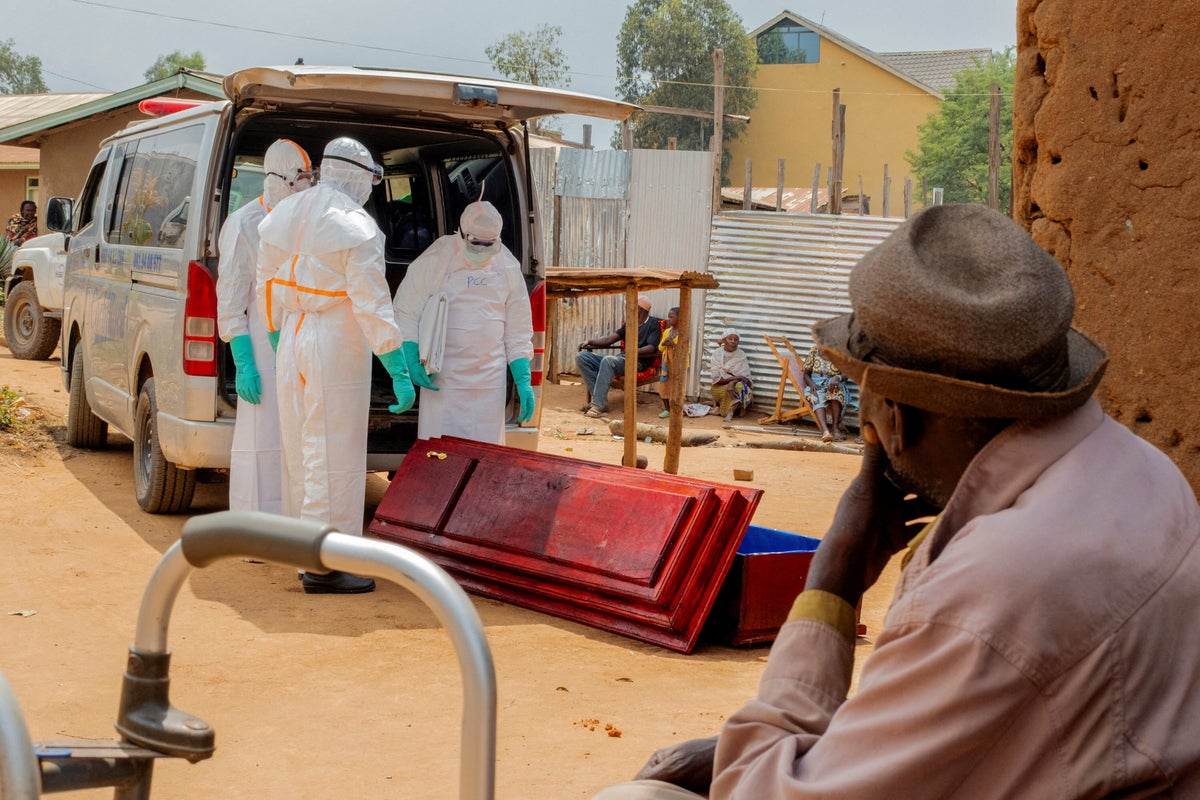
Epidemiology is a cold science on paper, but on the ground, it is deeply, achingly human. Imagine a nurse named Grace. She wears three pairs of gloves, a heavy yellow plastic gown that traps her sweat like a sauna, and a face shield that fogs up every time she breathes. Grace does not think about R-naught values or viral shedding kinetics when she steps into an isolation ward. She thinks about the child in bed four. The child is shivering, burning up with a fever that turns the body inside out, crying for a mother who is already gone.
Grace reaches out a gloved hand. She knows the risk. Every health worker in North Kivu and Ituri knows the risk. Yet, they step into the breach anyway, fueled by an impossible mix of professional duty and stubborn hope.
Why does one country pull back from the precipice while its neighbor slips deeper into the abyss?
The answer is rarely just medicine. Medicine is the easy part. You isolate the sick, you trace the contacts, you vaccinate the vulnerable. The hard part is trust.
Trust is fragile. It shatters the moment a community sees strangers in biohazard suits arrive with heavy trucks and stern commands, speaking a language of fear. Decades of institutional neglect, political instability, and whispered rumors create fertile ground for suspicion. When people believe the treatment center is a place you only enter to die, they hide their sick relatives under beds. They wash bodies according to ancient, sacred burial traditions, unknowingly inviting the virus back into their homes through the very act of love and grief.
Uganda learned this the hard way during past outbreaks. They built community-led response networks. They sat down with village elders, listened to grievances, and adapted. They made sure that survival stories were told loudly in local markets, proving that the isolation ward could be a place of healing, not just a final stop.
Across the border in DR Congo, the barriers multiply. Conflict tears through the landscape, displacing families into crowded camps where clean water is a luxury and social distancing is a cruel joke. Armed groups control territory, blocking medical teams from reaching remote villages until it is too late. The virus rides on the back of displacement, whispering through the shadows of a war zone.
Consider what happens next when a border is declared safe.
Celebration. Relief. But complacency is a luxury no one can afford. Viruses do not respect immigration checkpoints. They do not care about bureaucratic designations. A traveler crosses a footbridge over a swollen stream, carrying an incubation period in their bloodstream, and suddenly the finish line moves again.
This is the invisible stake of global health security. We are all living on the same interconnected web. When a community in Central Africa suffers, the tremors are felt everywhere.
We must talk about the emotional weight carried by the survivors. Surviving the pathogen is only the first battle. The survivors often return home to find their belongings burned to prevent contamination. They face stigma from neighbors who whisper behind closed doors, terrified that the ghost of the illness still clings to their clothes. Joint pain, vision problems, and crushing fatigue—often called post-Ebola syndrome—linger like uninvited guests long after the virus clears the bloodstream.
Healing requires more than a negative test result. It requires an entire ecosystem of empathy.
Look at the maps flashing on evening news screens. Watch the jubilation in Kampala, then look at the smoke rising in the distance across the Congolese frontier. Do not look away because the contrast is uncomfortable.
The distance between safety and catastrophe is measured in miles, but the bridge between them is built entirely of human connection. Until every village, every clinic, and every family has the tools, the trust, and the peace to fight back, none of us are truly standing on the other side.
The silence at the border holds its breath, waiting for the rest of the world to remember that we share the same skin, the same vulnerability, and the same desperate hope for tomorrow.