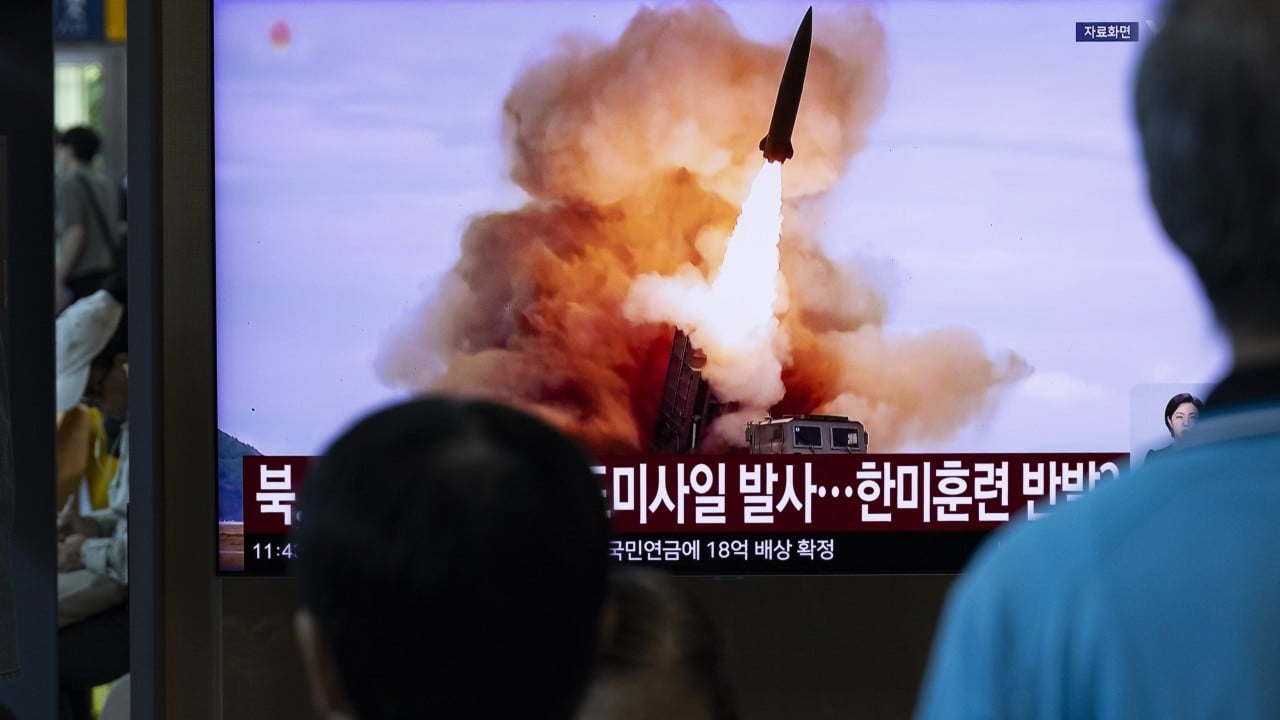
The morning air in Seoul tastes of dust and old coffee. Across the border, just thirty miles north, a different kind of morning unfolds under a heavy gray sky. Silence hangs thick over the Demilitarized Zone, that jagged scar of barbed wire and concrete cutting across the Korean Peninsula. It is a quiet that nobody trusts.
For months, diplomats in tailored suits spoke of olive branches. They used words like engagement, confidence-building, and diplomatic channels. They drafted statements in air-conditioned rooms in Washington and Geneva, hoping that words alone could soften a decades-long standoff.
Then came the fire.
High above the Sea of Japan, a missile sliced through the stratosphere. It was not a weapon meant for target practice. It was a message written in smoke and kinetic energy, delivered with brutal clarity. North Korea answered every diplomatic overture with an iron-clad rebuttal, proving once again that the language of weapons speaks louder than the language of peace.
The Weight of an Open Hand
Consider what happens when an olive branch is extended into a vacuum.
To understand the frustration of foreign policy strategists, you have to look past the cable news graphics and examine the human cost of perpetual threat. Imagine a young diplomat stationed in Seoul, someone who spent sleepless nights drafting proposals for humanitarian aid and reduced sanctions, only to watch a ballistic test vaporize months of painstaking work. (To be clear, this character is a composite sketch designed to illustrate the human toll of diplomatic failure, not a specific named individual.)
Peace requires vulnerability. When the United States offers talks, it opens its hand. But in Pyongyang, vulnerability is interpreted as a fatal flaw. The ruling regime operates under a stark survival logic. For decades, the narrative inside North Korea has been absolute: the outside world is an existential predator waiting to devour the state.
Therefore, every friendly gesture is viewed through a lens of extreme paranoia. An olive branch is not a gift. It is a trap.
And so, the missile flies. It is a predictable choreography of defiance. Whenever diplomatic pressure mounts or economic strangulation tightens, the launch pads activate. The strategy is ancient: manufacture a crisis, escalate the rhetoric, force the world to the negotiating table from a position of perceived strength.
The Anatomy of a Launch
Look closely at the mechanics of the escalation.
When a missile leaves a North Korean launch facility, it triggers a chain reaction across three continents. In Tokyo, emergency alert systems ping on millions of mobile phones, sending citizens scrambling for subway stations. In Washington, the Situation Room lights up before dawn, advisers waking the commander-in-chief with encrypted briefs. In Beijing, calculations shift as regional stability hangs by a thread.
We have seen this cycle repeat for generations. The names of the leaders change, but the rhythm remains identical.
- The diplomatic outreach begins with cautious optimism.
- The regime demands concessions before talks even start.
- Negotiations stall over verification protocols.
- A test fire shatters the fragile standstill.
- Condemnation follows, accompanied by tighter sanctions.
Why does it never change? Because the regime’s legitimacy is bound entirely to its nuclear arsenal. The bomb is the regime's insurance policy. It guarantees that foreign intervention will carry a catastrophic price tag. Without the missile program, the state loses its primary bargaining chip on the global stage.
The tragic irony is that every missile launch achieves the exact opposite of what the regime desires. It hardens hearts in Washington. It binds South Korea and Japan closer to American security umbrellas. It cements North Korea's status as a pariah state, locked in economic stagnation while its people starve in the dark.
Shadows on the Border
Walk down to the Joint Security Area in Panmunjom. Stand inside the blue conference huts where the armistice was signed in 1953. Right down the middle of the room runs a low concrete curb, no taller than your ankle.
That curb is a border. On one side, you can step into freedom, capitalism, and a hyper-connected digital world. On the other side, you step into a preserved epoch of strict ideology, surveillance, and isolation.
The distance between those two realities is measured in feet, yet it spans centuries.
When a missile arcs into the eastern waters, the vibration is felt right here in the floorboards of Panmunjom. It reminds the guards standing face-to-face across the table that the war never truly ended. It was merely paused, suspended by a precarious ceasefire that grows more fragile with every passing year.
The United States faces an impossible dilemma. Ignore the provocations, and watch the nuclear threshold erode until deterrence fails entirely. Respond with overwhelming force, and risk igniting a conflict that could engulf millions of civilians in Seoul and Tokyo within the opening hours.
There are no easy answers. There are only lesser catastrophes.
The olive branch was not a mistake, but it was profoundly misunderstood. Peace cannot be wished into existence by statesmen who speak different political languages. It requires a shared reality, and right now, Washington and Pyongyang inhabit entirely different universes.
The smoke from the latest launch has long since dissipated over the cold waters of the Pacific. The headlines have shifted to newer crises, washing over the public consciousness like waves on a shore.
Yet, in the hills just north of the parallel, the gantries are already being reset. The technicians are tightening bolts. The fuel lines are being checked. And somewhere in the dark, a silent countdown begins again, waiting for the next moment to remind the world that the gun is always cocked.


