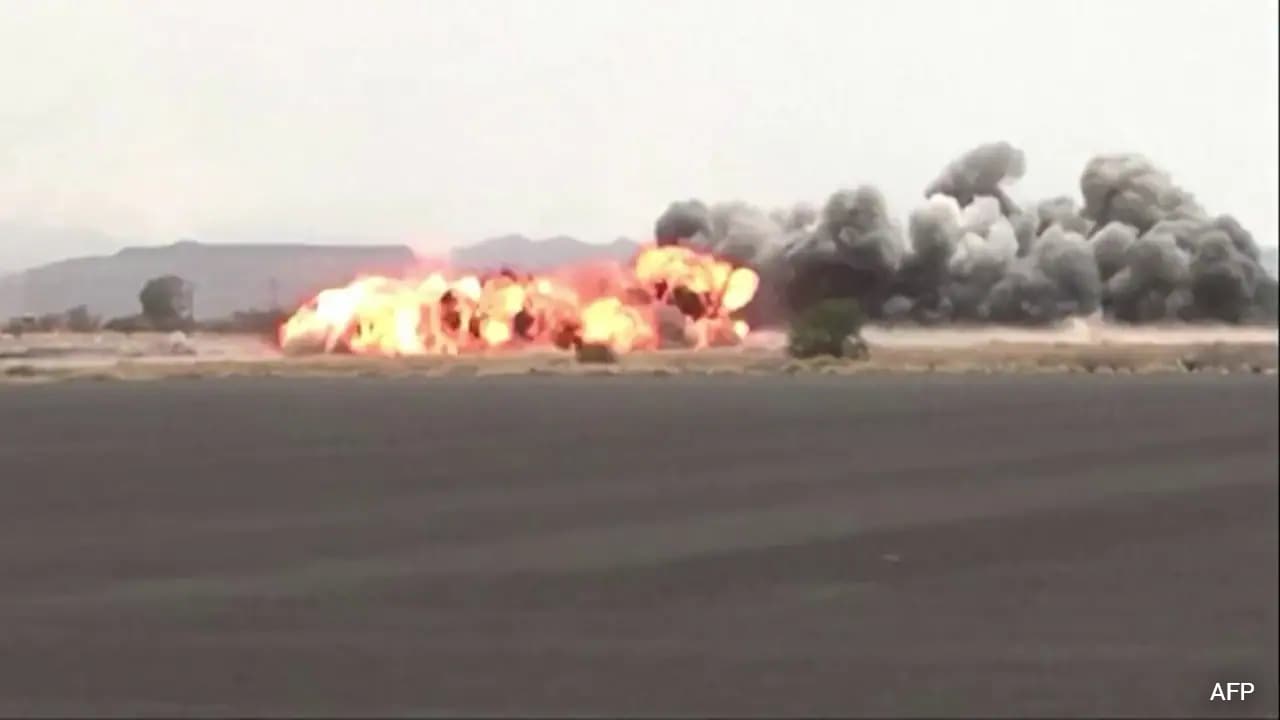
The fragile calm that kept the Arabian Peninsula from sliding into a regional conflagration for over four years has evaporated. On July 13, 2026, air strikes tore through the runway of the Houthi-controlled Sanaa International Airport in Yemen. Hours later, ballistic missiles screamed across the border into Saudi Arabia, targeted directly at Abha International Airport in the kingdom’s southern mountains. The Saudi-led military coalition confirmed its air defense systems engaged and intercepted the threats.
This is not a minor border skirmish or routine posturing. This is the official collapse of the de-escalation phase that held the region together since March 2022. While early wire reports framed the incident as a sudden, inexplicable flare-up, the reality points to a calculated geopolitical gamble over a secret air bridge between Tehran and Sanaa. Also making waves in this space: The Price of a Broken Promise on the Dark Water.
The internationally recognized government of Yemen, operating with heavy backing from Riyadh, took responsibility for the initial bombardment of the Sanaa runway. The objective was specific. They needed to stop an Iranian Mahan Air commercial flight from completing a direct transit from Tehran. The plane carried a high-level Houthi delegation returning from the funeral of Iran’s late Supreme Leader, Ayatollah Ali Khamenei. By attempting to force open an unregulated, direct air route into the heart of Yemen, the Houthi movement crossed a red line that Saudi Arabia and its allies could no longer ignore.
The Battle for Sovereign Airspace
The mechanics of this escalation reveal a profound struggle over the legal and physical control of Yemen's borders. For years, the blockaded Sanaa airport operated under strict regulatory oversight. Flights required pre-clearance, primarily connecting to neutral hubs like Amman for humanitarian or diplomatic transfers. Further information regarding the matter are covered by Al Jazeera.
That framework cracked when the Houthis authorized a direct flight from Tehran to Sanaa earlier this month. It marked the first unvetted, direct aerial connection between Iran and Houthi-controlled territory since the conflict intensified more than a decade ago. To the intelligence community in Riyadh and Aden, this was never about diplomatic transport or bringing home funeral attendees. It was the validation of an unmonitored logistical pipeline.
The Yemeni Ministry of Defense, via General Taher al-Aqili, stated that diplomatic avenues had been completely exhausted before the kinetic strike. The government attempted to negotiate with the Houthi delegation while they were still in Iran, offering to transport them back via a standard, pre-approved Yemenia flight. The Houthis refused. They insisted on utilizing the Iranian aircraft, directly challenging the sovereign aviation frameworks of the recognized government.
When the Mahan Air flight entered Yemeni airspace without authorization, the response was swift and destructive. Bombs shattered the tarmac at Sanaa, physically preventing the aircraft from touchdown. Forced to divert, the Iranian plane eventually found safe harbor at the Red Sea port of Hodeidah, an area also under Houthi administration but lacking the heavy anti-air architecture and institutional stature of the capital's main airport.
In the immediate aftermath of the runway strike, the situation inside Sanaa grew more complicated. Moammar al-Eryani, the Information Minister for the recognized government, accused Houthi forces of detaining an International Committee of the Red Cross aircraft on the tarmac, effectively holding its flight crew hostage as human shields or bargaining chips.
The Illusion of the Four Year Peace
To understand why this moment matters, one must dissect the false sense of security that governed the Gulf over the last few years. The April 2022 truce did not solve the structural drivers of the Yemeni civil war. It merely paused the cross-border drone and missile campaigns that targeted Saudi oil facilities, such as the devastating hits on Aramco infrastructure in previous years.
During this interlude, Saudi Arabia attempted to pivot toward domestic transformation. Crown Prince Mohammed bin Salman focused his energies on multi-billion-dollar development projects and economic diversification, which required a stable security environment. Riyadh was willing to tolerate significant Houthi provocations along the border if it kept the kingdom’s interior safe from explosive drones.
The Houthis used this period of relative immunity to build up their strength. They successfully disrupted global shipping lines throughout the Red Sea, demonstrating an ability to project power far beyond their immediate geographic boundaries. They launched sporadic long-range strikes toward Israel, proving their integration into the broader regional coalition led by Tehran. Throughout all of this, Saudi Arabia maintained a policy of extreme restraint, eager to prevent a domestic relapse into active warfare.
That restraint created a dangerous miscalculation in Sanaa. The Houthi command structure began to view Saudi patience as a permanent condition of weakness. By establishing a direct flight path to Tehran, the Houthis sought to break what they termed the siege of Sanaa, effectively legalizing the unvetted transport of personnel and cargo from their primary state sponsor.
Weapons Smuggling and the Air Bridge Reality
The primary threat of a permanent air bridge between Iran and northern Yemen is not the movement of politicians. It is the rapid transit of sophisticated technical components.
Historically, Iranian military assistance reached the Houthis through complex maritime smuggling networks. Dhows and cargo ships would carry missile guidance systems, drone engines, and fuel components through the Arabian Sea, attempting to slip past international naval patrols before offloading along the expansive Yemeni coastline. While effective, this process was slow, vulnerable to interdiction, and subject to maritime intelligence monitoring.
An open air route cuts delivery times from weeks to hours. Precision-guided munitions components, telemetry equipment, and advanced military technicians can sit on a commercial cargo deck in Tehran and arrive in Sanaa before regional radar operators can verify the manifest. This changes the balance of power on the ground. It allows the Houthis to rapidly iterate their weapons technology, adapting to Western and Gulf countermeasures in real time.
The strike on the Sanaa runway was a preemptive denial of this operational capability. Riyadh realized that allowing even a single unvetted Iranian flight to establish a precedent would mean ceding control over the skies of the southern peninsula permanently.
The Abha Counterstrike and the Erosion of Deterrence
The Houthi response was immediate and structural. Yahya Saree, the military spokesperson for the group, announced that the de-escalation phase was completely finished. The movement then launched ballistic missiles into southern Saudi Arabia, aiming directly at Abha’s international civil aviation infrastructure.
                ┌──────────────────────────────────────┐
                │ Iranian Mahan Air Flight Attempts    │
                │ Direct, Unvetted Landing in Sanaa    │
                └──────────────────┬───────────────────┘
                                   │
                                   ▼
                ┌──────────────────────────────────────┐
                │ Saudi-Backed Forces Bomb Runway      │
                │ to Prevent Air Bridge Establishment  │
                └──────────────────┬───────────────────┘
                                   │
                                   ▼
                ┌──────────────────────────────────────┐
                │ Houthis Declare End of 2022 Truce;   │
                │ Fire Ballistic Missiles at Abha      │
                └──────────────────────────────────────┘
The selection of Abha as a target carries immense symbolic weight. Abha is the capital of Saudi Arabia's southwestern Asir province, a mountainous region heavily frequented by domestic tourists looking to escape the blistering summer heat of the lowlands. Targeting its airport is a direct threat to the daily security of ordinary Saudi citizens and a warning to the royal family that the cost of interfering with Houthi-Iranian aviation lines will be paid in regional instability.
While Saudi Patriot missile batteries successfully neutralized the incoming targets, the political damage was done. The deterrence model that governed the Gulf since 2022 has cracked open. The Houthis have shown they will not hesitate to strike deep within the kingdom if their core strategic expansion is halted.
Fractured Coalitions and Hidden Vulnerabilities
The timing of this outbreak exposes deep vulnerabilities across the region. Internally, the anti-Houthi coalition inside Yemen is profoundly fractured. For months, tensions have simmered between Saudi Arabia and the United Arab Emirates regarding the long-term political architecture of southern Yemen. The UAE has heavily backed the Southern Transitional Council in Aden, which pursues an independent agenda often at odds with the Saudi-supported central government.
This divergence of interests extends beyond Yemen into the broader geography of East Africa and the Horn, leaving the anti-Houthi front disorganized and intellectually divided. The Houthis monitored these political fractures and calculated that their opponents were too divided to mount a coordinated response to the Tehran air bridge.
Furthermore, the regional backdrop is highly volatile. Iran’s broader alliance system has faced immense pressure over the past year, prompting its various proxy groups to seek new avenues of leverage. With other elements of the alliance structure tied down or degraded by conflict, the Houthis have emerged as one of Tehran’s most resilient and aggressively positioned partners. They are not an isolated domestic rebel group; they are an autonomous regional actor capable of dictating the security architecture of the world's most critical energy corridors.
The Flight Safety Crisis
The immediate consequence for global transport is severe. Following the missile fire toward Abha, Houthi command issued explicit warnings to all commercial airlines, advising them against utilizing Saudi Arabian airspace. In parallel, the Civil Aviation and Meteorology Authority under the recognized Yemeni government in Aden ordered the complete closure of all Yemeni airports to civil traffic until further notice.
This introduces immediate chaos into commercial flight routing. International carriers operating flights between Europe, East Africa, and Asia must now recalculate their paths to avoid the escalating missile risk over the southern half of the Arabian Peninsula. The airspace closures compress commercial traffic into narrow corridors over the Persian Gulf and central Saudi Arabia, driving up insurance premiums and operational costs for an industry already weary of geopolitical disruption.
The Illusion of Containment
The international community has spent years treating the Yemen conflict as a localized humanitarian tragedy that could be safely contained behind regional borders. The events of July 13 prove that containment is an illusion.
The structural flaws of the 2022 truce are now fully exposed. By failing to address the fundamental issue of Houthi cross-border logistics and their military integration with Iran, international observers allowed a temporary ceasefire to serve as a shield for long-term military buildup. The attempt to create an unvetted air bridge was the logical conclusion of that buildup.
Saudi Arabia now faces a critical strategic choice. The kingdom can attempt to patch together another informal ceasefire, offering economic concessions to the Houthis in exchange for a cessation of missile attacks on civil airports. Alternatively, Riyadh can accept that the truce is dead and commit to a renewed, high-intensity military campaign alongside its Yemeni allies to permanently degrade Houthi launch capabilities.
The first path offers a temporary reprieve but ensures that an unmonitored military pipeline to Tehran will eventually become operational. The second path means a return to full-scale war, putting Saudi Arabia's domestic economic ambitions directly in the line of fire. The bombs dropped on the Sanaa runway did more than shatter concrete; they destroyed the political fiction that peace can be maintained by ignoring the supply lines of your enemy.